Nurtured Parenting

What the Dominant Narrative Misses

What do disability, body literacy, fertility awareness, pregnancy, parenting, attachment, public health, and caregiving have in common?

I’ve been trying to articulate the answer to this question for myself for a while now. These fields can seem completely unrelated on the surface, and they’re made harder to see clearly by the layers of loud political ideology that get wrapped around each of them. I worry sometimes that people encounter my work in fertility awareness or responsive caregiving and think, “that’s some tradwife content I am not interested in.” I get it! These bodies of knowledge have often been co-opted, re-packaged, and handed back to us inside a political story that a lot of us don’t agree with and don’t recognize ourselves in. This often prevents people from accessing or practicing what could be providing a real benefit to them, or prevents them from seeing the thread underneath all of these that I think ties them together: care and interdependence.

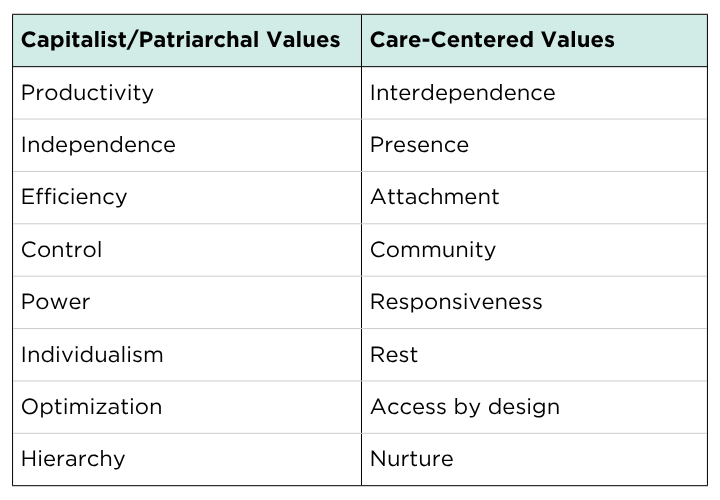
Disability justice centers care and interdependence. Attachment science centers care and interdependence. When you strip away the dogmatic ideological packaging from body literacy, parenthood, responsive caregiving, and public health, each of these takes human needs seriously and begins with the reality of human bodies and relationships rather than what productivity and capitalism demand.

Not one of us came into this world without needing care. It’s literally how our species has evolved to survive and thrive and that need doesn’t disappear. We all begin as beings who rely completely on others for survival, and most of us will arrive back there at one or more points in our lives. At illness, disability, chronic illness, childhood, elderhood, grief, postpartum, parenthood, crisis, mental illness: all of these require care and interdependence.

Public health makes this explicit in a way the other fields sometimes leave implicit: our actions affect each other. A mask, a vaccine, staying home when you’re sick aren’t just individual choices. They exist inside a web of relationships. The people who have made this most visible are disabled people and immunocompromised people. We’ve had to articulate, loudly and repeatedly, that our safety depends on the choices of people who are not us.

Disability communities often reach a point, especially for people who become disabled after living as nondisabled, where they realize that worth does not equal productivity. You are worthy as you are. Rest is not something you earn. It’s a biological need (we are not machines!). In fact, disability justice calls out these exact principles: interdependence, recognizing the wholeness of each person, and anticapitalist politics.

Parental brain science shows that becoming a parent literally changes the brain. It’s pruned and reorganized in ways that increase attention to relationships, caregiving, emotional attunement, and social connection. The parental brain is optimized for caregiving, not maximum output. (Oh hello! Now it makes complete sense why my brain felt so completely different when I came back to work from parental leave.) Meanwhile, the culture around new parents says: bounce back. Get the baby sleeping independently. Get back to work. Get productive again. The parental brain is in some ways a biological rebellion against those capitalist demands.

Attachment science tells us that a securely attached child doesn’t develop through being efficiently managed. Secure attachment is built through thousands of moments of connection, co-regulation, responsiveness, repair, and presence. None of those are easily measured nor show up in any productivity metrics. And yet they’re among the most important things we as human beings can do or receive. Holding a crying baby, sitting with a dying elder, listening to a friend, recovering from or living with illness, resting, building trust, co-regulating are, by and large, in capitalist culture, treated as interruptions to life rather than as life itself.

None of us are units of productivity. Not babies, not children, not disabled people, not elders. Heck, not even nondisabled adults, no matter how hard everyone pretends otherwise! Everyone thinks they’re invincible until they’re not.

The fertility awareness method (FAM) gives people accurate self-knowledge to make decisions about their reproductive lives, including the decision to end a pregnancy. Knowing your body well enough to detect a pregnancy at five weeks, before a six-week abortion ban kicks in, can be life-saving knowledge. FAM connects directly to three of the four tenets of reproductive justice: the right to have children, the right not to have children, and the right to bodily autonomy and sexual freedom.

FAM also shows us that our bodies respond visibly to how we’re living. Whether we’re sleeping, eating, under stress, being nurtured or ground down by hustle culture, it all shows up in our cycles. FAM is a monthly report card on our own wellbeing. Using FAM we can learn to read what our cycles have to show us about our own well-being and see in real-time how living in a care-centered culture (where we are nourished, rested, connected, etc) vs a productivity-centered culture (where we are burnt out, etc) affect our reproductive health.

Disability and parenthood are both often viewed through a deficit lens: how will you manage, how will you keep up, how will you stay productive enough? (Fuck that.) What I think disability and parenthood reveal is that as human beings we are relational, that we move through seasons, that capacity fluctuates, that care is non-negotiable, that there is wisdom in slowing down.

When I sit with care-centered values it’s obvious to me that disability justice, parental brain science, responsive caregiving, reproductive justice, public health, and body literacy all draw from the same well. No wonder they seem connected to me! They arrive at similar conclusions centering care and interdependence from different starting points. These fields of study are not some tradwife bullshit (though aspects of these fields get co-opted and distorted with dogma from the right regularly). They’re all asking a version of the same question:

“What if we organized our lives around what human beings need, rather than around what makes human beings most productive?”

The fourth tenet of reproductive justice, “Safe and supportive environments for families,” is one part of the answer. A girl can dream.

The Big Blank

When we started seriously thinking about trying to conceive, I couldn’t picture it.

Logically, it made no sense to me. I had carefully and very deliberately built a life around my capacity and needs as a disabled, chronically ill, neurodivergent person. And having a baby meant blowing that all up in the most unpredictable way possible. Every time I tried to think it through, I kept arriving at the same conclusion: “lol, why?”

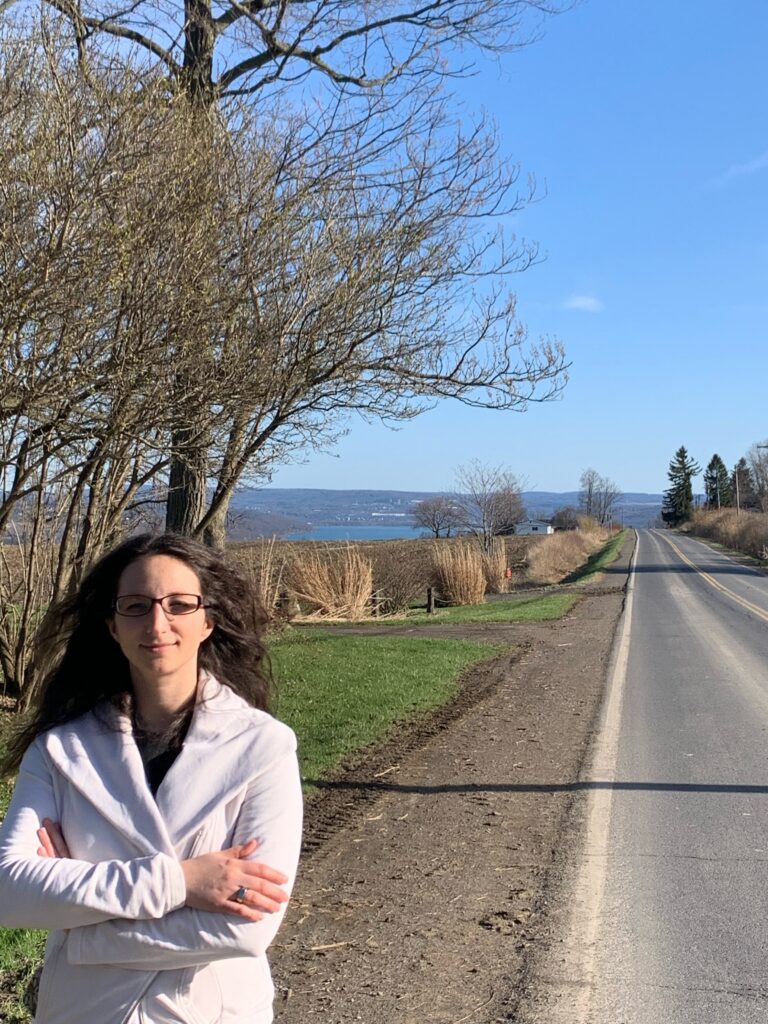
Erica with long brown hair stands at the edge of a rural road, arms crossed, looking toward the camera. A bare-branched tree is behind her and a lake view stretches in the distance. Early spring.
Photo from 2022 on a walk near where we were living after a particularly bad day, earlier in the year before we started trying to conceive.

The wanting wasn’t something I could access easily or directly because the immediate changes to my life seemed to contradict what I had up to that point learned I needed to take care of my body. What finally helped was thinking way ahead into the future and I asked myself, “At 70, would I regret not doing this?” And the answer was a clear yes.

People told me it was worth it. That they couldn’t explain it but it was true. My brain wanted to understand that for myself, wanted to try the identity on, take it for a spin, see how it felt, but it just couldn’t. My brain hadn’t been changed by parenthood yet the way theirs had. I couldn’t make the decision from inside of the experience. I had to trust that they were right, and look far enough ahead into the future to find out what I actually wanted.

What I also couldn’t picture was what parenting would look like in my actual body. Like on a high pain day, when my SI joints make walking impossible, when my capacity is already stretched before the baby has even arrived. Every image I had of pregnancy and parenthood was for someone else’s life—someone without hEDS, without MCAS, POTS, PMDD, without all of it.

I kept coming back to the same big blank.

I’ve been thinking about that big blank a lot lately, and about the fear underneath it. Not just the surface fears (the sleep deprivation, the logistics, the medical system), but the one that lives underneath all of them:

“What if becoming a parent requires me to become someone my body can’t sustain? What if the life I’ve so carefully built around my capacity, the routines, the pacing, the hard-won balance, just doesn’t have room for a baby?”

That fear makes complete sense, because something DOES change. The expectation that everything stays the same when you become a parent is a falsehood, for everyone, disabled or not. Before we started trying to conceive, James and I did a parenting visioning and values exercise together (because we like to nerd out like that) and landed on something we could return to and connect to. A north star.

We are choosing to change, and remain open to the unfolding of the unknown.

We knew we couldn’t possibly know everything. We knew we were walking through a portal from which there would be no return, and we didn’t want resentment to show up later. We wanted a reminder that we chose this, knowingly, even when it’s hard. A reminder of our values for change, adaptability, curiosity, and openness.

Our little north star/mantra/whatever-you-want-to call-it doesn’t cure the fear. It obviously still comes up. But, it has given us a sense of agency rooted in our values for this huge life change that makes the fear easier to sit with.

If that fear lives in you too, whether you’re already a parent or pregnant, thinking about trying, or just starting to let yourself wonder if it’s possible, tell me where you are in the comments.

If you’re navigating the path to parenthood as a disabled, chronically ill, or neurodivergent person and you’re tired of piecing things together from content that was never designed for you…I made something for you.

The Baby Registry Nobody Made For Us is a free guide built from real disabled parenting community knowledge. It’s a starting point for preparing for a baby in a way that actually accounts for your body and your needs.

Get the free guide here.

And if you’re looking for more than a guide, for an actual plan, built around your specific needs, with someone who has walked this path that’s what Body Compass™: Path to Parenthood is for.
Learn more and apply.

The Power All Along

In our house, we go to great lengths to avoid screentime for our child. Aside from Facetimes with relatives, screens are pretty much off-limits. The TV lives in the basement and is rarely on. When parenting gets REALLY hard and we’re teetering on the edge of losing it, we sometimes ask, “How do other people do this?” Then we remember: a lot of families rely on TV for childcare breaks.

Sure, we might be making it harder on ourselves, but we are hopeful that carefully managing screentime now will pay off later.

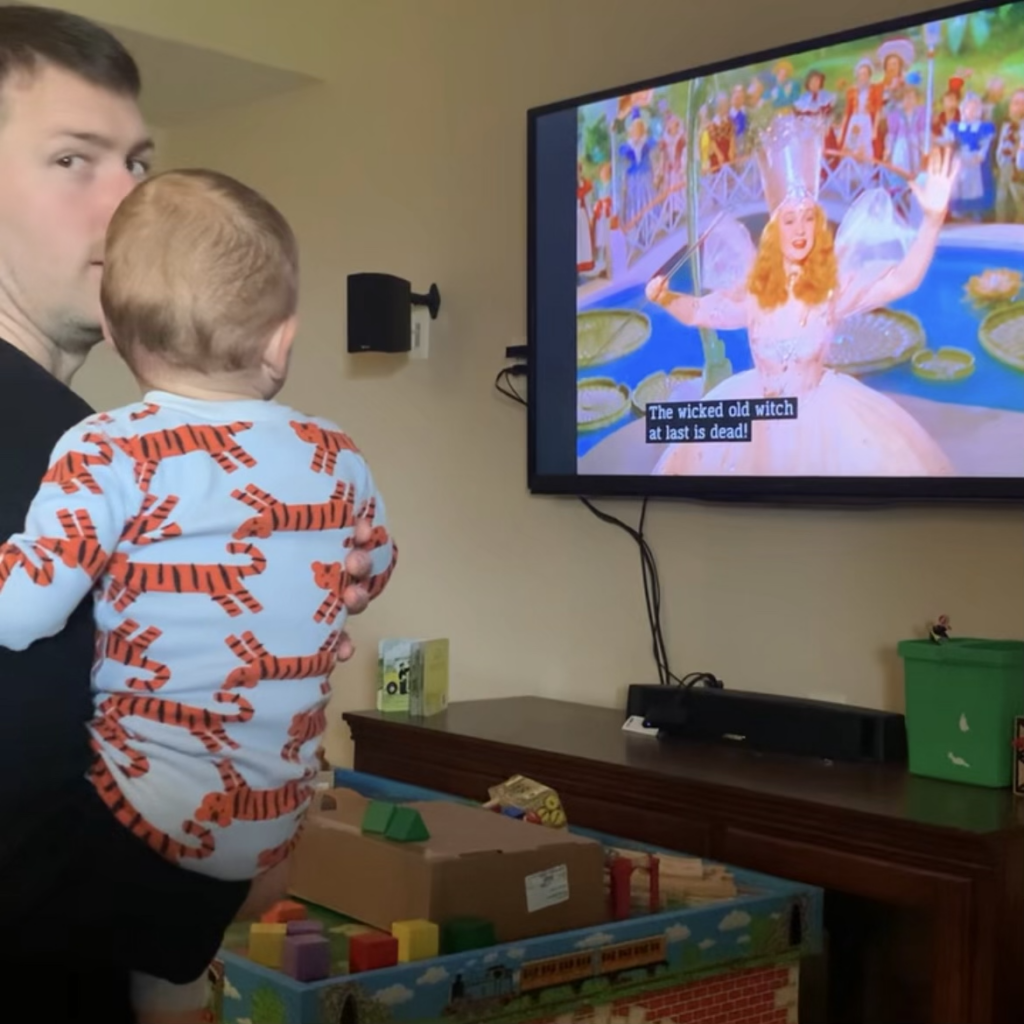
That said, we made an exception last week. We decided to watch The Wizard of Oz as a family—it was the first movie I loved as a kid, and we figured one movie wouldn’t be the end of the world. (Spoiler: our toddler didn’t care much at all and played with blocks.)

Watching it again reminded me of a line that’s stuck with me since childhood: “You’ve had the power all along, my dear.”

For years, before I decided I wanted to have a child and get pregnant, I doubted whether I was “regulated” enough to raise a whole human. During my coach training, “self-regulation” ranked near the bottom of the VIA Character Strengths Assessment for me. My partner, on the other hand, seemed to have self-regulation down. When something distressing happened, he stayed grounded, whereas it would absolutely ROCK me. My emotions hit like a violent tornado—tears, hopelessness, and anxiety swirling in full force. Add being in my luteal phase with Premenstrual Dysphoric Disorder in for good measure and it was disastrous. I’ve always been a “leaky” person, crying easily no matter the emotion. My therapist calls it my superpower—a way my body speaks before my brain catches up. Still, my inability to “stay grounded” added stress to my relationship. 

My partner couldn’t understand why I couldn’t self-regulate. He once asked if I had a quiet, still place inside myself to retreat to like he does when he gets distressed. I had no idea what he was talking about. So no, I didn’t have that place. For me, grounding isn’t internal; it’s external. Letting my emotions move through me and, more importantly, finding connection with others helps me regulate.

Eventually, I learned about co-regulation and realized it perfectly described my experience. Once I could articulate that, it became a recurring topic in our conversations and eventually in couples therapy (a quick plug: couples therapy is gold, even if nothing is “wrong” in your relationship).

I read about how we learn self-regulation through co-regulation in childhood. Every parent is doing the best they can (I know this now!), but given my nervous system, I probably could’ve benefited from even more co-regulation growing up. So, this is where I landed as I contemplated parenthood: imperfect and doubting whether I could ever become a parent if I wasn’t a self-regulating stoic.

Fast forward to my parenting journey—I was convinced I needed to “fix myself” before having kids. I thought I had to reach some mythical state of self-regulation mastery to be a good parent.

Spoiler: I haven’t mastered self-regulation.

But what I’ve discovered is this: I didn’t need to become the pinnacle of self-regulation to offer my child the co-regulation they need. When my baby and I co-regulate together, it’s not just my baby benefiting—I am too.

Here’s the fascinating part: the developing parent brain undergoes a remarkable period of malleability from mid-pregnancy through the first year postpartum (and continues evolving for years after!). It’s a biological remodeling process, reshaping the brain to suit the demands of parenting. When I learned this a couple months before giving birth, it hit me: I didn’t need to “fix” myself before becoming a parent. The process of becoming a parent itself would support my brain’s rewiring.

What a gift! (Not to mention release of pressure! Phew!)

Co-regulating with my child nourishes their brain and nervous system and my own. I’ve come to see my form of grounding—not through traditional self-regulation, but through co-regulation—as equally valid (and my partner has too!). Different nervous systems, different needs.

This first year of sensitive brain reshaping has felt like an opportunity—a chance to nourish my brain and bodymind in ways I didn’t know I needed. Most importantly, I’ve realized I can nurture my baby’s brain, body, and mental health with what’s already within me.

Like Glinda the Good Witch says, I had the power all along—I just needed to discover it for myself.

via GIPHY