What the Dominant Narrative Misses
What do disability, body literacy, fertility awareness, pregnancy, parenting, attachment, public health, and caregiving have in common?
I’ve been trying to articulate the answer to this question for myself for a while now. These fields can seem completely unrelated on the surface, and they’re made harder to see clearly by the layers of loud political ideology that get wrapped around each of them. I worry sometimes that people encounter my work in fertility awareness or responsive caregiving and think, “that’s some tradwife content I am not interested in.” I get it! These bodies of knowledge have often been co-opted, re-packaged, and handed back to us inside a political story that a lot of us don’t agree with and don’t recognize ourselves in. This often prevents people from accessing or practicing what could be providing a real benefit to them, or prevents them from seeing the thread underneath all of these that I think ties them together: care and interdependence.
Disability justice centers care and interdependence. Attachment science centers care and interdependence. When you strip away the dogmatic ideological packaging from body literacy, parenthood, responsive caregiving, and public health, each of these takes human needs seriously and begins with the reality of human bodies and relationships rather than what productivity and capitalism demand.
Not one of us came into this world without needing care. It’s literally how our species has evolved to survive and thrive and that need doesn’t disappear. We all begin as beings who rely completely on others for survival, and most of us will arrive back there at one or more points in our lives. At illness, disability, chronic illness, childhood, elderhood, grief, postpartum, parenthood, crisis, mental illness: all of these require care and interdependence.
Public health makes this explicit in a way the other fields sometimes leave implicit: our actions affect each other. A mask, a vaccine, staying home when you’re sick aren’t just individual choices. They exist inside a web of relationships. The people who have made this most visible are disabled people and immunocompromised people. We’ve had to articulate, loudly and repeatedly, that our safety depends on the choices of people who are not us.
Disability communities often reach a point, especially for people who become disabled after living as nondisabled, where they realize that worth does not equal productivity. You are worthy as you are. Rest is not something you earn. It’s a biological need (we are not machines!). In fact, disability justice calls out these exact principles: interdependence, recognizing the wholeness of each person, and anticapitalist politics.
Parental brain science shows that becoming a parent literally changes the brain. It’s pruned and reorganized in ways that increase attention to relationships, caregiving, emotional attunement, and social connection. The parental brain is optimized for caregiving, not maximum output. (Oh hello! Now it makes complete sense why my brain felt so completely different when I came back to work from parental leave.) Meanwhile, the culture around new parents says: bounce back. Get the baby sleeping independently. Get back to work. Get productive again. The parental brain is in some ways a biological rebellion against those capitalist demands.
Attachment science tells us that a securely attached child doesn’t develop through being efficiently managed. Secure attachment is built through thousands of moments of connection, co-regulation, responsiveness, repair, and presence. None of those are easily measured nor show up in any productivity metrics. And yet they’re among the most important things we as human beings can do or receive. Holding a crying baby, sitting with a dying elder, listening to a friend, recovering from or living with illness, resting, building trust, co-regulating are, by and large, in capitalist culture, treated as interruptions to life rather than as life itself.
None of us are units of productivity. Not babies, not children, not disabled people, not elders. Heck, not even nondisabled adults, no matter how hard everyone pretends otherwise! Everyone thinks they’re invincible until they’re not.
The fertility awareness method (FAM) gives people accurate self-knowledge to make decisions about their reproductive lives, including the decision to end a pregnancy. Knowing your body well enough to detect a pregnancy at five weeks, before a six-week abortion ban kicks in, can be life-saving knowledge. FAM connects directly to three of the four tenets of reproductive justice: the right to have children, the right not to have children, and the right to bodily autonomy and sexual freedom.
FAM also shows us that our bodies respond visibly to how we’re living. Whether we’re sleeping, eating, under stress, being nurtured or ground down by hustle culture, it all shows up in our cycles. FAM is a monthly report card on our own wellbeing. Using FAM we can learn to read what our cycles have to show us about our own well-being and see in real-time how living in a care-centered culture (where we are nourished, rested, connected, etc) vs a productivity-centered culture (where we are burnt out, etc) affect our reproductive health.
Disability and parenthood are both often viewed through a deficit lens: how will you manage, how will you keep up, how will you stay productive enough? (Fuck that.) What I think disability and parenthood reveal is that as human beings we are relational, that we move through seasons, that capacity fluctuates, that care is non-negotiable, that there is wisdom in slowing down.
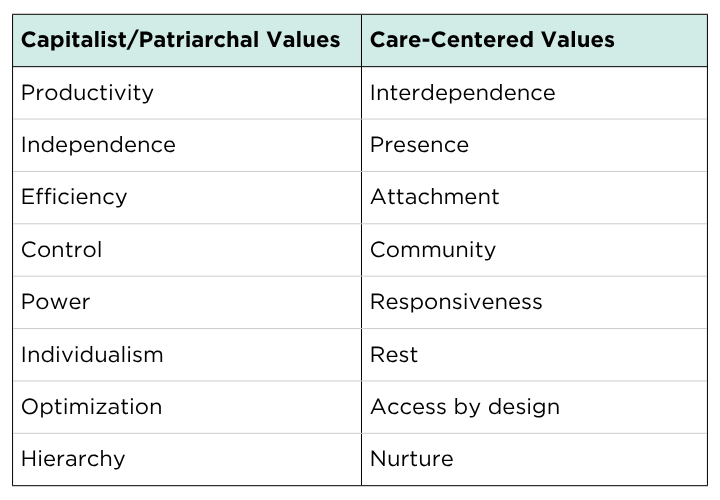
When I sit with care-centered values it’s obvious to me that disability justice, parental brain science, responsive caregiving, reproductive justice, public health, and body literacy all draw from the same well. No wonder they seem connected to me! They arrive at similar conclusions centering care and interdependence from different starting points. These fields of study are not some tradwife bullshit (though aspects of these fields get co-opted and distorted with dogma from the right regularly). They’re all asking a version of the same question:
“What if we organized our lives around what human beings need, rather than around what makes human beings most productive?”
The fourth tenet of reproductive justice, “Safe and supportive environments for families,” is one part of the answer. A girl can dream.