Body Literacy

What the Dominant Narrative Misses

What do disability, body literacy, fertility awareness, pregnancy, parenting, attachment, public health, and caregiving have in common?

I’ve been trying to articulate the answer to this question for myself for a while now. These fields can seem completely unrelated on the surface, and they’re made harder to see clearly by the layers of loud political ideology that get wrapped around each of them. I worry sometimes that people encounter my work in fertility awareness or responsive caregiving and think, “that’s some tradwife content I am not interested in.” I get it! These bodies of knowledge have often been co-opted, re-packaged, and handed back to us inside a political story that a lot of us don’t agree with and don’t recognize ourselves in. This often prevents people from accessing or practicing what could be providing a real benefit to them, or prevents them from seeing the thread underneath all of these that I think ties them together: care and interdependence.

Disability justice centers care and interdependence. Attachment science centers care and interdependence. When you strip away the dogmatic ideological packaging from body literacy, parenthood, responsive caregiving, and public health, each of these takes human needs seriously and begins with the reality of human bodies and relationships rather than what productivity and capitalism demand.

Not one of us came into this world without needing care. It’s literally how our species has evolved to survive and thrive and that need doesn’t disappear. We all begin as beings who rely completely on others for survival, and most of us will arrive back there at one or more points in our lives. At illness, disability, chronic illness, childhood, elderhood, grief, postpartum, parenthood, crisis, mental illness: all of these require care and interdependence.

Public health makes this explicit in a way the other fields sometimes leave implicit: our actions affect each other. A mask, a vaccine, staying home when you’re sick aren’t just individual choices. They exist inside a web of relationships. The people who have made this most visible are disabled people and immunocompromised people. We’ve had to articulate, loudly and repeatedly, that our safety depends on the choices of people who are not us.

Disability communities often reach a point, especially for people who become disabled after living as nondisabled, where they realize that worth does not equal productivity. You are worthy as you are. Rest is not something you earn. It’s a biological need (we are not machines!). In fact, disability justice calls out these exact principles: interdependence, recognizing the wholeness of each person, and anticapitalist politics.

Parental brain science shows that becoming a parent literally changes the brain. It’s pruned and reorganized in ways that increase attention to relationships, caregiving, emotional attunement, and social connection. The parental brain is optimized for caregiving, not maximum output. (Oh hello! Now it makes complete sense why my brain felt so completely different when I came back to work from parental leave.) Meanwhile, the culture around new parents says: bounce back. Get the baby sleeping independently. Get back to work. Get productive again. The parental brain is in some ways a biological rebellion against those capitalist demands.

Attachment science tells us that a securely attached child doesn’t develop through being efficiently managed. Secure attachment is built through thousands of moments of connection, co-regulation, responsiveness, repair, and presence. None of those are easily measured nor show up in any productivity metrics. And yet they’re among the most important things we as human beings can do or receive. Holding a crying baby, sitting with a dying elder, listening to a friend, recovering from or living with illness, resting, building trust, co-regulating are, by and large, in capitalist culture, treated as interruptions to life rather than as life itself.

None of us are units of productivity. Not babies, not children, not disabled people, not elders. Heck, not even nondisabled adults, no matter how hard everyone pretends otherwise! Everyone thinks they’re invincible until they’re not.

The fertility awareness method (FAM) gives people accurate self-knowledge to make decisions about their reproductive lives, including the decision to end a pregnancy. Knowing your body well enough to detect a pregnancy at five weeks, before a six-week abortion ban kicks in, can be life-saving knowledge. FAM connects directly to three of the four tenets of reproductive justice: the right to have children, the right not to have children, and the right to bodily autonomy and sexual freedom.

FAM also shows us that our bodies respond visibly to how we’re living. Whether we’re sleeping, eating, under stress, being nurtured or ground down by hustle culture, it all shows up in our cycles. FAM is a monthly report card on our own wellbeing. Using FAM we can learn to read what our cycles have to show us about our own well-being and see in real-time how living in a care-centered culture (where we are nourished, rested, connected, etc) vs a productivity-centered culture (where we are burnt out, etc) affect our reproductive health.

Disability and parenthood are both often viewed through a deficit lens: how will you manage, how will you keep up, how will you stay productive enough? (Fuck that.) What I think disability and parenthood reveal is that as human beings we are relational, that we move through seasons, that capacity fluctuates, that care is non-negotiable, that there is wisdom in slowing down.
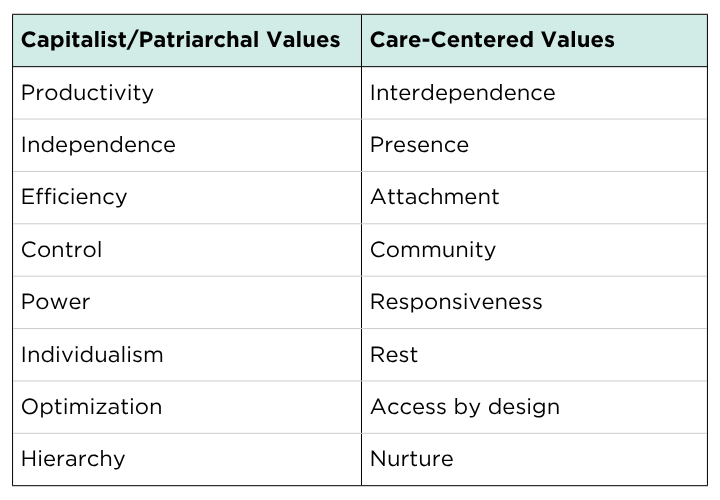
When I sit with care-centered values it’s obvious to me that disability justice, parental brain science, responsive caregiving, reproductive justice, public health, and body literacy all draw from the same well. No wonder they seem connected to me! They arrive at similar conclusions centering care and interdependence from different starting points. These fields of study are not some tradwife bullshit (though aspects of these fields get co-opted and distorted with dogma from the right regularly). They’re all asking a version of the same question:

“What if we organized our lives around what human beings need, rather than around what makes human beings most productive?”

The fourth tenet of reproductive justice, “Safe and supportive environments for families,” is one part of the answer. A girl can dream.
Rewriting the Script: Introducing BodyTalk! A Preteen Period Party

Ever wished you had a better understanding of your body when you were younger? Wish you could give your preteen the gift of body literacy you wish you’d had? Feel nervous about how to do it, but you know it’s important?! If you’re in the Greater Ithaca area, now’s your chance! Fellow FAM Educator Darcie Black and I are hosting BodyTalk! A Preteen Period Party, and we’d love for you and your preteen to join us. Registration closes in TWO days, and there are still a few spots left!

Let’s talk about why this workshop exists and why it matters so much to me.

When I was a preteen, my mom left a puberty book on my bed—it might have been The Care and Keeping of You, but honestly, I can’t remember. The moment I saw it, I was mortified. I flung it into the furthest corner of my room, treating it like it carried a contagious disease called “Puberty.” At some point, curiosity won, and I thumbed through its pages, but the embarrassment lingered.

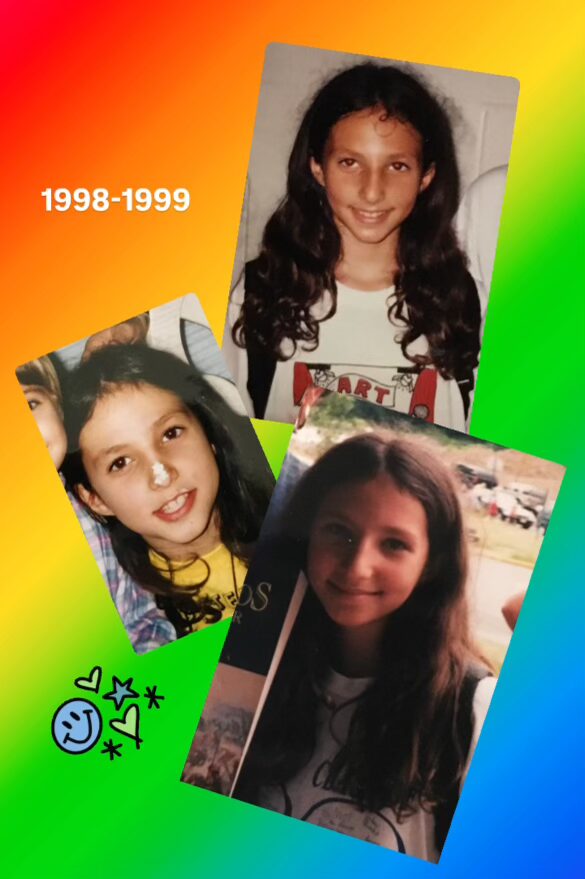
10-11 year old me in the late nineties!

Then there was the infamous “Mother/Daughter Night” in 5th grade. The school nurse gave a talk in the elementary school cafetorium, about puberty and the menstrual cycle. I was even MORE mortified. Sitting in that folding chair, staring at the floor, with my hair acting as makeshift blinders, among rows of other preteens, our parents in rows behind us, I wanted to disappear. Why was I so resistant? Maybe it was societal messaging about bodies and puberty being shameful. Maybe it was the clandestine “after-dark” setting that made the whole thing feel like a secret we weren’t supposed to talk about. Whatever the reason, I was not ready.

But something shifted. By high school, I’d done a 180. I dreamed of one day educating others about their bodies and reproductive health. At the time, I didn’t even know about body literacy and fertility awareness. I just knew how vital it was for people to have accurate, empowering information about their bodies.

Fast forward a quarter of a century, and here I am—working to rewrite the script on how we talk about bodies and menstruation.

BodyTalk is not your typical “puberty talk.” First off, it’s daylight. It’s fun. It’s open and welcoming. Preteens and their parents are invited to circle up, learn together, and celebrate what it means to grow and change. This workshop is packed with hands-on activities, including:

  • Drawing, puzzles, and games to understand anatomy and how the way we might feel through a cycle changes.
  • Learning about “red flow” and “white flow” in a clear, approachable way.
  • Exploring different period products and experimenting with absorbency using cranberry juice.
  • And more!

We’re taking the taboo out of periods, creating an inclusive and accessible environment, and promoting a body-positive approach. This is a space where you can connect with your preteen in a meaningful and empowering way.

This workshop is also a response to what I’ve heard time and time again from my adult clients: their first reaction to learning about their bodies as adults is often anger and rage that no one taught them these things when they were younger. We’re changing that narrative for the next generation.

This is a welcoming space for preteens ages 8–12, whether they’ve started menstruating or not. And parents? You’re likely going to learn something new, too!

Let’s normalize these conversations. Let’s shine a light on what’s often shrouded in secrecy. Let’s give our kids the tools they need to approach their bodies with confidence and curiosity. Most importantly, let’s make it fun.

Spaces are filling up fast, and registration closes in just two days. Don’t miss your chance to join us for BodyTalk: A Preteen Period Party. Together, we’re rewriting the narrative and creating a more empowered future—one period party at a time.

The Power All Along

In our house, we go to great lengths to avoid screentime for our child. Aside from Facetimes with relatives, screens are pretty much off-limits. The TV lives in the basement and is rarely on. When parenting gets REALLY hard and we’re teetering on the edge of losing it, we sometimes ask, “How do other people do this?” Then we remember: a lot of families rely on TV for childcare breaks.

Sure, we might be making it harder on ourselves, but we are hopeful that carefully managing screentime now will pay off later.

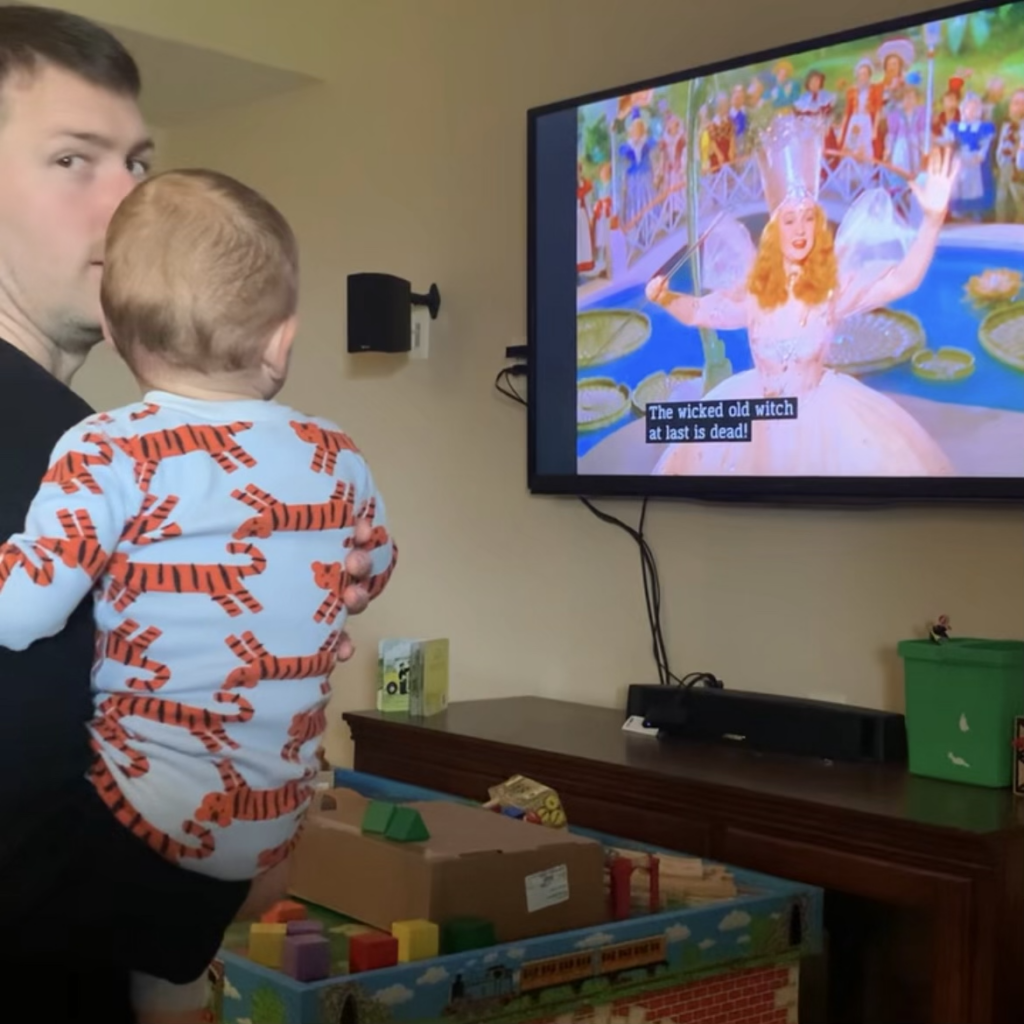
That said, we made an exception last week. We decided to watch The Wizard of Oz as a family—it was the first movie I loved as a kid, and we figured one movie wouldn’t be the end of the world. (Spoiler: our toddler didn’t care much at all and played with blocks.)

Watching it again reminded me of a line that’s stuck with me since childhood: “You’ve had the power all along, my dear.”

For years, before I decided I wanted to have a child and get pregnant, I doubted whether I was “regulated” enough to raise a whole human. During my coach training, “self-regulation” ranked near the bottom of the VIA Character Strengths Assessment for me. My partner, on the other hand, seemed to have self-regulation down. When something distressing happened, he stayed grounded, whereas it would absolutely ROCK me. My emotions hit like a violent tornado—tears, hopelessness, and anxiety swirling in full force. Add being in my luteal phase with Premenstrual Dysphoric Disorder in for good measure and it was disastrous. I’ve always been a “leaky” person, crying easily no matter the emotion. My therapist calls it my superpower—a way my body speaks before my brain catches up. Still, my inability to “stay grounded” added stress to my relationship. 

My partner couldn’t understand why I couldn’t self-regulate. He once asked if I had a quiet, still place inside myself to retreat to like he does when he gets distressed. I had no idea what he was talking about. So no, I didn’t have that place. For me, grounding isn’t internal; it’s external. Letting my emotions move through me and, more importantly, finding connection with others helps me regulate.

Eventually, I learned about co-regulation and realized it perfectly described my experience. Once I could articulate that, it became a recurring topic in our conversations and eventually in couples therapy (a quick plug: couples therapy is gold, even if nothing is “wrong” in your relationship).

I read about how we learn self-regulation through co-regulation in childhood. Every parent is doing the best they can (I know this now!), but given my nervous system, I probably could’ve benefited from even more co-regulation growing up. So, this is where I landed as I contemplated parenthood: imperfect and doubting whether I could ever become a parent if I wasn’t a self-regulating stoic.

Fast forward to my parenting journey—I was convinced I needed to “fix myself” before having kids. I thought I had to reach some mythical state of self-regulation mastery to be a good parent.

Spoiler: I haven’t mastered self-regulation.

But what I’ve discovered is this: I didn’t need to become the pinnacle of self-regulation to offer my child the co-regulation they need. When my baby and I co-regulate together, it’s not just my baby benefiting—I am too.

Here’s the fascinating part: the developing parent brain undergoes a remarkable period of malleability from mid-pregnancy through the first year postpartum (and continues evolving for years after!). It’s a biological remodeling process, reshaping the brain to suit the demands of parenting. When I learned this a couple months before giving birth, it hit me: I didn’t need to “fix” myself before becoming a parent. The process of becoming a parent itself would support my brain’s rewiring.

What a gift! (Not to mention release of pressure! Phew!)

Co-regulating with my child nourishes their brain and nervous system and my own. I’ve come to see my form of grounding—not through traditional self-regulation, but through co-regulation—as equally valid (and my partner has too!). Different nervous systems, different needs.

This first year of sensitive brain reshaping has felt like an opportunity—a chance to nourish my brain and bodymind in ways I didn’t know I needed. Most importantly, I’ve realized I can nurture my baby’s brain, body, and mental health with what’s already within me.

Like Glinda the Good Witch says, I had the power all along—I just needed to discover it for myself.

via GIPHY

Body Literacy Academy: Founding Statement

Founded by Erica Evans in 2019, the Body Literacy Academy empowers individuals to better understand and respond to their body’s unique messages across all stages of life—from menarche through menopause. 

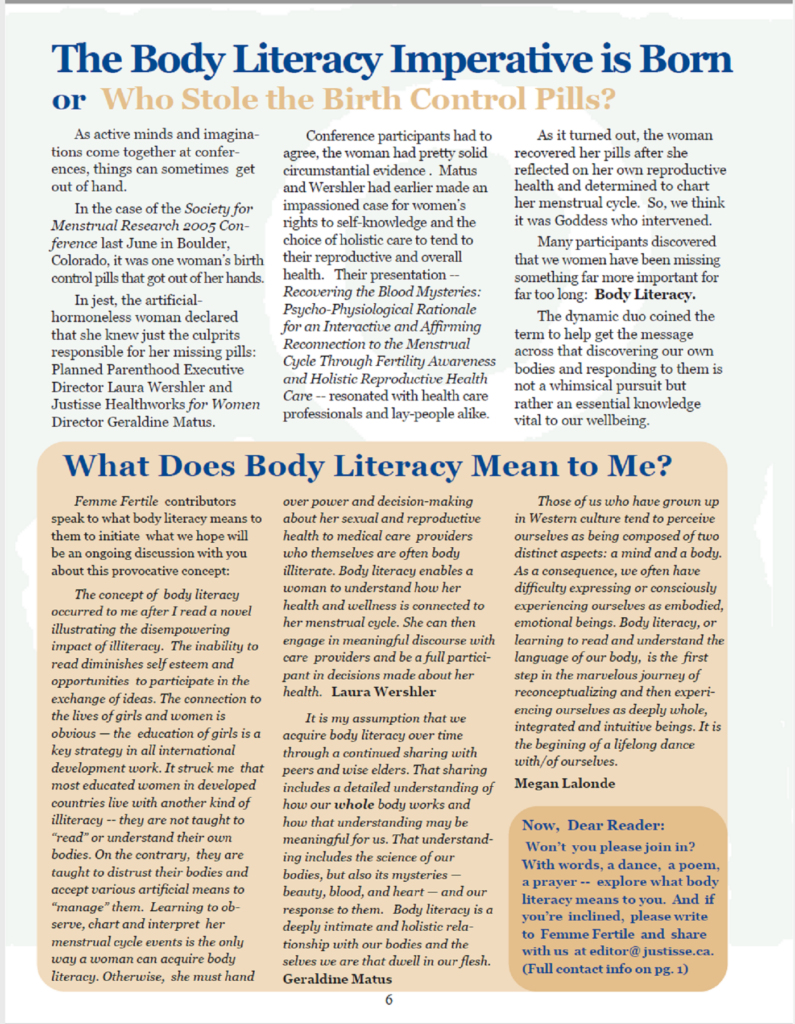
Body literacy, the academy’s guiding principle, is the ability to recognize, interpret, and trust the signs and signals our bodies communicate. In 2005, Laura Wershler introduced body literacy as “learning to observe, chart and interpret our menstrual cycle events.” 

From Femme Fertile, 2005, Page 6

While body literacy is often linked to fertility awareness, it also goes beyond. Megan Lalonde broadened the scope defining it as “learning to read and understand the language of our body.” For some individuals this is about tuning into their neurotype and understanding how their individual brain wiring and sensory needs shape their experience. For others, it means listening to their nervous system to identify what they need to feel balanced or about embracing intuitive eating to nourish themselves effectively. For many, it’s about understanding how the body’s messages can guide health decisions and reproductive goals.

The Body Literacy Academy also embraces disability justice, honoring that each body communicates in unique ways. Programs are structured to be accessible and inclusive of diverse learning needs, respecting that disabled people and those with chronic conditions may experience and interpret body signals differently. For some, body literacy might involve adapting to sensory processing needs or understanding how neurodivergent experiences shape the way we relate to our bodies. This inclusivity echoes the broader vision for body literacy, which seeks to make these practices available and meaningful to everyone.

Along these values, in 2000 even before Laura Wershler, the Tathapi organization in India developed the concept of body literacy as a “medium to scientifically explain the processes of the body, its parts and functions” to people across ages and backgrounds. The Body Literacy Academy believes that body literacy is for every body, every gender, every age. All genders and sexual orientations are welcome to learn.

The academy offers a diverse selection of inclusive programs for all ages and stages led by Erica and carefully chosen co-instructors. Participants can engage in programming with Erica or co-instructors, and in collaborative, co-taught experiences with both, allowing for a rich, in-depth exploration of body literacy practices from multiple perspectives.

How EDS and Chronic Pain Promote Fatigue and What to Do About It (Part 1)

Do you feel rested in the morning? Or do you want to roll over and go back to sleep? Maybe you’re thinking, “I’m a great sleeper! I can sleep for 15 hours straight!”

Neither of these are signs of someone who gets restorative sleep and both can be signs of fatigue.

Fatigue is a common symptom of many chronic conditions. Today we focus on fatigue in people living with Ehlers-Danlos Syndrome (EDS), and what anyone whether they have EDS or not can do about it.

The Ehlers-Danlos Society describes the Ehlers-Danlos Syndromes as:

A group of connective tissue disorders that can be inherited and are varied both in how they affect the body and in their genetic causes. They are generally characterized by joint hypermobility (joints that stretch further than normal), skin hyperextensibility (skin that can be stretched further than normal), and tissue fragility.

Ehlers-Danlos Syndrome (EDS) is considered a rare disorder. There are 13 different types of Ehlers-Danlos syndromes. The latest statistics list the total prevalence of all the types as 1 in 2,500 to 1 in 5,000 people. Clinical experience suggests EDS may be more common than that.

In fact, I have hypermobile Ehlers-Danlos Syndrome!  Many of us living with EDS will call ourselves “zebras.”

Why the Zebra?

Medical students have been taught for decades that, “When you hear hoofbeats behind you, don’t expect to see a zebra.” In other words, look for the more common and usual, not the surprising, diagnosis.

But many of us spend years pursuing a diagnosis for disorders that aren’t well known. Or aren’t expected in someone who looks normal, or is too young to have so many problems, or too old. Or even, what we might have is considered too rare for anybody to be diagnosed with it.

So the zebra became our symbol to mean, “Sometimes when you hear hoofbeats, it really is a zebra.” Ehlers-Danlos syndromes are unexpected because they’re rare. Hypermobile spectrum disorders are common, but are unexpected because they remain misdiagnosed or under-diagnosed. 

-The Ehlers-Danlos Society

Okay, let’s get back to sleep! 

There are many reasons why a Zebra might have chronic fatigue:

  • Autonomic Nervous System Dysfunction
  • Metabolic factors
  • Inadequate rest (not taking breaks/feeling guilty about it #permissiontorest)
  • Cognitive tasks (which are just as tiring as physical tasks!)
  • Emotional stresses (draining)
  • Everyday life (which sucks up your energy)

It’s important to keep in mind there is no one thing that will work for everyone. Every person’s body is different. You are the expert in what it’s like to live in your body, and no one else.

EDSers tend to have non-restorative sleep. The most common pattern of sleep disorders in EDS is not enough time in deep sleep (my Oura ring can vouch for this!). The continuity of deep sleep is broken by arousals which cause us to wake up feeling tired. 

Did you know you have to be awake for 2 minutes to remember being awake? An awakening is defined as disruption to continuity of sleep that lasts more than 30 seconds. And less than 30 seconds is called an arousal.

Dr. Alan Pocinki in his presentation on chronic fatigue at the Ehlers-Danlos Society’s 2019 Nashville Global Learning Conference shared that in one sleep study of a woman with EDS, she had no deep sleep or REM, and was not cycling through the stages of sleep. The sleep study showed her continuity of sleep had been broken 150 times in seven hours!

I’m exhausted just typing that.

So what can we do about disordered sleeping?

From the perspective of someone living with a chronic condition with a pain characteristic, there are two areas that can be focused on:

  1. Practice good sleep hygiene 
  2. Manage pain 

There are many lifestyle interventions that promote sleep hygiene (behaviors that contribute to good quality sleep as well as alertness during the day). Let’s explore five of them today.

1. Control your exposure to light

Light is one of the primary drivers of our circadian rhythm and the sleep/wake cycle.

  • Avoid blue light in the evenings and hours leading up to bedtime.
  • Avoid or minimize use of electronic screens two to three hours before bedtime.
  • If you must use screens install a program like f.lux on your computer, or wear orange-tinted, blue-light blocking glasses at night.
  • Use blackout shades or an eye mask to keep your bedroom as dark as possible. 
  • Cover or remove anything that emits light in your bedroom like digital alarm clocks. We put black electrical tape on the green digital lights of our window AC unit during the summer months. 

Blue light is not all bad. What matters is getting it at the right time of day. In addition to your sleep hygiene in the evening, you’ll want to make sure you get sunlight during the day. 

  • Take a short walk when you wake up
  • Eat breakfast outside
  • Use a light machine (I do this during the long, dark days of winter!)

2. It’s time to move it, move it!

But you don’t need to even do it that much. As little as 10 minutes of aerobic exercise can dramatically improve your sleep quality. Physical activity also improves sleep duration.

However, the timing of exercise can make or break your sleep. According to the National Sleep Foundation:

Early morning and afternoon exercise may also help reset the sleep wake cycle by raising body temperature slightly, then allowing it to drop and trigger sleepiness a few hours later. It can be especially helpful if you are able to exercise outdoors and let your body absorb natural sunlight during the daylight hours.” 

This explains the sleep-like-a-baby feeling I get in the evenings after an afternoon bike ride!

It’s important to note that strenuous exercising too close to bedtime can actually be detrimental to your sleep quality. This does differ from person to person, so as always, you know your body best – find out what works best for you.

While we’re all familiar with the common refrain to “get more exercise,” exercise is not the only kind of movement that counts. Non-Exercise Activity Thermogenesis is all the movement we do throughout the day that isn’t sleeping, eating, or sports-like. Walking to the store, taking the stairs, doing house or yard work all increase NEAT.

Start observing how sedentary you are during the day and where you might be able to get more NEAT in.

Are you able to take that phone call while on a walk? How about standing at your desk for a bit?

3. Nutrition and Sleep

In general it’s best to not go to bed too full or hungry. And since no two people (or Zebras) are alike, it’s important to pay attention to your body.

Are you someone who needs a snack before bed because you tend to have low blood sugar? Waking up in the middle of the night can sometimes be an indication of this!

Or are you the type of person who does better with a smaller dinner? Is your body getting enough nutrition to help you sleep at night? Low-carb and low-fat diets could also impact your sleep.

Did you know as many as 20% of Americans use alcohol to help them fall asleep?

While it may help you fall asleep more quickly, it leads to poor quality sleep by disrupting your circadian rhythm and blocking REM sleep, your body’s most restorative sleep.

By now we all know about the effects of caffeine on sleep. If you have a caffeine habit that needs breaking it’s best to wean off rather than quit abruptly. 

4. Manage Stress

In today’s day and age, feeling stressed seems like the default.

With a global pandemic, civil unrest, rampant racism, and record rates of unemployment, it’s hard for it not to be!

When every night brings another day’s news cycle depicting the pain, trauma, and devastation occurring around the world to a close, calming our nervous systems can feel like a Herculean feat.

Add to this our propensity to use our smartphones to get those additional hits of the news right before bed and it’s a double whammy of blue-light exposure and stress activation!

Explore different types of stress management techniques and tools like deep breathing, meditation, yoga, prayer, knitting, and more to help you manage stress. 

5. Create and Maintain a Relaxing Sleep Space

Don’t sleep with your kids or pets.

While sleeping with kids or pets might work for some, if you are waking up tired in the morning, you might consider not sleeping with them to see if that helps.

If possible only use your bedroom for sleep and sex.

The intention is for your bedroom to be a relaxing place. If you’re also folding laundry, working on your computer, and eating in your bedroom it can create unnecessary stressors.

Is there a lot of noise outside your bedroom?

Use earplugs, or a noise machine to block it out.

Avoid using electronics in the bedroom.

Study after study shows digital tech activates our sympathetic nervous system making it harder for our bodies to shift into sleep.

I know, “But my phone is my alarm clock!” In some cases, analog is a better choice than digital – this is one of those cases.

The lights from a digital alarm clock (or your phone) are actually bright enough to disrupt your circadian rhythm!

Control the temperature of the room.

Sleeping in a slightly cooler room tends to work best for most.

Many EDSers also deal with dysautonomia, the dysfunctioning of our autonomic nervous systems (ANS). One of the responsibilities of the ANS is to regulate body temperature.

Many EDSers report non-hormonal hot flashes during sleep. Dr. Pocinki in 2019 at the EDS Global Learning Conference shared that these hot flashes are often autonomic in nature. Hormonal hot flashes tend to be in the upper body, chest, and face. Whereas, waking up hot all over usually signifies they are due autonomic dysfunction.

A person with EDS’s body temperatures often bottoms out in the middle of the night, and so it overcorrects. We warm up too much and wake up in a hot sweat with our hearts racing.

The heart racing could be a nightmare or dream, or it could be adrenaline. The ANS is also what tells the body to release adrenaline. 

The Autonomic Nervous System is what keeps us on an even keel. When it malfunctions, things start to fluctuate. Our sympathetic ( fight or flight) VS parasympathetic (rest and digest) responses go out of whack.

When the sympathetic nervous system is activated it causes us to release adrenaline more often. We might overreact to minor stresses in our lives and waste energy that we could be conserving leading to more fatigue. 

How comfortable is your bed?

This might be obvious, but if your bed is uncomfortable, your sleep is not going to be great.

As a hypermobile person, a mattress’s quality and comfort are even more vital. If you haven’t caught on to the theme yet, you know your body best. 

Some considerations for the Zebra:

  • A mattress that is too soft could misalign your spine, cause sore muscles, or subluxation/dislocations in your joints
  • Too firm and it could cause bruising and pain 

Some people find a softer bed more comfortable, others like a firm mattress, still some folks are in between. Get your Goldilocks on and find yourself a mattress that feels just right.

To sum up

Getting the right kind of light at the right time, moving more, optimizing our nutrition for sleep, managing our stress, and maintaining a relaxing sleep environment all contribute to better quality and duration of sleep. 

When living with a chronic illness like the Ehlers-Danlos Syndromes it’s easy to run out of spoons before midday. The little things add up! And so do the little things you can do to improve your sleep and manage or reduce fatigue. Do you have to cover all five of the areas on this list? No. 

I know how overwhelming it is to live with chronic illness.

What feels like low-hanging fruit? One baby step that feels doable to you now? 

Start there. 

Have you made improvements to your fatigue by working on your sleep hygiene? What worked for you? 

Tell me about it in the comments below!

Stay tuned for Part 2, where I go over how chronic pain promotes fatigue and what you can do about it. 


    1.