Sleep Deprivation, Chronic Illness, and Early Parenthood
Before I had a child, sleep was non-negotiable for me. I needed a minimum of 7 hours to function — really closer to 7.5 to 8. Under 7 and it was not pretty. Under 6 and I genuinely could not function. This really worried me—how would I be able to respond in a way that was aligned with my values for care and connection to my baby, day or night, if I was not getting my usual sleep? As someone with hypermobile Ehlers-Danlos Syndrome, MCAS, POTS, and PMDD, I had managed my body carefully around that need so that I could be functional for years.
Long before I had a kid, a friend talked about early parenting exhaustion in a way that implied without meaning to that whatever I was already living with from my chronic illness was no match for the exhaustion from sleep deprivation of new parenthood. I took a little offense to that, and I filed it away as something I’d judge for myself if and when the time came.
My assessment when I finally got to experience it for myself: they’re both crappy, but they’re different.
Chronic illness fatigue for me is the kind of tired where there is no amount of rest that will touch it. You sleep and you’re still tired. Your body doesn’t recover. New parent exhaustion for me was different. If I could get more sleep, I would feel less tired.
Identifying that difference was important to me. It didn’t make new parent exhaustion easy. But it meant I was dealing with a different problem than the one I’d been managing for years, which meant it could be approached differently.
On becoming a napper
I’d never really been a napper, instead a full unbroken night of sleep was how I got my rest. In early parenthood, somehow that changed. I found myself napping during the day (actually sleeping when the baby slept!) which I had assumed would be impossible for me. And, over 24 hours the rest added up. I relished those daytime naps.
Could it have been the parental brain changes that come with birth and bonding? The hormones of lactation? The suppression of ovarian hormones that happens during breastfeeding and how that was impacting my chronic illnesses? Just so exhausted from broken sleep at night that my body relented and I could nap during the day? Probably some combination of all of it. Something shifted in what my body was capable of. In fact, I was able to respond to my baby with care and connection even with unbroken nighttime sleep.
I eventually learned the neuroscience of how the parental brain changes, and knowing this can make a big difference (especially for disabled and chronically ill people who are worried about sleep): the parental brain actually changes to support your capacity to respond to your baby. The brain is most plastic during pregnancy through the first year postpartum and we can work with that plasticity to support the parental brain.
How we designed our sleep
We also didn’t approach nighttime sleep the way mainstream new parenthood in this country assumes you will.
Safe bedsharing, done well with current safety guidelines, can mean more sleep for everyone while providing the oxytocin and connection that support both your stress system and your baby’s. For disabled and chronically ill parents especially, even if you never plan to bedshare, it’s absolutely worth understanding this option exists and the evidence behind it, and how to do it. (I always say the best time to learn how to safely bedshare is before you need it rather than at 3am when you’re sleep deprived, desperate, and more likely to make unsafe choices).
Here’s what our sleep setup actually looked like:
In the beginning, we started with a bedside cosleeper bassinet in our bedroom right up against the bed. When I switched to exclusive pumping, we divided the night. I took the first half to sleep since I had to wake to pump anyway in the middle of the night, my partner took the second half for uninterrupted sleep. At that point we moved the bassinet to another room where the person on call slept on a futon next to the cosleeper. Each of us got some uninterrupted sleep every night. We then moved to a floor bed in that other room and started bedsharing, and it was at this point we all actually started getting some real sleep.
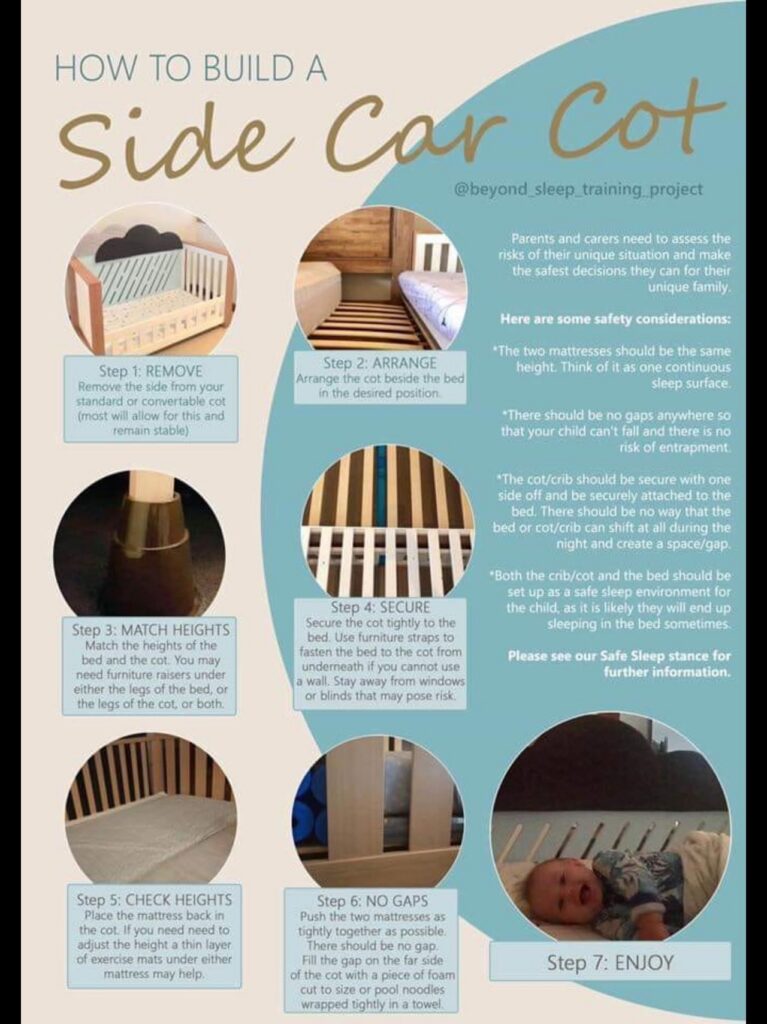
Eventually we converted our up to that point unused crib into a sidecar cot right up against our bed (see image to the right for more information from The Beyond Sleep Training Project) and all moved back into the bedroom together: bedsharing with our baby in our bed and using the sidecar cot right up against our bed when needed. Over the years, the amount of time our child spent in our bed versus the sidecar cot has shifted and now at almost 3 years old, most of the night our kiddo is in the sidecar cot, joining us in bed usually somewhere between 3 and 5am (typically after a middle of the night pee in the potty).
We hadn’t initially planned on bedsharing. But I’m so grateful that we quickly learned how to do it safely because while we had problem-solved a way to each get some uninterrupted sleep every night, bedsharing allowed us all the ability to get better sleep together. In a future post I will share more about why better sleep is not the only reason to bedshare either (though it is a great one!).
We were still more tired than before we had a baby, but not as tired as we were before we came up with this solution (because as we know, becoming a parent means choosing to change). We designed it around what we needed, and all of us got more rest.
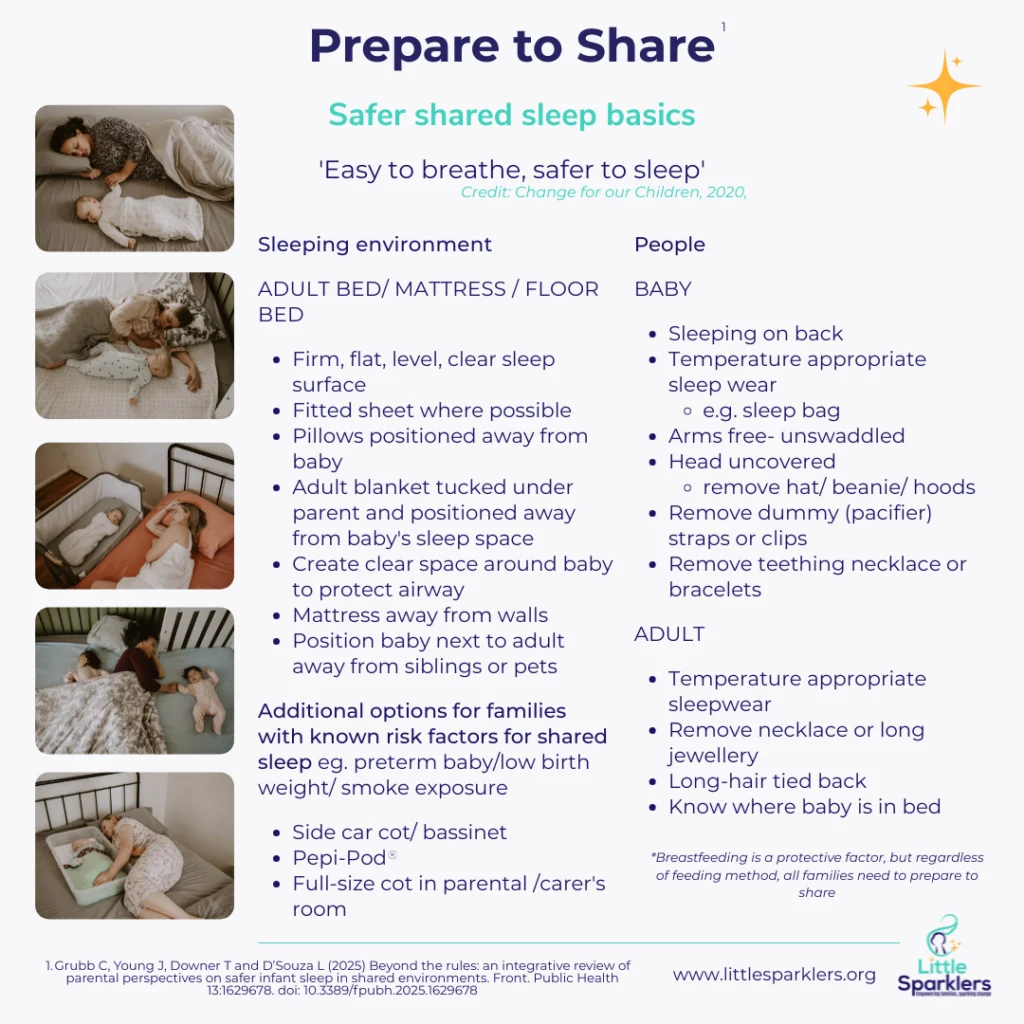
If I had to do it again, I’d start with the sidecar cot bedsharing setup from the beginning. Littler Sparklers has a great resource on realistic expectations for infant and toddler sleep and preparing to bedshare.
What I’d want you to know
If you’re a disabled, chronically ill, or neurodivergent person who is worried about sleep, your body may surprise you. Mine did, in ways I can’t fully explain and didn’t expect.
You will still be tired. And the tired you’re imagining right now, from the outside, may feel different once you’re actually in it because your brain will be different, and because you can design your sleep situation (safely) rather than defaulting to whatever the mainstream version assumes.
Designing-differently is what we’ve been doing our whole lives as disabled, chronically ill, and neurodivergent people. It’s also what I help people do in Body Compass™: Path to Parenthood: building a real plan around your actual capacity, before the baby arrives, so you’re not figuring it out at 3am.
If you’re preparing for a baby and want a starting point that was built for folks with bodies and brains outside the status quo, The Baby Registry Nobody Made For Us is a free guide with a whole section on sleep setups. What actually helps when you’re managing a chronic illness or disability alongside a newborn.
And if you’re looking for support across the whole path (conception, pregnancy, and early parenthood) that’s what Body Compass™: Path to Parenthood is for.