Podcast

Episode 3 with Dr. Lindsay Ulrey: Parenting After Becoming Disabled

Prefer to read instead of listen? Jump to the transcript.

What changes about how you see your role as a parent and how you see your kids when your own body has to learn everything over again?

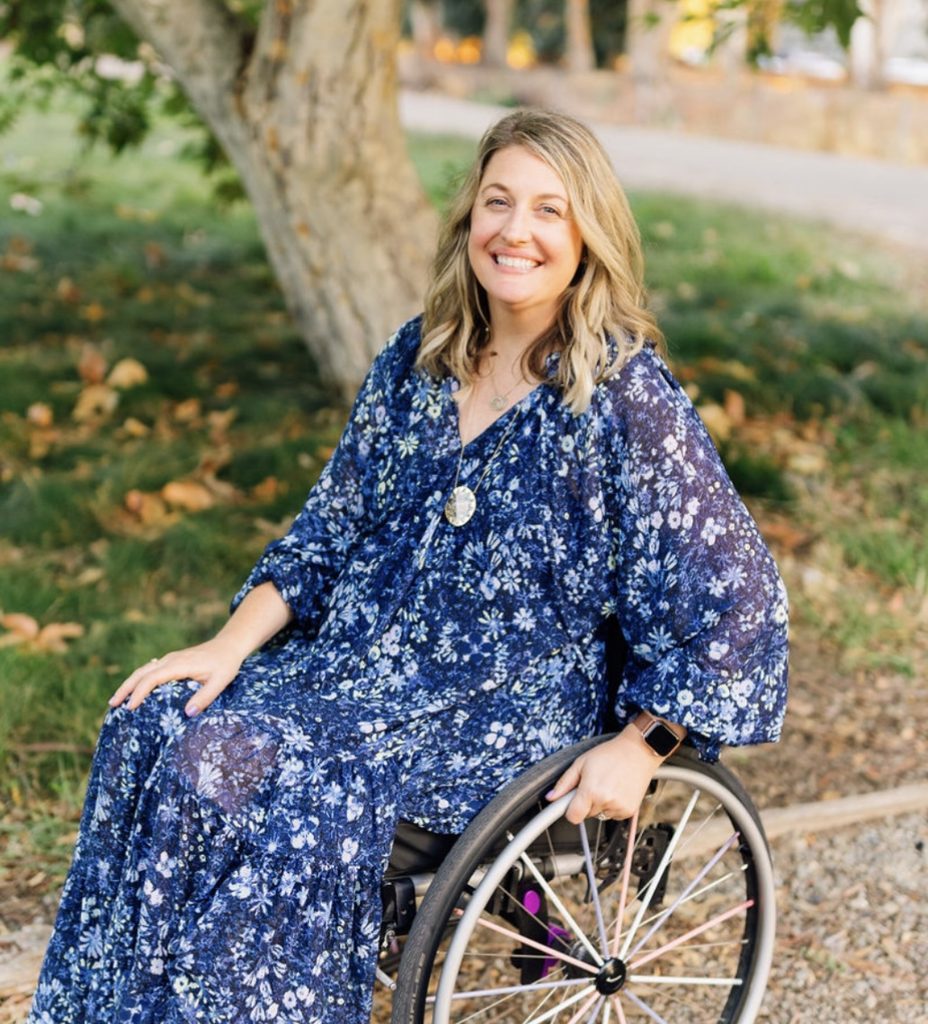
Dr. Lindsay Ulrey was already a mom of two, ages 2 and 5, when transverse myelitis left her paralyzed from the chest down, seemingly overnight. In our conversation about parenting from a wheelchair, she talks about googling “wheelchair moms” because she had no template, the way adjusting to her injury echoed her postpartum months, body grief, and the day she realized her kitchen was built for taller someone taller (and that her kids may feel that way all the time).

If you’re parenting after becoming disabled, or you’re close to someone who is, this conversation has good company in it.

In this episode we explore

  • 00:28 – Becoming paralyzed overnight and searching for “wheelchair moms” online
  • 07:42 – Looking for a template, and discovering there are many ways to mother
  • 12:35 – The parallel between postpartum recovery and adjusting to a spinal cord injury
  • 16:51 – What surprised her: how much of parenting stayed the same, and how quickly her kids adapted
  • 21:21 – Body grief as something that stays present rather than resolving
  • 31:49 – Redefining “good mom” from productivity and output to presence
  • 41:05 – Interdependence versus parentification: what kids can help with, and what they shouldn’t carry
  • 49:13 – The blueberry story
  • 1:00:26 – Seeing the world from her kids’ vantage point

Resources and links

About Lindsay

Dr. Lindsay Ulrey (PsyD, PMH-C) is a busy mom on wheels, licensed clinical psychologist in private practice, and certified perinatal mental health specialist who is passionate about supporting and empowering mothers of all abilities. She facilitates Wheel Good Motherhood, a free monthly support group for disabled moms, creating space for connection, community, and shared experiences. In 2021, Lindsay acquired a complete T4 spinal cord injury as a result of idiopathic transverse myelitis. Since then, she has been navigating a new chapter of motherhood as a full-time wheelchair user, bringing her professional expertise and lived experience together to support other moms along the way. You can learn more about her at www.drlindsayulrey.com and follow her @wheel.good.motherhood on Instagram.

Disclaimer

The Disabled Parenthood Podcast shares personal stories and educational conversations about disability, pregnancy, parenthood, and family life. The information shared in this episode is not intended as individualized medical advice and should not replace guidance from your own healthcare professionals.

Transcript

Erica Evans (00:00)

Welcome to the Disabled Parenthood Podcast, where we have honest conversations about disability, pregnancy, parenthood, and family life.

Erica Evans (00:06)

I’m Erica Evans and today I’m talking with Dr. Lindsay Ulrey Lindsay and I connected through Instagram, through her Wheel Good Motherhood account. And I’ve been very much looking forward to getting to know her a little bit better and having this conversation. So, Lindsay, please say hi. Tell us a little bit about yourself and the work that you do.

Dr. Lindsay Ulrey (00:27)

I’m so honored to be here. Thank you for reaching out. I’m really glad that we connected on Instagram. And so, yeah, my name is Dr. Lindsay Ulrey I am a perinatal mental health specialist and a therapist. I have a private practice that I do from my house. That’s actually where I’m sitting right now. and I also am a mom. I have two boys who are 10 and 7.

And so I started Wheel Good Motherhood. It was almost two and a half years or it’ll be three years in January. So um that’s exciting. And so I started Wheel Good Motherhood when I was finding I was trying to find resources and support online for moms who use wheelchairs.

So I acquired a T four complete spinal cord injury from something really rare called transverse myelitis. And it was completely out of nowhere, completely unexpected. And so I literally became paralyzed overnight out of nowhere. And at the time, yeah, at the time my kids were two and five.

I was so lost and overwhelmed and really truly had no idea what I was doing. I didn’t know a single person in a wheelchair, let alone any moms in wheelchairs. And so I really felt I’ve never felt more isolated in my entire life, I will say. Going from, parenting on my feet with really very little knowledge about disability and knowledge about

How to move through the world with a disability as a mom, I was yeah, just very, very overwhelmed and scared. And so I ended up going online and I think I literally just Googled wheelchair moms and started finding random people here and there. and then I was really grateful to connect with this group of women who were actually mostly in Canada, but we were on a Facebook group and a lot of them were moms and that just really helped me feel like I could ask them questions and then I also just felt a lot less alone. I felt more hopeful for my future and I felt like I would hear the things one of the moms was like, yeah, I like coached my kids’ soccer team and she uses a wheelchair full time. You know, so all these things that I thought were over in my life. I thought I was never gonna drive again, never gonna do pretty much anything I imagined myself doing as a mom. And then I would talk to these other moms in wheelchairs and they were completely just doing all the things I thought I was going to be able to do. So that started off that. And then as a mental health professional, I was well aware of the importance of having spaces, where you can talk about common experiences. And I was

really craving a support group type thing for moms who use wheelchairs and I was asking around like I didn’t at the time I was like, I don’t really want to start one because I didn’t want to take on an extra thing. But I was asking all these mom friends that I knew in wheelchairs and they were like, We know, I don’t know about one. I don’t know of one. Um, you should start one. And so I was like, yeah, why not? You know, and then I had the idea to start this Instagram page that was really focused on building community and also honestly just showing my life and showing parts of my motherhood experiences on wheels because I did find a couple pages, but I also didn’t really see a lot what that was kind of connected with mental health and motherhood and wheelchairs. And so I kind of wanted to just curate my own what I really needed at the time and what I could have I think would have been really helpful for me to see and to experience when I was first. And so I ended up starting putting little thoughts together. I share experiences that I have out in the world as a mom in a wheelchair and just thoughts about acquiring a spinal cord injury and as a mom and what that feels like for me. And ways to talk to wheel, you it’s just like different different aspects that I cover. But I really like it. And it’s honestly been kind of healing and therapeutic for me to put my life out there in a way that feels like I can kind of reclaim my narrative or something like that and feel empowered. It’s still kind of a work in progress. But for right now it’s an Instagram page, and then it’s a free monthly support group that we meet once a month. And it’s virtual, it’s on the third Tuesday of every month at noon, Pacific Standard, 3 p.m. Eastern. And yeah, it’s free and it’s a peer support group. So we all come and just share what’s going on for us. And we always start off with a little intro and then we share one thing that we’re working on and one thing that we’re really proud of. It’s kind of a nice way to, you know, join together and discuss the things that we encounter as moms who use wheelchairs.

Erica Evans (05:35)

There’s nothing like connecting with other people who are doing the thing…

Dr. Lindsay Ulrey (05:39)

Yeah.

Erica Evans (05:40)

…to instill a new vision for oneself to see, here’s how other people are doing it. I can do this too. Here’s what that could look like.

Dr. Lindsay Ulrey (05:50)

Yeah, exactly. And I’ve had a lot of people reach out to me and say, Your page is exactly what I needed. It’s really, you know, it really resonates. It’s really filling a space that I didn’t know was empty and just things like that. And to me, that’s exactly why I’m doing it. I have my reservations about social media in general, but it links people together. It really does. And it was kind of a lifeline for me in the very beginning of my injury. If I didn’t have that resource, if I wasn’t able to kind of just go on the internet and look up wheelchair moms, and I mean, I really wouldn’t have met a lot of the people I’ve met and I wouldn’t have the community I have. I’ve tried to be really intentional about this is a community space. This is a safe space for people to come and to

And even for people who may be women who are in wheelchairs but aren’t moms yet, but are thinking about it and want to see what’s possible and learn about what’s possible. I’ve had a couple prospective moms come to our meetings and they just soak in the wisdom and ask questions. And so that’s another thing to mention is that it’s not just for moms. It’s for I mean, seriously, anyone if you’re curious about pursuing motherhood.

Erica Evans (07:09)

Yeah. I think you might be the first guest I’m interviewing who had a story of disability that happened when you already were a parent, when you were already a mom. And I can imagine that, I mean, it’s a whole life change. Parenting is already a life change, and then you’ve got this other huge piece on top of it. When you went on the internet we’re like wheelchair moms and we’re looking for that, what were you looking for there in the immediacy you couldn’t find? What was that, what was it you were really looking for?

Dr. Lindsay Ulrey (07:42)

I think I was just looking for examples of what I could do or what my life could possibly look like. I just honestly, I mean, I really remember so clearly sitting in or laying down in the bed, paralyzed, you know, from the chest down basically and saying, How am I gonna live like how? Like literally, how am I gonna be a mom? I don’t it just wasn’t in, you know, I just didn’t have it in my brain as a uh

as a template. So I was looking for a template to pull from. And I remember um there was a woman in the rehab facility and she was a mom. And she was a quadriplegic She was injured when she was 17 and then she had a kid later on. And so she was really encouraging me to, you know, be like, you can do this. Like I did it from the very beginning. and so

She encouraged me to search online and find other examples of people living their lives as moms in wheelchairs. So I think I was again looking for a template, looking for hope I guess too. I I needed to find some hope because I really felt quite hopeless and I couldn’t wrap my head around how I was gonna do anything. Like, I mean, this is someone who I didn’t even know hand controls existed.

I didn’t even know I was gonna be able to drive. So I was thinking I’m not gonna be able to drive my kids anywhere. And now I drive them everywhere. I would look up at things like how are moms, you know, taking I don’t know, how are they taking their kids to soccer practice or how are they doing these everyday things? And so that was super helpful again for me to just feel like okay, there’s again, I’m not the only one.

And it’s very possible. And so you just keep going.

Erica Evans (09:23)

When you did start to see other disabled moms doing the thing, how did that change what you thought was possible for yourself?

Dr. Lindsay Ulrey (09:31)

I had very limited experiences seeing moms disabilities. So I think it opened up my mind to just how little I understood about what was gonna be possible and then it made me realize that parenting doesn’t mean you have to have a certain type of body.

I think that’s what I really thought. It was probably my own internalized ableism or something like that around and also just honestly a lack of experience because again, I did not know a single wheelchair user or a mom in a wheelchair. So I think it was just a combination of I just physically couldn’t understand what was gonna happen or how these things were gonna happen. And then I started to kind of see, yeah, and be like, okay, so.

This was my own probably limited experiences and beliefs that were getting in my way too. And so I think that was helpful in terms of expanding my perspective around how parenting can be done, because for me especially at five and two, it’s such a physical stage. My two-year-old was still in diapers. And I was like, my God, I’m gonna have to potty train from a wheelchair. And again, we did it and we figured it out. But I remember just being like, How am I gonna do this? And then it was like, okay, there is a way. There are many ways. And there’s many creative people out there with disabilities doing this every single day. And this really helps me feel like, okay, we got this, right?

Erica Evans (10:50)

You got this, you’re not alone. Other people have been doing it. We can adapt too.

Dr. Lindsay Ulrey (10:54)

Yes, exactly. And then I remember clearly coming across the work of Rebekah Taussig and her book Sitting Pretty. And I was like, my god, I love you. And I just was bawling, reading her beautiful words and feeling just she just put into words so many things that I felt. and that helped too. So then I started just like reading more and then I read um We’ve Got This, the Eliza Hull. So I just was like, Oh, I can okay, this is not only doable, this is badass and I just felt like Yes, this is this is what I need to be surrounding myself with yeah, more.

Erica Evans (11:28)

Yes. I’ve got literal goosebumps right now. When I was pregnant, maybe right before I got pregnant, I read an essay of Rebekah Taussig’s that I think was in We’ve Got This, but it was on some website somewhere. And she talked about in it how her body prepared her to be a parent. It helped her lean into like she’s already familiar with fluctuating capacity and limitations outside oneself and I think I read that essay three or four times a week throughout my entire pregnancy. Like it was a prayer because it gave me a vision, a hope, I can do this. Not only can I do this, I am uniquely qualified

Dr. Lindsay Ulrey (12:10)

To do this. Yeah. Yes.

Erica Evans (12:13)

Yeah. I already know what it’s like to live like for a lot of non-disabled people, becoming a parent is the first time they have to deal with limitations outside themselves. Or lack of sleep and pain and still having to function. It’s all of these things that wait a minute. I’ve been doing this. Okay. We’ve got this. Literally, we’ve got this.

Dr. Lindsay Ulrey (12:35)

We’ve literally got this. and that is so true. And it’s really interesting you said that because I did not have that life experience before. Right. However, I kept finding these parallels between when I first had, especially my first kid, he was breech and I had to have a C section. Like you just said, for me as a person, non-disabled person, that was my first time my body wasn’t quote unquote full functioning because I had the C-section scar, I was exhausted, my nipples were on fire because we had terrible breastfeeding issues. I remember that was the first time I had ever been like, my gosh, my body does not want to cooperate. And this is so challenging. And I remember being really frustrated. It’s also my first time ever in a hospital for longer like ever, really. as the patient. So I remember when I acquired my injury thinking back, I’m like, this some of this feels like postpartum all over again. But like in this weird way where like I’m the baby in a way because I’m relearning, I have to really accept the fact that I have really real limitations and I have to relearn how to do everything. I have to learn how to use the bathroom. I have to learn how to bathe myself. I have to learn so many things like how to get myself off the floor, and so I remember thinking, dig deep because in postpartum, that’s when I was the most fragile. And I would say, that is a disability. I was disabled temporarily. Yeah. And I remember pulling from that experience and it was really helpful to remember, like, remember when you got through that? That was the gnarliest thing you’ve gotten through. You can get through this. And remembering, like you said, it was a lot of accepting my capacity and honoring and how to work with that though. My entire capacity and my physical abilities were completely shifted. And so anyway, I just remembered that and I wanted to write about this, but I don’t know in some way. Some point I maybe will, but just those interesting parallels between postpartum adjustment and acquiring a disability and there’s a lot of grief. There’s so much body grief. There’s so much. Oh yeah. It’s so humbling. But it’s also so beautiful. And those have been the pieces that have really stuck out to me slowing down as a mom in a wheelchair is like, and don’t get me wrong, we are busy and we are not just sitting around. but it definitely is especially in the beginning, like it really made me truly appreciate just these tiny moments with my kids that I would have rushed through before. And I had a highly traumatic medical experience. And so that also was, I mean, there was a point where I thought I wasn’t gonna survive. And I so that whole thing was also really mind blowing in terms of the different priorities, the different perspectives, the different ways of being with my children and really not taking any single moment for granted because especially in the very beginning, it was a really big deal for me to get out of my bed, into my wheelchair and outside with my kids. That was a really big deal in the beginning. And I’ll never forget just sitting outside in our backyard and the sun was on my face. My kids were playing. I started crying. It was such a simple thing that I wouldn’t have thought twice about before my injury. It would have just been you know, running around and checking my phone and just being scattered. And so it was kind of a beautiful thing to be wow, I mean, it’s slow, it slows you down in some ways, but it also just makes you really appreciate these really tiny moments that I think would have just slipped by before that I wouldn’t have thought twice about.

Erica Evans (16:10)

The thing that you want to write, you’ve been wanting to write something about postpartum and becoming disabled, there’s sort of these parallels and mirrors. It’s funny because I often think about it flip-flopping the other way, about how I can learn from or relate my experience of having a disability prior to becoming a parent to what the lessons are that I’ve taken from that and applied to postpartum, you know.

Dr. Lindsay Ulrey (16:36)

So interesting. I love that. Maybe we should work together. Maybe we should do

Erica Evans (16:40)

something together on that. I know. Yeah. So you started to touch on this a little bit. What surprised you about parenting after becoming disabled?

Dr. Lindsay Ulrey (16:51)

You know, honestly, something that surprised me was how not different it was once things got more stabilized for me. I was still holding all the snacks. I was still in charge of a lot of things. And um well, like I I don’t know, it’s hard it’s interesting because like, yeah, sure, I’m I’m getting around differently for sure, but I’m dealing with pretty much all of the same stuff that I was dealing with before in terms of just being a mom and navigating toddlerhood and all that kind of stuff. So I remember thinking like I imagine it being profoundly different. I was just like, wow, every single thing’s gonna be so different. And again some things, especially in the beginning, were really different. and they’re still they still are. I still get around differently. But overall. Now again, now that things have stabilized, and I’m driving, I’m riding my bike, I’m getting around. I just happen to be getting around a little differently. But I’m dealing with a lot of the same stuff my mom friends who are non-disabled are dealing with every single day. I think that surprised me for whatever reason. Um, I’m also kind of surprised by part of my disability. I get fatigued pretty easily and I have to rest more and I have to kind of really take breaks. And I thought that was gonna be really, really hard to do. and there are times when it’s been harder than others, but I’ve also been surprised by how amazingly my kids have adapted to so many parts of that. They’re like, Okay, mom’s laying down. Let’s go lay down with her. Or we’ve done like play play in bed and they really quickly were especially I don’t know if it was their ages, but they were like, um, okay, she’s in a wheelchair, but like, let’s go, you know, like we’re not we’re not like sitting around they’re not sitting around being like, Oh, poor mom. Like they like, Wow, like, okay, so this is interesting. And I’m sure they have their own experiences that I’ll always be really curious about when they’re older. I’ll be like, What was it really like? You know, I don’t know. But, for the most part, it surprised me how easily we all adapted to recognize capacities. And that surprised me because I was imagining that my kids just not getting it and running off and really being us being in lots of dangerous situations where I couldn’t run after them and um I will say my kids are naturally very attuned and They’re not the boys who are classically jumping off walls and they’re not those kinds of boys anyway. They never were. But they are also very attuned to seeing where I’m at and checking in and so I think I’m lucky in that regard, because they are naturally just those kids who are gonna stay nearby anyway. If that makes sense.

Erica Evans (19:30)

Yeah. And you know, the thing too is I think sometimes people forget, we forget about kids, especially when they’re two, four, five. Um, they wanna be a part of what’s happening. They wanna be a part of a family. They wanna belong. They wanna feel like they’re in it too. And they’re like sponges for learning, right? And understanding the world around them.

My almost three year old, I think it was six or nine months ago, we had a new sitter who was coming, who was covering for somebody who couldn’t be here. And a lot of our child care help at home, they are also other disabled or chronically ill people. It’s just the way things worked out. And at the end of the day I went to get my kid from the other part of the house where they were with the sitter.

And this person said to me, Erica, you know, I’m just so impressed by the way that your child just honors my capacity and limitations. Like he wanted to run around or whatever it was. And I told him, I don’t have the energy for running around games right now. Can we find something to do on the floor? And he was like, okay, yeah, my mama has that do that sometimes too, it was just a proud mama moment for me.

My kid understands access intimacy and he’s two and a half. But this is normal for him. And even your kiddos having this experience along with you, they’re young enough that they can adapt and understand. Okay, well, this is just what it is now. Yeah.

Dr. Lindsay Ulrey (20:57)

Yeah, exactly. Like

Erica Evans (20:59)

Horizontal parenting is a big part of our lives. Get in bed, let’s do the things, whatever.

So it is surprising and revealing of just how adaptable family kids can be. What turned out to be harder than you expected?

Dr. Lindsay Ulrey (21:21)

Hmm. I think um the grief part I think I was imagining the grief, the body grief around things that I used to be able to do would kind of like eventually fade off into the distance. And that has not been the experience at all.

It’s kind of a daily thing, honestly. It’s kind of living on my shoulder at all times. And um I really did think well, I don’t know. I mean, there’s a lot of layers to this because with my disability, it was unclear if I was gonna regain any mobility. with TM, I don’t know if this is a real stat, but you hear this in the community of one third of people regain full function. One third of people have partial function and then one third don’t gain anything back. And so, you know, and there’s this whole thing in the SCI community where it’s two years, you have two years and again, this is really I don’t even know who what this is based on and this is probably not really factual, but there’s this thing you hear where if you get to two years, that’s where you’re that’s where you’re gonna be for the rest of your life. So I think that prolonged the grief too because I just wasn’t really sure. Absolutely. I just really wasn’t sure what I had to adjust to yet or adapt to yet. And even in our family, we were like, well, do we need to get a van or do we what do we need to do? Because am I gonna be walking next year? I really didn’t know. So I think there was this prolonged thing of well, maybe, maybe, maybe this will change, maybe this will change. And I’ll regain function. And then it was learning, no, no, no, and seeing through the years, it doesn’t seem like that’s gonna happen at this point, and then at this point, at this point. And so that has really been challenging because of the grief part, because I didn’t really have the language for body grief until I discovered it from Jayne Mattingley. She has a really good book called This Is Body Grief. And have you heard of that book? 

Erica Evans (23:17)

I haven’t read it yet.

Dr. Lindsay Ulrey (23:18)

It’s amazing. It’s so good. That book was really helpful for me, just that term too, because I would just feel so profoundly sad about certain things that I used to be able to do that I could no longer do. And it would take me down. We went to this family camp that I grew up going to forever and it was two years in. And I was so excited to go. And I because I was like just in my mind, I was picturing this really beautiful healing place that I just was so needing, after being in the hospital and just all this stuff. And then we went and it was so not accessible. It was so sad because all the things I used to love doing were impossible for me to do all the hiking, all the things. And it again, it wasn’t a camp designed for wheelchair users. So it was also I think naive of me to just kind of show up and expect it to be like, you know, I don’t know. I wasn’t prepared and I got really depressed and really sad. And um, you know, so and and again, like that has shifted. And I have now learned from that experience and I have a different set of experiences. And I have a different—every time that we have a trip. I think traveling is a really big one, actually, because that used to be something we would do quite a bit, something I used to really enjoy. And it was a good escape for me. And now it feels like a big chore and a big task, but it’s something that I value. So we do it. Um so yeah, I think that there’s a lot of other things, but that’s the thing that came to mind for me.

Erica Evans (24:44)

Yeah. Yeah, there’s I’m I’m just I’m definitely gonna read that book, that body grief and how you said it sort of sits there on your shoulder. Uh I think with disability, whether it’s acquired, whether suddenly, whether over time, whether you maybe you have always had it, but it progressively is getting worse whatever it is, um, there is grief, I think, for most of us. I don’t want to speak for everybody, but I think most people I’ve talked to and myself included, there is a grief that comes and in my life I’ve felt like there’s points where I’m okay, I’ve made peace with this. This is—my grief has sort of retreated a little bit. And then I enter a new stage of life. And suddenly this looks so different than the way that I had imagined. Like becoming a parent was a big part of it for me. I didn’t think I just pictured it differently. I pictured the things we would do together differently or or whatever it is. And that grief comes back around. It’s like a spiral where I just keep coming back around to it over and over and realizing, okay, this grief is never gonna go away. Um, it will always be here as long as I’m having new experiences.

Dr. Lindsay Ulrey (25:52)

And okay.

Erica Evans (25:53)

And as long as those new experiences are probably not matching up with whatever it was I had imagined for myself years ago or what have you, you know.

Dr. Lindsay Ulrey (26:03)

Yeah, absolutely. And I even just—random stuff like my older guy, he’s really into sports and he’s really athletic. And, I was really athletic too as a kid and I played volleyball and I played soccer. And I remember I always pictured that I would do some sort of coaching or something because I just really loved always connecting in that way. And so that’s been tricky too, because that that came up with soccer and then that came up with baseball and then even just interesting things that I never really thought about, but sitting in bleachers, I can’t get onto a bleacher and it anyway, there’s just yeah. So yes, it’s like all you’re like exactly like you said, it’s these new experiences where and I think for me it’s I have thirty seven years that I did things in the in the body in a certain way that, accessibility was not something I thought ever about, ever, and then suddenly, yeah. So yes, it comes back. I picture it like circling around this drain and it’s just coming back and coming back. And it’s probably you’re right. I think it’s always gonna be a part of my life. And but it but I will say too that finding words for it, finding resonance in other people’s stories, um has really shifted it and helped it kind of evolve. I don’t know if I’ll ever make peace with what happened and, the fact that um I have this is supposed I don’t know, like a permanent disability, it seems like, unless they find a spinal cord injury cure. But for the most part, yeah, I feel very much like it’s gonna be probably there on my shoulder for forever.

And you know, how do you integrate that in? And I think that that’s where um it’s like an art form, And yeah, but this is we talk it grief comes up a lot in the support group as you can probably imagine.

Erica Evans (27:56)

This is what the support group is primed for.

Dr. Lindsay Ulrey (27:58)

Yeah. Exactly. Exactly. It really does come up, I think, almost every single time we talk, so we’re not alone. Yeah.

Erica Evans (28:07)

For sure. And I think that’s been one of the most valuable things about connecting with other disabled parents is you don’t always have to explain everything either. because you both have that lived experience, even if it’s two different disabilities, there’s an experience of emotion or feeling that um you can recognize in one another. Yeah. What do you think people misunderstand about parenting as a wheelchair user or or just disabled parenthood, motherhood more broadly?

Dr. Lindsay Ulrey (28:35)

Mm. I think a lot. I mean, I think a big thing is many people misunderstand that again, life goes on and we’re not just sitting at home doing nothing. I think there’s I think that’s from the outside that might be the assumption of wow. So that must be, you know, your kids, I don’t know, it must be like a limited experience or something. I don’t know. But, I think that there’s that. And then I think that again, there’s so many assumptions about motherhood that are very physical, like physically based. And I see that a lot in a lot of these mommy wellness spaces where it’s are you mom enough? And are you and it’s like, I don’t know, I think that there’s there’s so many layers to mothering and yes, some of it is some of it is physical, a lot of it’s physical, but there’s so many other things, right? And I think the pieces around emotional attunement and showing up for your kids, meeting them where they are, all those things where it’s like, that has nothing to do with ability. You know? So I think that there’s something there in terms of um

People don’t get that. I think there tends to be this more like, oh, that’s so sad. And those kids must be caretakers and they must have to do some you know what I’m saying. Yeah. And I’m like, no. And I’ve actually did a post about this where it was like, uh-uh. So there’s I think these assumptions, uh yeah, around um around those types of things.

And it’s interesting because I have a unique experience because I was moving through the world as a mom on my feet for the first five years of motherhood. So I was treated a certain way. I had a certain set of experiences and now I have this other set of experiences. And it actually will be five years this October. So after October, I’ll be a mom in a wheelchair for longer than I—which is also kind of a trip. But um but I do see how people treat me differently and look at me differently when we’re at Target or whatever. And um it’s weird because I do feel a lot more pressure than I ever felt in terms of showing that I’m good mom and showing my competence and I mean, I think all moms to some degree, when you’re out in public, you’re like, okay, you’re you’re doing your best momming, right? But I think I noticed when I became a wheelchair user and people would kind of look and I have my kid in my lap and you feel like you’re under a microscope a little bit, and it feels like you’re suddenly I so weird. I found myself being like, I have to be an extra good mom now. And um, so again, probably my own internalized ableism stuff, but also there is a different experience and there is a way.

Erica Evans (31:27)

Yeah. It’s hard because you also feel a little bit like and I’m sure non-disabled parents feel this too, but I think with our lived experience being disabled, you feel like you’re you have to perform good mom more. Yeah. You know? I’m curious, did becoming disabled change your own idea of what being a good mom was supposed to look like?

Dr. Lindsay Ulrey (31:49)

Yeah, absolutely. Yes. Yes. Because a lot of my good mom stuff was about productivity and how much can you do and how much can you get done and how many activities are you going to be engaged in? And that was how I really saw being a good mom as before my disability. And then like yeah…

Erica Evans (32:10)

What does Mom enough mean to you now, right?

Dr. Lindsay Ulrey (32:13)

Right, yeah. And it’s like, oh well, there’s so many more there’s so many different layers now that I’m like, it doesn’t actually really matter if I’m hustling and doing all these things. If I’m there present with my children, showing up in the ways that I can, that is enough. And it’s more than enough. It’s beautiful. And in fact, it’s also helped me get out of the rat race, if you will, or the, I don’t know, the hamster wheel or whatever you want to call it. But I’ve just noticed not only is it not possible, it’s undesirable to me at this point too. Because it really wasn’t that fulfilling anyway. I think there were a lot of myths there around like, oh me, I’m gonna do this, I’m gonna do that, I’m gonna be over here, I’m gonna be there, and go, go, go, go, go. and if anything, that was just creating a lot more distraction and a lot more fragmented attention. And so I think it has kind of I don’t know what’s the best way to say this, but yeah, it’s kind of opened up my mind to like um there’s so many nuanced ways and other ways that you can show up and as a mom and be there for your kids that again is not about what I think the traditional stuff is around um going, going, going, going, getting get getting get stuff done, stuff done, stuff done.

Erica Evans (33:31)

Just before we started our conversation, I was on a call with a bunch of other disabled parents, and the topic of conversation came up about being like, Am I enough as a disabled mom or a disabled parent? Um, and the same conclusions are reached because they’re universally true.

A kid needs to be loved and cared for and know that they matter. That’s what they need. Love, care, nurture, and to know that they matter. and it makes me think what you’re saying is the before, idea of a good mom was oh my god, I don’t know why this is the analogy that came up for me. I I or I had a small stint where I worked at a nonprofit and we had grants and we were always having to do grant reporting and we would talk about outputs versus outcomes, right? So, what are the actual number of, I don’t know, workshops we held, but then what are the actual outcomes in the community of those workshops? And I feel like the before what makes you a good mom is the output. How many—all the doing? What are you doing? How are you doing it? What are all those things that you’re producing or the activities? But really what matters is the outcome. Does my kid, is my kid loved? Do they know that they matter? Do they have what they need to grow up and be a human in this world?

Dr. Lindsay Ulrey (34:36)

Yes, exactly. Exactly. And part of that I think is in the outcome piece with it’s like the quality for me, it’s like the quality time you spend with your kids and the way you show up with your kids is so much more meaningful to me and to them. And I don’t know, I really feel like um it also became a lot more for me anyway, satisfying to slow down and to be like, we’re gonna do this task at home in our garden. And we don’t have to book a million activities and we don’t, I don’t know. It’s just there’s like a quality. And then I found myself feeling a lot a lot more present and a lot more kind of um yeah, relaxed in my role. And I don’t know, it’s an interesting thing because I mean, who and that’s the thing, I’m always curious about the outcomes for my kids because they are young and I do hold this in my heart all the time around what will it really be like? How will they look back, when they’re in their 30s or in their 40s and what will that experience be? And how do I want to be, how do I hope they remembered me, and I and I hope it’s like I was there, you know, like I showed up.

Erica Evans (35:56)

Right. I think as an adult what meant more to me was it the number of things that my parents did with me or was it that they showed up?

Dr. Lindsay Ulrey (36:03)

Yes, exactly.

Erica Evans (36:04)

They showed up and they saw me for who I was. Yes. That’s right. Yeah. What adaptations or accommodations or supports have made the biggest difference in your parenting since becoming disabled?

Dr. Lindsay Ulrey (36:21)

Well, I mean the van that we have—I have a wheelchair accessible van that I drive. That was such a game changer. Like, my gosh, driving ’cause we have a we live in a kind of suburban community where you kind of have to drive everywhere. I told you this before, I had no idea that hand controls existed. And I was just like, What? And so it was really helpful. I ended up calling this driving rehab place and this wonderful man came and showed me all the ways that I could drive. and then we found a van. Um, we had a GoFundMe. It was really a lovely kind of thing. All my friends wanted to know how can we help? How can we help? And I was like, actually, this van is not cheap and it could really, really help us. And so that was a huge thing for me just as someone who, you know, um, the freedom and just having access to a way to try to get transportation for myself and for my kids, that was huge. So I’d say that was always the one that stands out to me. but also finding a a wheelchair that worked best for me kind of in the home and then outside of the home. So I I use a manual chair around the house because it’s just it’s easier for me to move around in a manual chair around the house. But when we go outside,

I have this front attachment thing that it’s called a striker, but it makes it so it lists up your casters and then you can go on grass and you can go on trails and so that thing’s been pretty cool too because I can now go to soccer games because there’s grass and gravel and all these terrains that, are a nightmare if you’re in a manual chair. and so this thing’s cool because it attaches on and off. So then when you don’t need to use it, you don’t have it because I actually originally had a power chair when I first got out of rehab because I didn’t know what I didn’t know anything. And I was like, what can I—what’s gonna be the easiest way to get my kids to and from places before I can drive? Um but then I and I and it was great and I still have it, but it was kind of clunky around my house. and then I realized that it might be making sense for me to have a manual chair. So anyway, I think those things and then um we did a couple adaptations in the bathroom that were really helpful. Like I did a roll in shower, a roll under sink, and we have a roll under sink in our kitchen as well. We’re in a one story house, which also really helps too. Um Right, right.

Erica Evans (38:33)

Yeah, you had mentioned earlier that one of your first thoughts was, Oh my god, I have a two year old who’s in diapers, am I gonna have to potty train him now? Can you think of any other of those first parenting things where you were like, Okay, how the hell am I gonna do this now?

Dr. Lindsay Ulrey (38:49)

Yeah, I feel like there’s so many.

Erica Evans (38:51)

And then, what did you figure out? how did you how did you work around that, adapt to that, change it up?

Dr. Lindsay Ulrey (38:58)

Yeah. Um well, let me think. There’s I feel like there’s so many, but now I’m like, how okay. Well, I think one of the biggest ones, the one of the first ones was navigating the classroom, like navigating my kids’ classrooms. And I had to have some conversations with teachers around the space being a little cramped and needing to have desks moved around. And I got more and more comfortable with just being like, Look, I’m gonna show up to a place and then we’ll figure it out. I think that I was at first really nervous and anxious about asking people to move and I just didn’t know. I had this whole thing about like I don’t wanna be high maintenance and you know, yada yada. And then I just was fuck that. I mean sorry, I was like, screw that, I’m not gonna do that because I wanna show up for my kids and I also wanna show them that it’s okay to need accommodation. There’s nothing to be like, oh sorry. It’s like no, in fact this should be the norm. So, I’ve kind of come into more confidence with that. Like, no, we’re gonna need to move that desk over there. And I go into the kids’ classrooms and I help at the parties. I have done readings and you know, like read books about disability. And so I think um, but like that, it would that even just navigating a classroom was super hard and intimidating at first, but now I’m just okay, I’m here and I’ve actually made it a point to always go to my kids’ classes and just be like, yeah, this is this is me. I’m in a wheelchair and this is how I move around in the world and answer questions, stuff like that. But um what else is there? Grocery shopping. We did a lot of Instacart actually in the beginning because I couldn’t even imagine dealing with it. But we started kind of working together. Um, my kids really like to help.

It’s fun because as they get older they can do more stuff. and they want to. And they’re like, okay, I’m in charge of the cart, you’re in charge of this, and we’re gonna do this all together. And we again collaborate on um, okay, can you reach that thing up there? Okay, if none of us can reach it, who should we ask? You know, like who should we talk to? So I’m always externally processing too. So I’m like, Oh, whoops, okay, that one, that item that we want is way up high. Can you try to reach it? Okay, can you try? All right, none of us can reach it. Who should we ask? Who should we have help us? And yeah.

Erica Evans (41:05)

I know there’s I feel like a lot of the mainstream narrative critique is the parentification of children who have disabled parents, right? Whatever. Let’s put that aside. But so it does happen. However, what I think is so wonderful about what I’m hearing you say is that you’re also teaching your skills like how to be in the world. Yeah. These are gonna be some kids who understand like there’s some adult adults you know who are like I don’t know how to ask somebody to get this for me. I don’t know who to talk to or what I’m gonna do. But your kids are developing some really important life skills.

Dr. Lindsay Ulrey (41:43)

Exactly. I’m teaching them that we are in a community. We are not isolated people with it’s like we all are in community and we all will need help at some point. Like, you know, no matter exactly. And it may happen gradually, it may happen immediately. It could happen at any moment. No one is immune to this, you know, no one is. So yeah. So I think part of what I love about it is that I’m showing them too. This isn’t a unique thing that I’m only doing because I’m in a wheelchair, but everyone can ask for help and everyone should work together when we’re out and about in the community. And I think the whole parentification thing is a tricky one, but I also think that that’s totally something you can be really intentional about in terms of teaching your kids. Supporting other people and helping out is not necessarily like you’re not taking on their emotional burden of their experience. I think that’s where the parentification comes in when they become the adult in the room and they have to manage emotional experiences as well as physical. That’s a whole different conversation, right? That could be a different podcast altogether, but um a whole different episode. But I’ve been intentional about that too, because I don’t expect them to hold my grief with me and I think that’s where I really draw the boundaries around that.

Erica Evans (43:06)

Absolutely. Absolutely. There’s a difference between teaching my kid that interdependence is a part of the human condition. Right. And and who’s

Dr. Lindsay Ulrey (43:16)

Responsible.

Erica Evans (43:17)

for somebody’s emotional well being capacity, whatever it is. Yeah.

Dr. Lindsay Ulrey (43:23)

Right, exactly.

Erica Evans (43:25)

As your kids have gotten older, how have the things you need to adapt to as a family changed? What’s something you’ve had to reinvent as your kids have grown?

Dr. Lindsay Ulrey (43:35)

Well, we’ve had to reinvent or kind of reimagine our family trips. Because growing up, we were the family that was always hiking, always going to national parks and traveling a lot and walking a lot, honestly, walking, walking, walking. I just remember as a kid, we were always walking places and that was a big part of it. I think a big one is adapting how we take a trip and what we do on our trips and how we spend how we spend our time together. I guess overall too, not just on trips, but overall how we work together to to move, you know, and so part of that could be I have a hand cycle, an adaptive hand cycle, which is also a great and amazing tool.

Because that is something that we can do together. We can go down to the park or we can bring it to places and ride bikes together. We’ve definitely had to kind of reimagine those kinds of experiences. We went to the Santa Cruz boardwalk, which is like a little amusement park over down here. It’s these roller coasters and all these rides that I just can’t really easily get on and off. And so we had to make a plan with my son and my husband hates rides. And so we were trying to make a plan for how we could make it fun for everyone. And so again, it’s all of these things that um I before my disability wouldn’t really be, I wouldn’t think much about them. I’d just be like, yeah, we’re gonna go to this, we’re gonna go here and do that. Now we have to kind of rethink, what’s this, what’s gonna make this accessible, what’s gonna make this um, not exhausting and what’s gonna make this fun for everyone. So I think that’s what so that’s one of the things we’ve had to kind of reimagine for sure.

Erica Evans (45:18)

Mm-hmm. going back a little bit to your kids, do you remember how you explained what was happening back when they were young?

Dr. Lindsay Ulrey (45:29)

Yeah, let’s see. Well, they were really young. Yeah, two and five. My younger guy, well, my younger guy was so young. I mean, there wasn’t really a way to be. I mean, so for my five year old though, he was in kindergarten, he just started kindergarten. And you know, I I always was very much using terms that I picked up, I don’t remember where, but something just around like, um this is how I’m gonna be moving around now. And this is how this is because my legs need help now. My legs used to not need help and now they need help. And so this wheelchair is actually really helpful for me because if I didn’t have this wheelchair, I’d be stuck in bed all day long. You know, and so I started off really early with the um like this wheelchair is actually a really helpful tool. And and I’ve used that language through throughout and I even

I’ll never forget when I went to one of their kindergarten classes and I was reading a book and one of the kids was like, Why in a wheelchair? And I was like, because it helps me get around. And he’s like, Well, that’s great. And she was like, She’s like, and then he just goofed a lot. He was so happy about it. He’s like, That’s you know, he’s just like I’m like, Yeah, it is great that it does help me. And I will never forget that. But yeah, but so talking about my actual disability though, I just talk about spinal cord injury. I don’t say transverse myelitis. I don’t go down all that right now anyway, because it doesn’t help anything. But basically, mommy’s spinal cord got damaged. And the spinal cord is the way our brain communicates with the rest of our body. And so when there’s some sort of damage, the communication signal gets blocked, like a traffic jam. And so that’s what I’ve always said. And that’s why I always say when I explain it to their friends, it’s like, yeah, it’s like the messaging can’t get through past a certain point. So mine’s T4. So I can move this part of my body and the brain, the signals can go through in that way. And then when it goes down below and I say, wiggle your toe, it’s like it gets stuck and it can’t go down past there. So um that’s what I say. And they’ve asked me many times, is your spinal cord injury gonna go away?

Um, when are you gonna walk again? What’s what’s happening? we’ve had to have a lot of conversations about at this point, there is not a cure for a spinal cord injury, but there is research being done. We don’t know. So I always just say, for now, this is how I’m gonna be getting around. And um, and I don’t know how long. I’m honest about it. I don’t know if this is going to be something that is gonna be a part of our lives forever or I don’t know.

You know, so but for now I try to focus on. I am really grateful that I have my wheelchair and that I have a way to move through the world. My husband is an engineer and so they’re cool kids because they think a lot about just how things work and they’re always kinda thinking like they were really into Iron Man for a little bit. And they’re like, We should make you a wheelchair that has rocket jets. And so you can just who cares about stairs? You’ll just fly right over them. And maybe we should just make you a jet pack and all these cute little things. Or I’m gonna invent a wheelchair that just hover. It’s a hoverboard wheelchair. And I’m like, Yes, let’s let’s do this. It’s really cute. They’re constantly trying to think of cool ways to um adapt and they want to make all these cool new wheelchairs, new age wheelchairs. And my kids are always like, Mom, there wasn’t a ramp. ah Where is the ramp? and they’re like, Oh, come on. They’re so cute. They’re like the cutest little accessibility. They’re like, wait, okay, there’s the ramp it’s over there. Okay. We’re good. They’re so really sweet. They’re constantly aware.

Erica Evans (48:59)

They’re looking out.

Dr. Lindsay Ulrey (49:00)

You know, they’re aware. Yeah. They’re always going to be aware.

Erica Evans (49:04)

Yeah. Was there ever a moment after becoming disabled when you thought, I can actually do this? Or was there never just one moment?

Dr. Lindsay Ulrey (49:12)

Um, there were a lot of moments. I remember the first day I was home alone and the kids were at their various activities and or I think there was daycare and school. And because when we first got back when I first got back in the hospital, I was I don’t I don’t know, I was very I was having a really hard time. We ended up hiring this kind of caretaker to help out with certain things and um that was a hard adjustment. She also ended up not being a really good fit for our family. And so anyway, I started gaining more skills and I was just getting more confident. And so I remember the first day and I was like, whoa, I haven’t been alone in so long. I was just so and I have a dog, but we were um I was trying to take him outside and then I remember I went to the I was just I felt so accomplished. I’m like, I can just be alone in my own house. Like this is but I also was kind of scared. But I’ll never forget this. I let the dog out and then I went to the fridge to just grab something really quickly. And then this whole thing of blueberries fell on the ground. And I’m like, my God. blueberries are like it’s like a wheelchair and I’m like, what do I do? And I was squishing all over them, squashing them into the ground because I was rolling around trying to figure out how to clean them up.

And I started crying and I ended up calling my husband and being like, there’s blueberries everywhere. And I had blueberries in my wheels. And I was just like, no. And I remember being really annoyed, but also I got through it. Now I can laugh about it because it was not that big a deal. But um, I don’t know. So then I think once I started seeing and I went back to work and I started seeing my clients, and I was like, okay, I can do this. I’m a therapist, my job is sitting and talking. So I can sit and talk. I can still do that. And so regaining, I think that part too. I remember being like, oh, seeing my first client after I was back, after I was away in the hospital. Um, I remember feeling so just like this part of my identity. I didn’t lose that. She’s still in there. I still get that. And so that actually really felt like, my God, I can do my job. I’m so lucky. I’m so lucky. Because there’s so many jobs that are really hard to adjust to after an injury. And so I was like, wait, I had this moment where I was like, I am so lucky. I get to do my job still and pretty much do it exactly how I did it before. Not exactly how, but for the most part, it’s pretty much the same. So that was cool too. I was like, okay, I can do this.

Erica Evans (51:39)

Yeah. because you do spend a lot of time with your support groups, talking to other, disabled moms, moms using wheelchairs, what have you learned being in community with them? are there worries or experiences that you hear over and over again? Or is there something that happens when this group of people come together that doesn’t happen in more general parenting spaces that you see?

Dr. Lindsay Ulrey (52:01)

Um I well, I again I think the grief part comes up so frequently. And and and and again we have different disabilities. This is a group of um different types of disabilities but the grief really does come up in all these different ways. And so I don’t. I don’t feel like I hear that as much when I’m with my non disabled mom friends.

There’s still grief for other things, like, my kid’s not not a baby anymore, or I miss having a toddler. There is that, but the body grief, um, and then the grief of not being able to participate in certain things that you really want to. I remember one of the moms was like really bummed because um she was taking her daughter to this dance class, but the dance class wasn’t accessible and she had to watch from a video screen and you know, and I was like, we all were like, yes, we’ve all had a variation of I wanna be in there, but I have to observe and or you know, or I like or I don’t have to observe. But you know what I’m saying I have to sit back and spectate a little bit because that’s the only way that I can be uh involved in this. And so that’s a theme that comes up quite a bit in these different settings that I think really yeah, definitely deviates from experiences with non-disabled moms that I talk to. Um but what I also love is we can just see how everyone is just so so happy to see each other and to hear again to be reminded that they’re not the only mom in a wheelchair because often we are the only moms in wheelchairs in our communities. There’s an event later tonight at our school and I’m going and I’m gonna be the only mom in a wheelchair. But when I know that my gals are out there doing their thing all over the country, it just makes me feel a little more confident and also just a lot less lonely. It’s so nice to go talk to those people in particular because they really really get it, and I love my non disabled mom friends too. I mean I do, but there’s just a felt—there’s just a lived experience that you just can’t really explain. And so I think the resonance that is a part of that group is so palpable. It’s like, oh yes. And we’re all just like, yes, preach, you know, like me too. And um so I think that that that really it and I think it really like I don’t know, it’s a unique bond that we get to have. And um it really holds a special place in my heart when I think about it because it’s like, yeah, there’s just um these really beautiful, unique experiences. And then when we have a win, it’s such a big win. I figured out how to pick up my baby and we’re all like, yes, and and I just don’t and people will say that, yeah, you guys are the only ones who really get what a big deal this is. like physically, how yeah. Like you guys really get how big a deal it is for me to I took my kid solo to Target. Like ah, you know, what I it’s like it’s—So there’s those kinds of things too where we really do get it. And so we really celebrate all the wins, even if they’re a tiny little thing. It’s something that seems really tiny, maybe to the outside, we know it’s not tiny.

Erica Evans (55:04)

Right, There’s that shared connection and belonging. There are things that I think we do as disabled parents that might look unusual to other people, but that are completely normal in our lives and in our families.

Okay, so before we wrap up, if somebody listening sees themselves in your story and is wondering whether parenthood could be possible for them, what do you hope they take away from hearing your story today?

Dr. Lindsay Ulrey (55:39)

Um, I hope they take away the fact that they are not alone. And that I really do encourage anyone who’s considering becoming a parent to find your find other people, like find pair so go find a parent who has a disability that you um admire and that you see things that you want to be doing and go talk to them and ask them questions and connect with them and make them be your peer mentor maybe or something like that. I don’t make them, but ask them if they’re open to talk. And I think that is part of it where um you would be amazed, I think what you can actually really do, but you can’t do it alone. I mean you can do it alone, but I don’t recommend it. I think I do recommend trying to find your community. And it’s probably gonna be virtual. I mean I don’t know for sure, but don’t be shy about reaching out to people and just that that was a big thing for me too is I just sent people messages. I was like, hey, this is me. And what do you think? Let’s chat. And that was really helpful for me too because again, the more information that I gathered, the more again, I could then find my way. But I just always came away from those conversations feeling so much more empowered and hopeful and with different ideas and just um, you know, you don’t have to brave this one alone. and so I think as much as you can put yourself out there and try to try to connect with people who um, who you relate to and who you feel like are doing something that you want to be able to do too.

Erica Evans (57:17)

What about someone who’s already a parent and has recently become disabled and they’re wondering like how am I gonna do this now? What would you want that person to hear or know?

Dr. Lindsay Ulrey (57:26)

I want them to hear that first of all, I really get it, how scary it is initially and how devastating it is. I really do get that. And to keep going and it will evolve and shift and change and it’s not always gonna be this hard. It’s not always gonna feel so impossible. Um you are way stronger than you know. And, um, but again, I think part of it is coming to terms with the fact that your life has profoundly changed. And the more you can find support, like go to support groups or go just I think just talk to other people, find other people who understand, read all the books you can get your hands on. Um, but give yourself grace and give yourself time. It’s gonna take time to navigate your new life.

Um, it’s gonna take time. But I think the thing that I remember really clearly in the beginning was um just feeling so lost. And then I think I just had to do one day at a time and just figure out one task at a time and then it started to just, you know, kind of roll from there and I just felt so much better once I started talking to other people. So um that’s what I would say is just keep on reaching out and keep on keep on remembering that you are actually not alone. Even though I know it feels really lonely.

Erica Evans (59:01)

Connection and community are the two most important aspects of it. Yeah. Absolutely.

Dr. Lindsay Ulrey (59:05)

Yeah. Yeah.

Erica Evans (59:07)

Okay. And last for fun question. What is bringing you joy in parenthood these days?

Dr. Lindsay Ulrey (59:14)

Oh man. Um I actually am having a lot of joy uh watching watching my kids sports and being a sports mom and actually finding the things that I can really help with. I organize the snack, the snack charts and whatever else we need. Um, I really do love doing that. I love because I do love being involved in the ways that I can be. Um I also really love cooking and so I’ve been enjoying helping teach my kids how to cook. And um yeah, my 10 year old, we’ve been trying to perfect the art of making a grilled cheese sandwich. And it’s really fun. I’m adapting in the kitchen and it’s kind of fun. We’re both navigating a space that um can be intimidating. But I think we’re both working together on that. And I really do love it. It’s really fun because we’re like, Okay, how did we melt the cheese right? And we’re, you know, look how nice and toasty that is. We didn’t burn it. Yay. It’s just been really fun for me. And I always loved cooking and so kind of rediscovering joy in that has been really fun for me with my kids.

Erica Evans (1:00:20)

Yeah. Growing and having new experiences for both of you in a different way together.

Dr. Lindsay Ulrey (1:00:26)

Exactly. And I will say the last thing I will say about that is it is really interesting to acquire a disability and then see the world from I mean, quite literally my point of view that my kids have in terms of I’m lowered to the ground. I see our house, and I see our space from a seated position. And I’ll never forget the first time I came into the house and I was like, like, why is everything up so high? And ugh, I was so annoyed. And I’m like, my gosh, this is what it must feel like for them. So then we rearranged the whole kitchen so we could reach things, but I was like, my gosh. So I really have a lot of empathy and a lot of you know, it resonates a lot with me to be a beginner or trying things out for the first time again and trying it from a point of view where you’re seriously just lower to the ground. And um that has been such a cool thing because I said this earlier, I had to relearn how to do l so many things and it was so frustrating. And so I really feel like it’s provided me with a huge perspective shift on when my kids are navigating something new, when they’re doing something new for the first time.

I really can join with them and being like, I really get how frustrating this can be. And I really also know you can do it. And so the whole we can do the hardest things is that was a really big part of this too, was that I I can really I still am really connected to that experience of doing things for the first time again and really being humbled by this perspective shift, but I think it’s also really helped me join with my kids’ experience as um, you know, a younger person in the world navigating. Um, because if you think about it, kids are constantly navigating inaccessible spaces all the time. Absolutely. All the time. Absolutely. Yeah. Yeah. And so they’re cool and they’re doing great. And so we are too. Okay. And so I’m just, I think that was so fascinating to me. And um because I didn’t think about it until then, like, wow. This is annoying that all the cups are way too high and you have to ask somebody. Let’s move them down, So anyway. Um, yeah,

Erica Evans (1:02:34)

I think also like you said, kids navigate an inaccessible world constantly.

Dr. Lindsay Ulrey (1:02:40)

Yeah. All day, all the time.

Erica Evans (1:02:42)

Right. And I think that gives us a really unique, a really unique perspective and ability to be alongside them, which I think a lot of people don’t think about being alongside their kid. The term like raising children, to me it implies that there is a hierarchy or something, but we can be alongside our kids and see the world the same way that they do in a way that other people might not be able to easily access. And that I think it makes us better parents. Not better than other people, just makes us a better version of the parent we are.

Dr. Lindsay Ulrey (1:03:17)

Yes. Oh, I completely agree with that. And I can really honestly speak to the two different experiences and one hundred percent. and I I don’t you know, I always struggle with better, but it uh there’s a quality that I…

Erica Evans (1:03:31)

A different quality. There’s more texture to it. Mm-hmm.

Dr. Lindsay Ulrey (1:03:35)

Yeah, a hundred percent. And it’s something that, it’s an interesting thing to think about as um I mean, I don’t know if what’s the right word. Yeah, l like a I don’t like to say the word blessing, but kind of you know, like a it’s a piece that I never would have known if this never happened kind of vibe. So…

Erica Evans (1:03:55)

We could call it a door opened that maybe wasn’t open before.

Dr. Lindsay Ulrey (1:03:58)

Yeah, it’s like a yeah, it’s a portal of some

Erica Evans (1:04:00)

A different, like a new opportunity that maybe yeah maybe that opportunity was always there, but it wasn’t right in your focus.

Dr. Lindsay Ulrey (1:04:07)

Yeah. And I just don’t see how I would have been able to access that. Um any other way. Yeah. This has been such a joy to talk with you. I absolutely love this conversation. Thank you for having me.

Erica Evans (1:04:19)

Thank you for listening to the Disabled Parenthood Podcast. If this conversation resonated with you, I’d love for you to follow the show and share it with someone who might find it helpful. You can find episode notes, resources, and more about the show at disabledparenthood.com.

Erica Evans (1:04:32)

How did that feel for you?

Dr. Lindsay Ulrey (1:04:33)

It was great. I love talking about this stuff because it also helps me process things out. And um I’m telling you, like there’s a book somewhere inside my brain and um I don’t know. It’s kind of related to the postpartum, disability thing and the new perspective thing with the kids. Like those are the themes that keep coming up to me that are so interesting and I just want to share it with everybody.


Episode 2 with Ziah McKinney Taylor: Self-diagnosis, Chanting Through Labor, and Raising a Disabled Kid as a Disabled Parent

Prefer to read instead of listen? Jump to the transcript.

My guest this week found her entire family in a search result. Ziah McKinney Taylor is a doula, lactation consultant, and patient advocate who spent years building a carreer and a body of survival skills without a diagnosis to explain any of it. Then, while researching someone else’s illness, she clicked on Ehlers-Danlos Syndrome and read a description of generations of her family, herself included.

We talk about a pregnancy unable to sit upright without help, 24 hours of chanting through labor, and an under-informed doctor who told her she’d be dead if she actually had the condition she’d just diagnosed herself with. We also talk about parenting a disabled daughter and going on their journeys of diagnosis together, and the question Ziah proposes: how much of a disabled person’s life is actually theirs once you subtract everything spent managing other people’s comfort?

If you’ve ever had to build your own map because nobody handed you one, this conversation will feel familiar.

In this episode we explore

  • 01:41 – An undiagnosed caretaking childhood, and escaping onto the Renaissance Faire circuit, family history of miscarriage, and her unexpected pregnancy
  • 12:56 – A pregnancy defined by SI joint pain so severe she couldn’t sit up without help
  • 15:57 – The childhood meditation practice that resurfaced, uninvited, the moment labor started and didn’t stop
  • 37:47 – Researching someone else’s illness and finding her whole family described in EDS case studies
  • 40:24– The doctor who told her, “If you’ve had that, you’d be dead by now.”
  • 44:25 – How diagnosis retroactively explained a lifetime of accommodations
  • 57:50 – The cost of constantly performing for medical and school systems
  • 1:04 – Having a baby versus becoming a parent, and choosing relationship of ‘management’

Resources and links

About Ziah

Ziah McKinney Taylor is an AuDHDer, EDSer, and mom, as well as doula, lactation consultant, and patient advocate. Learn more at her website ziahmckinney.com or connect with her on Instagram at @ziah_EDS_doula.

Disclaimer

The Disabled Parenthood Podcast shares personal stories and educational conversations about disability, pregnancy, parenthood, and family life. The information shared in this episode is not intended as individualized medical advice and should not replace guidance from your own healthcare professionals.

Transcript

Erica Evans (00:00)

Welcome to the Disabled Parenthood Podcast, where we have honest conversations about disability, pregnancy, parenthood, and family life. Today I’m talking with my very good friend, Ziah. Ziah, tell us a little bit about yourself.

Ziah McKinney Taylor (00:15)

I’m Ziah McKinney. I am a disabled parent of a disabled child. My family has Ehlers-Danlos Syndrome, specifically hypermobile EDS, autism, ADHD, POTS, MCAS, Dopa-responsive dystonia, you name it. We’ve got the pentad and whatever the next one up is gonna be. My daughter has ended up with a lot of it too. And my husband has his own connective tissue disorder stuff that we don’t know what that is about. So he’s had a lot of surgeries and stuff in his life and we have had to manage parenthood around those kinds of you know recovery time period. We’ve got a lot and still have to manage day-to-day life. So that’s who I am in the parent family body experience.

Erica Evans (01:24)

How old is your kiddo?

Ziah McKinney Taylor (01:27)

She is twenty one now.

Erica Evans (01:31)

You’ve had a lifetime of parenting so far.

Ziah McKinney Taylor (01:33)

Yeah.

Erica Evans (01:34)

Tell me more about your journey to parenthood and what that looked like.

Ziah McKinney Taylor (01:41)

My husband and I lived a very atypical life prior to parenthood. Partly because I had spent a lot of my childhood caretaking my mother. I lived alone with my mother and she had all the health issues but completely undiagnosed. And I was the caretaker. So not the best childhood to go through. So when I got the chance, I got the heck out of Dodge. I wasn’t even allowed to finish college because I would keep getting interrupted by caretaking duties for her. So I got to senior year in college and was just so interrupted and so disrupted and so lacking things that I just shifted and did something that fit that disrupted lifestyle. Then when I was able to, I escaped on to the Renaissance Festival Circuit, where we traveled from fair to fair. And this was before cell phones or anything so the only way to contact us was: I called somebody on a payphone with a pay card. 

So I escaped and left my mom to figure her stuff out on her own because we were all undiagnosed with all of this stuff. It was very hard. I was basically compassion tapped out at that point in time. So we spent like four or five years traveling and ended up settling in a state different from Houston, Texas. I ended up settling in Atlanta, Georgia, which ended up being adjacent to my mother, where she ended up, which was Tennessee, just north of me, and where she had gone to take care of my grandmother, who of course also had all the issues that our family had. So we were just in this continual caretaker cycle.

And towards the end of our renn fair life, I had started trying to get pregnant. I didn’t necessarily have a lot of health issues, other than my joints were in an intense amount of pain all the time. I was taking belly dancing for exercise to help that, because it’s a dance of contraction, very small stuff, so there’s not a lot of impact on joints. It’s very strengthening on lots of individual joints. It helped me immensely. And so that’s what I did for my pain management a lot. Also helped what I now know is my dopamine-responsive dystonia because lots of dopamine in dance and exercise. Lots and lots of lovely dopamine that helps counteract that issue. So all of that converged into Atlanta. And I started trying to get pregnant around the time that we’d settled in Atlanta. My mother had had lots of miscarriages between my sister and I. My sister and I are 10 years apart from each other. Sister’s older.

And there were at least seven or eight miscarriages between the live birth of her and of me. My mom had continual miscarriages from what I was told. And I am possibly a DES daughter. My mom was probably given the drug that women were given to prevent miscarriage. And a lot of times they weren’t even told they were given it. They had told their doctors that they had a history of miscarriage and they were told it was a vitamin.

So that’s a whole other set of health issues that even gets passed to my daughter. 

DES granddaughters are a thing, right? It affects your female reproductive system. I also had fertility issues. And with Ehlers-Danlos Syndrome, there is a perception that we have more fertility issues. and are more prone to miscarriages, but when they actually compare the data, it doesn’t really pan out. But I think a lot of miscarriage data is not collected because the majority of miscarriages can be just perceived as a late period coming in. 

So all of the people born in my family, from my mom to my sister to me to my half sister to my nephew were all born in nines years. So 59, 69, 79, 89. And I got pregnant in 98 and would have had a baby in 1999. And I miscarried. So that was weird knowing that there’s this 1999 person in some alternative timeline that fits into our family’s pattern. I did try some amount of fertility support stuff whatever the tablet is that they give you to starts with a C. Why can’t I think of what they…

Erica Evans

Clomid? 

Ziah Mickinney Taylor

Clomid. Yeah. I know that I did that. We did a few other things. Nothing ever really panned out. We didn’t have enough money to do like you know, big stuff. I was a dance teacher. He worked at a university. No money, or not enough money for that kind of stuff. And I just weirdly got pregnant in 2003 without trying. You know, I mean you know, we had sex, but [laughs]

Erica Evans (08:40)

[laughs] It was not an immaculate conception.

Ziah McKinney Taylor (08:45)

Not an immaculate conception, but not planned. We weren’t trying to get pregnant or anything.

Erica Evans (08:53)

And so what did you worry about before becoming pregnant?

Ziah McKinney Taylor (08:58)

My worry, like what I remember worrying about, is that it would change my husband and I’s relationship. That we had a, you know, not a perfect marriage, but we had a good, easy, you family relationship. Right. We were family, and I worried, because of all the stress of infertility and the miscarriage that definitely causes stress in a family. I worried that this pregnancy and if anything happened with the baby would cause more issues. So I very specifically remember that being a stress. The baby thing didn’t stress me out. I had always been a child caretaker in my neighborhood. It gave us weird amounts of responsibility when we were like nine and eleven back in the early Gen X time period. I was taking care of infants at 11. It was ridiculous, like unattended, I was taking care of two toddlers and a baby. Like it was…

Erica Evans (10:29)

A different time.

Ziah McKinney Taylor (10:32)

…Wild to think about that now.

Erica Evans (10:36)

At this point, when you became pregnant with your daughter, you hadn’t been diagnosed with any of your current diagnosis?

Ziah McKinney Taylor (10:45)

Nothing. Nothing. I had worries about my mom’s mental illness passing to our family. But of course now we understand that her mental illness was stress with being not listened to and having an unmanaged disability and neurodivergence, you know, anybody’d be stressed out and not handling it well, right? But we perceived it as a mental illness at the time. And so, I was definitely worried about anything like that passing on in the family. But I wasn’t worried.

You know, there were definitely issues with my family. My mom always had back problems, but she was fat, you know, as we call the term now. Back then we called it obese. Well she was obese because she couldn’t exercise because her body was in so much pain. And, she had the same knee problems I did. We just had knee problems. Other things hurt, but the knee things were a debilitating kind of hurt. So I didn’t have a perception of I was a disabled person taking on that and passing it to another human. We weren’t in that mindset at that time period, if that makes sense.

Erica Evans (12:31)

Totally.

Ziah McKinney Taylor (12:31)

I was worried about miscarrying during my pregnancy. Once I had a live child, I was completely not interested in being pregnant again. Because that was such an intense worry constantly during the pregnancy.

Erica Evans (12:50)

What was your pregnancy like? Now knowing that you have these other conditions, do you look back on your pregnancy and can you say, ‘that makes sense’?

Ziah McKinney Taylor (12:56)

Well, I mean, I had intense SI joint pain, sacroiliac pain, which is not uncommon in general for pregnant people, but more common for people with EDS that already have loose connective tissue. And so that spreading of the pelvis, loosening, adding the relaxin hormone in loosens the joints more. There was a point in my pregnancy where I could not even sit up. We had to put a futon on the floor for me. And my husband had to help me sit up and have a bucket on the side of the bed for me to pee. I literally couldn’t even sit up. It was so intense.

Erica Evans (13:41)

When you said the sitting up part, was that related to pain? Was it related to POTS symptoms?

Ziah McKinney Taylor (13:45)

No, no, I couldn’t sit because of the pain in the SI joint. Me rolling up right onto that joint and putting pressure on my Sitz bones would push the joint further out of place. And it caused blinding amounts of pain. And again, this is pre much internet, we had some internet groups, Yahoo groups and tribe.net, stuff like that. And somehow a friend of mine who was a physical therapist up in Virginia got word of what I was going through and mailed me an SI belt.

Erica Evans (14:33)

Well, thank goodness for that person.

Ziah McKinney Taylor (14:36)

My doctors didn’t know what was going on, but she was a physical therapist and she’s like, you just need this. For now you can just cinch up one of your husband’s belts around your hips just to test and see if that’s even it. Or wrap a wide scarf around your hips and cinch it up.

To see if that helps. And yeah, it did, like it instantly alleviated it. So that was hard. I did have some bleeding during the pregnancy. It was not a fun pregnancy partly because I was just scared because of our history of miscarriage. I was worried about her constantly. I got a Doppler, I rented a little Doppler and restricted myself from listening to her more than once a day. I learned how to differentiate between my pulse, listening to mine and hers. and I would listen to her once a day to keep myself safe. And once she was born, I was like, and we are done with that aspect. I don’t want that stress ever again. I’m good.

Erica Evans (15:53)

What was your birth and postpartum experience like?

Ziah McKinney Taylor (15:57)

My birth was fine. It was sort of a normal labor and birth. I did birth in a hospital. I labored at home from Monday night until Tuesday night, Wednesday midnight morning timeframe.

Something I didn’t mention about my childhood and my pain issues is my mom was a psychology teacher. She taught at the community college. She was a single parent at the time, divorced my dad, and my older sister went away to college. And so I would go to her classes a lot. So I learned about all this stuff.

And one of the things that she was studying and doing papers on was meditation—very 70s, right? And she would go to these ashrams and study their meditation techniques. She would get permission to be allowed to, not just monitor but also participate to have the the inside experience of what it was. And she would take me along. So I learned these chants and stuff and found out that that meditation helped take me away from that pain that my body was during birth. 

Erica Evans (17:35)

Was this just during birth?

Ziah McKinney Taylor (17:36)

I was a seven year old child, yeah. I had a meditation practice. [laughs] I had my Swami Mukdananda poster up in my room. I had my little chance cassette that I would do daily. I mean like I had a serious meditation practice until I found dance, which supplemented that.

Erica Evans (17:55)

A kind of embodied practice that helped you manage your pain.

Ziah McKinney Taylor (17:58)

That.

And so I would chant every day and, you know, do this. When I found dance, I sort of left that, set it aside. The second I went into labor?

I started chanting instantly.

Erica Evans (18:18)

Just muscle memory.

Ziah McKinney Taylor (18:19)

Yeah, not a planned thing. I had taken the childbirth education classes. I had done birthing within. We held ice cubes in our hand. Like, what are you gonna do when you feel this intense pain? What do you feel drawn to? You know, all this stuff. That had never been the plan.

Erica Evans (18:42)

It’s amazing. It’s amazing what comes up when you’re actually in the moment of birth and what your body tells you without a doubt it wants and doesn’t want. I mean, it is some kind of cellular innate wisdom that you cannot plan for it. And I’m a planner, so I did all the planning ahead of time. 

Ziah McKinney Taylor (19:01)

Exactly.

Erica Evans (19:02)

For those who don’t know, Ziah also a doula. and and a fabulous doula at that. And the minute I went into birth, into labor, I didn’t want anyone to touch me. I didn’t want music. I wanted to be left alone and just keep the cold washcloths coming on my neck. That’s it. Yeah. Let me be in my outer space place.

Ziah McKinney Taylor (19:25)

I was a dancer. My whole life was music and live music and everything. So I thought that’s what my labor experience and everything was gonna be: me listening to music and moving and all that stuff. Yeah, I wanted quiet, do not play any music, like don’t right? It was quite interesting, intellectually, my plan was out the window.

Erica Evans (20:02)

Yeah.

Ziah McKinney Taylor (20:03)

I didn’t want anybody holding me, picking me up, I didn’t mind people being in attendance and comforting me that that felt very nice, but I didn’t want people talking. I chanted. When I say I chanted, I chanted from noon on Tuesday until I gave birth at almost noon on Wednesday. Constant. My voice was raw. I could barely speak afterwards. I did not stop.

And when I went into transition, I ramped it up to a different chant that was intense. And my doula was like, ‘okay, I know what this is, it’s very apparent when you’re in transition.’ She’s like, ‘this is helpful.’ My hospital just thought it was wild because you could evidently hear it down the halls.

I have since served births in this hospital. and they have been told tales about this. There’s still people that work there.

Erica Evans (21:15)

You’re legendary.

Ziah McKinney Taylor (21:17)

I think that’s hilarious. So yeah, that’s how I got through my labor. So I tell people yes, hypnobirthing works, but you have to practice it. It can’t be something where you take the class and then you put your CD on or your little things on your headphones. It has to be something that your body is practiced in doing. Yeah. I truly believe in it. I lived it. But it has to be something that you apply yourself to. It has to become a practice so that your body falls into that.

Erica Evans (22:06)

Do you wonder, knowing you’re autistic and neurodivergent, do you look back on that need you had for quiet and silence and then the chanting, which for me a lot of times, I wouldn’t say I have a chanting practice, but there’s like that echolalia that happens—do you relate any of that to your autistic neurodivergent needs or sensory needs now? Do you say like, ‘there was this coming out here and I was meeting them just sort of naturally because this is what my body wanted,’?

Ziah McKinney Taylor (22:35)

I haven’t necessarily deeply thought about it for myself. I have for my clients because I serve a majority people with complex needs, disabilities, whatever, that’s my client population that even if I’m just helping them prepare a birth plan helping them understand what their accessibility needs might need in a birth room and stuff like that, whether home or hospital or whatever, so I definitely think about those things in that, in stressful situations you don’t want to be touched in stressful situations, you know, this is an issue. Think about where you’re gonna be giving birth. Think about how much control you have about your space. Think about how much ahead of time you need to prepare for your birth team. How much you need to have in your chart, what’s in your birth plan, because what’s in your charts is taken a lot more seriously. Especially in a hospital situation than just what is in a birth plan. So, how much planning, according to what your needs are in those kinds of situations, I help people make plans around those things.

Because part of my autistic things that I do not like, I don’t like my body being stopped if I’m going from one place to another. A family member will just reach out their hand, ‘hey, hey, you know, before you go outside, can you, remember to get this thing and bring it in or whatever.’ You know, whatever a family member, ‘No.’ It gets my dander up. And so, being in labor and laboring down and getting the baby out, right, is all of this instinctual movement where you’re just following what your body’s saying, as far as, you know, trying to work this person down and out. Suggestions people gave me didn’t work. Them trying to help me into positions didn’t work. You know, like all of these things were not helpful. And I did not like when people were talking in my room. I understood when my doula was doing it, she was trying to make conversation with the nurses to sort of get the nurses on her side and stuff. Intellectually I understood that this was a useful thing, right? That my doula was utilizing these, interpersonal skills right but emotionally

Erica Evans (25:51)

Your birthing body was like, no, thank you.

Ziah McKinney Taylor (25:55)

I was annoyed and I was like, ‘this is a singular event for me, and y’all are just talking about this as an everyday thing.’ I get it, it is an everyday thing for them, right? It’s an everyday thing for me now, right? But it was a singular event, and I knew it was a singular event. This was gonna be the one person I was birthing. And they were treating it like…that was totally annoying.

So I just tell people, think about these things because that’s going to dampen your oxytocin. If you’re annoyed, then your love bonding hormone is going to be dampened. And that hormone is the thing that helps your uterus contract. So if the thing that helps your uterus contract and you know, help the baby out, is dampened, you need to take that seriously. This is a serious consideration. If you want a physiologic, as physiologic as we can get in a medical atmosphere, birth, you need to take this oxytocin production seriously. And so I just sort of talk them through it like that. Yeah. So I have sort of not seen it as worth the bother to look back at my own birth. I’m like, it’s fine, it happened. I did the thing. People are like ‘would you have a hospital birth again? You know, would you do this again?’ And I’m like, it’s not worth it to ponder on that,

For me, I don’t know that I would have a hospital birth again. I think I might be at home, but I was also very anxious because this was the singular person that I was going to be giving birth to. And I understand that fear and worry, and we’re sold this medical idea of safety, even though the statistics say different, but it’s very hard when you’re in that protective state to apply that, right? You want to be in the most protective as possible, you know. So I have just not bothered to look back on it. I don’t know what choices I would make knowing the things I know now. So yeah, I have not done a lot of self reflection. I remember the chanting when I’m talking to people about what kind of childbirth education class might fit them well. Are you this kind of person then hypnobirthing? Are you more analytical then the evidence-based birth class might—and I relate this all interpersonally to them when they’re asking questions about which class might fit their needs and desires and stuff.

Erica Evans (29:09)

Let’s look forward a little bit. So you gave birth, you had a kid. You had a tiny little baby, you’re like, this is it, this is my one, and I’m done. I can relate, Ziah. Being a parent and then eventually getting your diagnoses and understanding what that meant for you. What has surprised you in parenthood and parenting while disabled?

Ziah McKinney Taylor (29:40)

Well, I will say that my husband and I were very on the same page about how we wanted to caretake our little person from before she was even born. Co-sleeping—there wasn’t even a consideration for something other than that. Baby wearing—there just wasn’t even a consideration for something other than that, like why wouldn’t you want your little person with you as much as possible? Why wouldn’t you sleep with your—all the mammals sleep with our babies, right? so it was very nice to have somebody who was very much aligned on that. So there wasn’t ever any pushback or anything. And so that was nice, especially because of my worry about introducing this new data point thing. Like we had been doing well as a family. And now there was a new family member, and so what stress was that going to cause on the relationship and stuff. So it was very nice to not have that worry about at least the caretaking part and how we felt about our child. There was no contention around that and that was nice. Especially now looking back on autism, and it was nice to not have a source of stress around that in my home.

Erica Evans (31:21)

Particularly at a vulnerable time like postpartum.

Ziah McKinney Taylor (31:23)

Right. So that was very nice too. My husband very much wanted the baby, you know, in their arms as much as I did. There was no stress about: I nursed during the night, he changed diapers at night. That was just a given. I don’t even remember how we came to that. It’s just what happened. And that was, it was fine, so as a neurodivergent person, it felt very safe to have a child and a new stressful thing in my life. There was no sense of stress around that.

I was a dance teacher and traveled for work and that was also a very safe space. It wasn’t always perfect, taking your child with you to work and traveling and stuff. But I didn’t receive any pushback or anything. Those kinds of stressful things that are normal everyday stressful things that other people encounter, those more sort of everyday stressors, I did not have.

Breastfed, with a little bit of support from a lactation consultant that came to the house at the beginning. Things weren’t going well, but it was just the beginning, the third day mess, all the postpartum hormones and crying and the stress and then she was great, a few little adjustments. So breastfeeding was super easy for me, after that little bit of support that we had. Love me some lactation consultants. I’m a lactation consultant now. And I breastfed for three years. I’ve been a lactation consultant in my community from then till now. So all of that was fun.

It was very apparent that my child was what we will call neurodivergent, possibly OCD, pretty early on. And before we had diagnoses and support and a little bit more gentle parenting understanding, I very much tried to ease her out of those rigid expectations of her. There had to be eight pieces of zucchini on the plate if there was an uneven number of pieces of zucchini then you know that was not okay and so instead of confronting it i just sort of like cut them all up and jumbled them all up

so that it wasn’t a countable thing. I saw this as gently steering her away from things that she could—which like I don’t know now that we understood that we’re autistic I don’t know how I would handle that now. Now that it’s an understood thing and now I understand where that was coming from. I I’m pretty sure I would handle it differently. But I don’t know exactly what I would do. 

Erica Evans (35:11)

You’re in a different life space now with your child also.

Ziah McKinney Taylor (35:14)

Right. I had undiagnosed AudHD, autism ADHD, and so did she. I think that affected us a little bit more. We had lots of “food allergies”. And so that just meant that we had to cook at home a lot. We couldn’t be the McDonald’s birthday party kind of family. We had to be the make gluten free cupcake kind of family birthday party people. So we were considered sort of the hippie healthy people, but it was just an enforced, nutritional thing. I mean sure I probably would have given my child more nutritional stuff than McDonald’s. But since I never had the option, I don’t know what choices I would have made, you know, what we understand now is mast cell activation syndrome and that neurodivergence definitely ruled early childhood into the point where we got diagnosed.

Erica Evans (36:34)

Yeah, and how old were you when you were diagnosed?

Ziah McKinney Taylor (36:36)

The year right before they changed the classifications. Because 2017 is when they changed the classifications. So we were diagnosed with EDS type 3 or whatever it was back then. So right before the classification changed. So that’s how I always sort of remember when it was. And so I would have been 45 something like that.

Erica Evans (37:07)

And your kiddo would have been around like 10? 11, maybe?

Ziah McKinney Taylor (37:10)

So she was pre-teenage. Yeah, she was born in 2004 so was 12. Yeah, she was like 11, whatever.

Erica Evans (37:22)

Yeah. So once you got diagnosed, you and your daughter, how did that change the way you thought about disability, the change the way you thought about parenting? how did that all kind of get integrated into your way of being or relating to it?

Ziah McKinney Taylor (37:42)

Well, it made a lot of things make sense.

Erica Evans (37:46)

Yeah.

Ziah McKinney Taylor (37:47)

Basically I got diagnosed. So I had been a patient advocate because of my caretaking skills that were created by my family situation. Most patient advocates are organically grown. because we are caretaking our family. You just sort of have to learn how to navigate the world in that way. Anyway, so a friend’s son had fallen ill. He basically started fainting when he reached puberty. and finally, after a few years, it was suggested that he had postural orthostatic tachycardia syndrome (POTS) and my friend had traveled many hours away to go see a specialist. It wasn’t even the specialist that figured out, it was a cardiologist listening from the other room that heard the description and came in and said, ‘Hey, have y’all ever considered?’ And so she was getting in the car, she called me and she’s like, ‘This is what we just got told. Can you spend the next three hours researching this? And when I get home download the information into my head.’ Because this was basically the service I served in my community. And I like, sure. So during that process, you click on all the link hyperlinks and everything and read everything. One of the things was Ehlers-Danlos Syndrome. And I clicked on it and it was basically a description of my entire family.

Erica Evans (39:25)

This is before you got diagnosed.

Ziah McKinney Taylor (39:28)

Yeah, I diagnosed us.

Erica Evans (39:29)

Yeah, okay. Gotcha.

Ziah McKinney Taylor (39:32)

I diagnosed us. I was gaslighted for three years trying to get a proper diagnosis. And just read an entire case study for every single issue. Our entire family from my grandmother to my mother to me to my sister to my nephew to my daughter.

Every single thing. The way I stood, the way I everything. It was a description of our family. I had never ever considered that all our little proclivities, whatever things would ever be a cohesive thing.

Erica Evans (40:21)

That it could ever be explained by something.

Ziah McKinney Taylor (40:24)

By a singular issue, right? “Singular,” I know, it’s weird.

And so that was a very intense experience and my sister has since met with that mom. and talked about how much of an intense experience that was for our family. That, supporting her brought this information into the family and changed our whole entire way we thought about ourselves. And that that was a life changing moment. It became my special interest, became my AudHD special interest of things that I studied on and when I brought it you know health summary basically of me and my family and how it related to EDS to my doctor, he just looked at me incredulously and said, if you had that, you’d be dead by now.

Erica Evans (41:51)

Are you for real?

Ziah McKinney Taylor (41:52)

That’s the exact quote.

Erica Evans (41:55)

I thought that was gonna go somewhere else.

Ziah McKinney Taylor (41:58)

You’d be dead by now. Because what he was thinking about was VEDS, vascular EDS. Which is the thing that doctors are mostly screening for because of course it can be very quickly a scary issue, you know, for somebody. So the only thing that they’re probably ever taught. You know, I’ve seen the medical books. There’s one poorly written paragraph and it’s all information about vascular EDS. But they just say Ehlers Danlos Syndrome, right? It’s not like, ‘this is vascular EDS and you know.’ So that’s what I was told. And he very much poo-pooed me and rolled his eyes and said, ‘well, you’d have heart issues.’ And I’m like, ‘I was just at the ER, two months ago with a heart issue.’ And he’s like, ‘that’s not in your chart.’ And I’m like, ‘I was in this system, it’s in my medical records.’ And he goes and looks at it, ‘oh.’ But nothing I could say would make him understand. So I stopped going to him and found a local group, and my daughter and I went to our local support group, which was meeting a therapist who had found out she had had EDS through a dire medical issue, had started a local support group, which is thousands strong in Georgia now. That’s where our support journey started, was learning about the clinicians that were supportive and the diagnosticians and everything that were supportive in Georgia and Atlanta through them.

Because just accessing regular medical, we know still to this day, is awful. My daughter and I would go to the support groups and listen and write one more thing down. That’s EDS too. That’s EDS too, just list upon list. We would hear people describe their lived experiences and add another issue to the list.

Erica Evans (44:11)

How did this change family life for you? Because it was really not a singular journey, you went alongside this with your daughter. How did this change your nuclear family life? How did that show up for you guys?

Ziah McKinney Taylor (44:25)

In some ways it made the accommodations that we were already making for ourselves like—first we understood why we needed all of these small accommodations that we had just worked into our lives. Why I couldn’t work in air conditioned buildings because of the dopamine dystonia and in the intense air conditioning, it literally made my muscles twist. You could see my muscles twisting. It’s disgusting. But I didn’t know anything about it. My muscles hurt. I get cramped, I can’t be in the air conditioning.

So I choose a career differently. Okay, well now we can at least understand why I can’t work a corporate job, which affects you monetarily, because there was no working remotely back then, That wasn’t an option. That affected us monetarily, needing to accommodate me to create my own job in order to meet my accommodations. So I understood why I needed to do this specific kind of dance form, why it didn’t hurt me. I now understood how to change it so it didn’t affect my joints in different ways. I now understood what the food allergy thing was. I now understood why I saw stars when I stood up. I now understood all of these little things that you make adjustments for your entire life.

The autism and ADHD thing wasn’t even part of it. That wasn’t part of our life until a couple of years into it when it was starting to get more understood that that was also comorbid with EDS, right? It went alongside it, but that wasn’t understood initially. So we actually came to those two different diagnoses early. But AudHD came later. I read this book called Care Work.

Erica Evans (46:49)

Ugh, one of my favorite books of all time, for real.

Ziah McKinney Taylor (46:52)

Yeah. And like understanding these ways that I had been adjusting to supporting my community in order to support myself that I had become an event producer because the events that I had been hired to teach at my whole career, how they didn’t support me, and I’m like, well, I can create events better.

Well, sure, it was better for me for my accommodations, right? So reading Care Work really hit home all these micro adjustments, these accommodations that you need for a disability, that I guess I hadn’t really intellectually come to grips with that I have been doing, if that made sense.

Erica Evans (47:48)

Yeah, it’s a coping strategy you’ve been using all along that you didn’t know was actually just an accommodation.

Ziah McKinney Taylor (47:53)

Right. And so that really hit home. I have been creating these accommodations all along.

Erica Evans (48:06)

Yeah.

Ziah McKinney Taylor (48:08)

And it turns out the belly dance community is full of EDS people, an exercise form that supports our joints and for the type of EDS people that are naturally sort of bendy, they tend to have a natural ability. I am not that kind of EDSer. I have a stiffness in my joints where everything’s sort of tight because of the Dystonia stuff too. So it turned out that the EDSers loved my events because of all the accommodations I was making for myself. And so the events were super popular because that turned out to be a huge population of the belly dance community.

So it just all ended up being this weird cyclical thing.

Erica Evans (49:02)

Well, you started this with it was really hard to figure out how you could support your family financially when you couldn’t work in a corporate setting. And so through your accommodations, it led you to a way that you found your profession that ultimately does support your family.

There’s something about hearing where your story started with being the child of your mom who had undiagnosed and unmanaged disability, and you were sort of thrust into this caretaking role at a young age. And there’s a lot of stigma, or the narrative a lot of times that you see around what disabled families look like, where the parents disabled is that the story that gets told in mainstream narratives is often around the child becomes the caretaker. “How tragic,” right? And I think a lot of disabled activists and advocates are trying to counterbalance that around, well, here’s what being a disabled parent also could look like. And it is still true for some people that this is the situation, particularly in a family where there is undiagnosed, there’s unmanaged, there’s no support for that parent who can understand what’s happening in their life. And then hearing about you and your child, different generation later, going on this journey together of diagnosis, of management, something that your mom never had, that she couldn’t take you on that journey.

Ziah McKinney Taylor (50:32)

She was a cool person. Right. Like my mom was such a cool person. And I feel so awful that she didn’t get this support. You know, God. It just hurts my heart.

Erica Evans (50:48)

It’s heartbreaking, really. Yeah, it’s heartbreaking. And so now you and your child have gone on this journey together where this has landed you, now you’ve sort of rewritten the trajectory. You’re not repeating that same scenario that maybe happened for your mom and you, and you and your child are doing it differently.

Ziah McKinney Taylor (51:05)

So I will say, yeah, as a parent of a disabled child, as a disabled parent of a disabled child.

Ziah McKinney Taylor (51:16)

It’s…management is tiring.

Erica Evans (51:21)

Mm-hmm.

Ziah McKinney Taylor (51:23)

Just the general…I definitely overcompensate.

Partly because of my infertility issues. She is a very precious thing to me. And I know that I overcompensate for that. Because she’s my rainbow baby. I don’t know if you know the term rainbow baby. It’s if you’ve had a miscarriage or late loss or whatever. This is your sort of second chance.

I definitely relate to that, listening to people’s experience. I understood that I was a little bit, you know, I will just use the word clingy, a little bit overcompensating, I think, in the experience that I had with my parent. And that I wanted our relationship to be better. I think I definitely overcompensated in trying to be the best parent ever. You know?

Erica Evans (52:46)

As parents do, right? I don’t know where I heard this first. It’s like we just want to try to not fuck up our kids in the same way that we were fucked up.

Ziah McKinney Taylor (52:57)

And, but that being said, we’re a very interpersonally supportive family. When my husband has to have surgery, we definitely all take care of him and all have to adjust our lives in order to be supportive and meet his recovery needs.

This is a bigger skill set than her friends at college have for knowing how to do those things and stuff. I haven’t sheltered her from those things. So definitely didn’t overcompensate on that. We’re not like, I’m gonna protect her from all of that stuff, you know. We definitely try to do all those things in a more healthy way.

Go to each other’s doctor’s appointments, learning how to support each other and communicate so that when there is an issue, we’re very aware of what’s going on and can communicate. So she’s very used to doing that. I’m a patient advocate and she very much has that skill set already. She could be as efficient a professional patient advocate as I do in my daily life, partly because now she’s away at college and she has to do all of that stuff for herself. She’s in another state, so I don’t have immediate access. But she’s also the person that goes with her friends to the ER. And she’s the patient advocate at the ER for her friends. So I hope that I’ve given her a healthier skillset on that than I was sort of forced into. We also didn’t know. But just the management of—I know all parents experience this—that I tend to neglect my medical appointments and stuff a little bit and work more on her stuff. And that is not a solely disability thing. We hear so many parents talk about that, that they go undiagnosed with something for a while because they just sort of cope with their thing because just being a parent is a busy, tiring experience, right?

Erica Evans (55:22)

Disability on top of it and you’ve got like six different full time jobs. Yeah.

Ziah McKinney Taylor (55:26)

Right, right. And so I definitely, even being a patient advocate, definitely fit into that that’s just a standard parent experience. I’m trying to get better about that. Taking care of myself. There’s a lot of interconnectedness in being disabled, being a caretaker, learning about what your needs are and acquiring communication skills to communicate with the medical world so that you get support instead of gaslit or ignored or dismissed. I think that that unfortunately is put upon the disabled population in general. That we have to sort of rise above and be better at these things. We can’t just be cranky people in pain. And you can’t be too intellectual because then you get accused of playing Google Doctor and you can’t be too this and you can’t be too that. And I feel like there’s this whole existential problem of we never get to be ourselves.

Who are we then?

If we’re just reacting to all of these external and internal ableist pressures all the time, then do we ever get to be? I’m like, I don’t even know what clothes I would wear if I wasn’t playing Decatur Mom in order to get my child the accommodations medically and school that she needed. I literally have no idea what my clothes choices would be if I didn’t have to put that costume on all the time.

Erica Evans (57:50)

The other side of being a disabled parent, or being the parent of a disabled child. There’s a lot of performing we have to do. Yeah.

Do you think that having gone through your disability journey alongside your kid is equipping her to have a better or healthier relationship with her own disability?

Ziah McKinney Taylor (58:12)

Oh sure. yeah.

Erica Evans (58:13)

Yeah.

Ziah McKinney Taylor (58:15)

She’s amazing. I mean, she gets so surprised because we’re so open about it. I haven’t shut her out of it. We have a very small house. We are very up in each other’s junk about everything. She knows every bit of doula knowledge that I know. She knows every bit of patient advocacy knowledge I know. We know everything about each other’s health.

We know everything because all these skill sets literally keep you alive. And other people alive. And she sees other kids at college who have never gone to a doctor’s appointment, where they’ve had to manage it on their own. They don’t even understand their own disabilities, they don’t understand how birth control affects their EDS. They’re like, yeah, I started having all these issues when I went on birth control.

Erica Evans (59:19)

You know what this makes me think about is you said earlier that sort of in reaction to your experience with your own mom, you swung the other way and overcompensated with your daughter. It sounds to me like you’re not overcompensating at all. It sounds like you’ve actually just equipped her with the life skills she needs to be a thriving human in this shithole dumpster fire of a place that we live in that can also be pretty cool sometimes. [laughing]

Before we wrap up, If someone listening sees themselves in your story and is wondering what parenthood could look like for them what do you hope they take away from hearing you talk about your story today?

Ziah McKinney Taylor (1:00:01)

That it can be joyful. It’s amazing. Give yourself grace for the mistakes you make. The mistakes are part of life and you’re not wrecking your kid just because you make some mistakes. I mean be safety conscious but don’t knock yourself for the mistakes. 

And be aware that it’s work. Don’t go into parenthood thinking that it’s not a lot of labor. Just being a regular parent is a lot of labor and work. For some people it’s sort of like the push into adulthood that now they have to stop goofing around. But I don’t think you should use a child for that. You shouldn’t use a child to fix a marriage. Just having a baby is not going to fix a marriage. It’s going to put more stress on a marriage. Just having a baby is not gonna make you an adult person all of a sudden. There is a lot of joy in just watching a person discover butterflies for the first time. You know, there’s a lot of joy seeing a Papua New Guinea flag and not knowing anything about the country and y’all both opening up the internet and let’s learn about Papua New Guinea together. There’s just lots of joy in watching a human discover this world. That I think is for me as a parent is super fun. 

And interact with your kid. It’s a very screens world, and they don’t get interpersonal skills from that. A kid is not something to be managed and forced to make good grades. A kid is a person that you have in your life, you have 20 years to give them the skill set to manage themselves for the next 80 years. You get 20 years to do that. And then they have to go manage themselves for another 80. It’s not that you’re gone out of their lives. You definitely still are supportive. The kids that graduate from college, by far statistically, are the ones that have normal, constant interaction with their parents, whether they’re out of state or not. This is not helicopter parenting. This is just called family life. And those are the kids that graduate from college.

But not treating this thing as something to manage is my big—when I’m talking to clients and stuff and when I’m just sitting around with other parents, like don’t look at this person as a thing that you have to manage. When do I get it to sleep? When do I? How do I get it to get good grades? How do I get this food in it? How do I get it to be the star of the soccer team? How do I get it into the college that I think it should get into? How should I? That has nothing to do with this person who’s gonna be somebody’s roommate someday.

Erica Evans (1:03:37)

Yeah, yep, yeah.

Ziah McKinney Taylor (1:03:40)

Make sure that this person is gonna be somebody’s roommate in a non toxic way. That’s a priority.

Erica Evans (1:03:53)

Yeah.

Ziah McKinney Taylor (1:03:54)

If you look at them that way and treat them like an actual human, then the other stuff works out. But treating it as a problem to manage it just means therapy for everybody later.

Erica Evans (1:04:11)

Something that I often talk about with friends and family and clients and colleagues is that when you decide to have a baby, you’re choosing to become a parent. Those are two different things: having a baby and being a parent. And that having a baby and becoming a parent means you are choosing to be in a relationship with a person you have not yet met and know nothing about, and you’re gonna be in that relationship for the rest of your life, likely. And that’s very different from managing someone. That is being in relationship. 

Okay, one last quick fun question, a really short one. and I love that you started your last answer with that ‘it’s joyful.’ What’s bringing you joy in parenthood right now?

Ziah McKinney Taylor (1:05:07)

So my daughter’s home from college for the summer and we built a little cottage for her on our property because she wants to be a librarian and librarians make no money. So we are accepting that our child’s not gonna make a lot of money. So she has a little home, but she spends a lot of time with us during the day and before she goes to her cottage at night.

And what we do is sit on the couch. My husband goes to bed sort of early because he has to get up early. And she and I play Global and Time Guesser. We get very competitive about where it is and when it is. And we get very ecstatic if we get it perfect, where the location is and where the thing is. And then we just have these long conversations, it can be ten minutes of our life that night. It could be three hours of our life that night because we go down some rabbit hole to where we learn about some country or event in history or why this flag has these things on it and what the history about how that country got created. So it feels like homeschooling because we did homeschool for a time period. So we super geek out and that’s a very autistic experience joy that I have with my child every night. As long as we have the energy to do it. Sometimes we don’t have the energy to do it. We don’t force ourselves into it. 

But that tends to be our nightly ritual, and that’s very joyful to have a person that likes to geek out on that same thing and likes to learn and likes history and likes, fashion history and why fashion was these things. We just learned that high heels came after World War II because pinup posters had high heels on. High heels were not a normal fashion thing until people came home from World War II and women were meeting the expectation of that pinup thing. That’s why high heels on women came to effect.

Erica Evans (1:07:30)

There’s like a very specific disabled family joy in that experience you have with your kid.

Ziah McKinney Taylor (1:07:37)

We’re sitting on the couch doing our thing and learning about the world because the world’s fascinating.

So that’s what I find joyful. Talk to your children.

Erica Evans (1:07:51)

Thank you for listening to the Disabled Parenthood Podcast. If this conversation resonated with you, I’d love for you to follow the show and share it with someone who might find it helpful. You can find episode notes, resources, and more about the show at disabledparenthood.com.

Erica Evans (1:08:04)

How did that feel for you?

Ziah McKinney Taylor (1:08:05)

It felt great.

Erica Evans (1:08:07)

Great. There’s stuff I didn’t know about you. I learned a lot about you today. I just want to sit here and listen to your life story.

Ziah McKinney Taylor (1:08:15)

We have a weird life, okay?

P.S. with Julie Edwards: Doing Postpartum Differently the Second Time

Prefer to read instead of listen? Jump to the transcript.

After Julie Edwards and I finished recording our first conversation, there was one thread I couldn’t stop thinking about: how differently she approached feeding and the sensory side of parenting the second time around. So I asked her back.

We get into the values she anchored her feeding plan to instead of a rulebook, the ADHD-specific boredom she planned for this time instead of being blindsided by it, and the slow work of letting go of the idea that you’re either meant to be a mother or you’re not.

If you’ve ever white-knuckled your way through a feeding plan that wasn’t working for you, this conversation is for you.

In this episode we explore

  • [00:32] – Going into baby two with the insight from baby one, and why the second adjustment felt smaller
  • [04:25] – Noticing the relief in how Julie talks about this pregnancy and postpartum compared to the first
  • [06:07] – My own postpartum, told through the TV shows and pumping sessions I remember it by
  • [08:10] – Julie’s rule for herself: one show reserved only for pumping
  • [09:31] – Feeding with love, and knowing more tools exist the second time around
  • [10:03] – Lowering the threshold for switching to formula, and putting the phone down without guilt
  • [12:46] – What changes when you’ve already lived through the hardest adjustment once
  • [14:10] – Revisiting the fear from our first conversation: “I don’t know if I was meant to be a mom”
  • [16:12] – Living in the gray area instead of the binary

Resources and links

About Julie

Julie Edwards is an ADHDer, mom of two, and integrative nurse practitioner helping high-achieving women uncover the root cause of focus, mood, and energy struggles. Learn more at her website marisintegrativehealth.com or connect with her on Instagram at @julie_edwards_np. 

Disclaimer

The Disabled Parenthood Podcast shares personal stories and educational conversations about disability, pregnancy, parenthood, and family life. The information shared in this episode is not intended as individualized medical advice and should not replace guidance from your own healthcare professionals.

Transcript

Erica Evans (00:00)

Welcome to the Disabled Parenthood Podcast. I’m Erica Evans. This is a P.S. conversation with Julie Edwards. After we finished recording our first episode together, there was one thread we didn’t have time to fully explore, so I invited Julie back to continue the conversation.

Erica Evans (00:13)

Thanks for hopping back on. There was a mention you had of how differently you approached feeding and the sensory side of parenting with your second child. And I kept thinking, I want to know more about that. What did you do differently the second time and how did those changes affect your experience?

Julie Edwards (00:32)

Having a second baby did for me feel like a chance to redo everything that I wanted to do differently with all the insight. It was really cool. And I went into it that way, thinking, what did I like? What did I not like? What do I want to change? And it was harder in some ways, but then easier in some ways, harder because I also had another kid, but then easier also because I knew more about what to expect and knew how to plan around it. Plus, I feel like for me personally, going from zero to one was like climbing this mountain. And going from one to two was more like just a little, a little hump, And there were certain pieces of it later that were much harder, of course, but I think that initial adjustment was so much harder. And then for number two, I felt like I was already at, “Okay, I’m operating at this max capacity. Like, what’s throwing on another baby? I’m already, I’m already there.” So feeding specifically is one thing I did very differently. I probably did pregnancy differently too, let me say that. I was pretty laissez faire about pregnancy with my first, but I was even more laissez faire with my second about the different food rules that I, you know.

And so I was a little less stressed, I think, the second time around. I was also sicker. So I had to be more mindful of how to protect it. I took more of a restful maternity leave with my first. I worked right up until the day before I went into labor. Because I didn’t really, I was so uncomfortable physically that I was like, if I’m at home, I’m just gonna be miserable. I might as well keep myself distracted at work. The second one I think I had a little better understanding of how to better care for myself and was able to really rest the four weeks before. I think he came early, so it wasn’t a full four weeks, but that was really nice. Feeding specifically: I had mentioned that it was a little bit of a sensory stimulatory overload with my daughter, especially because of mastitis and all the things. So with him, I went into it with a plan of I’m going to formula and breastfeed right off the bat. Unless he comes out just like rare and to go, and breastfeeding is a completely blissful experience. I’m just gonna go with that. And I sort of had prepared in advance, what were the cutoffs going to be if I was gonna switch to formula feeding? Like the threshold was lower for me. I wasn’t like I’m gonna stick with this rigidly. And kind of like I mentioned, I wish I had had someone to help me get back to the values of it. I think I was very clear on what are my values in feeding. And my values are nourishing my baby, having good bonding experiences, and keeping my mental health and stress well cared for. And so as soon as it started feeling stressful, I felt really clear about that.

I would then readjust the plan and make it feel better. So we did that from the beginning. We did breastfeeding, formula feeding. I did not put any stress or pressure on myself to pump past the point I didn’t want to. And I kind of held it loosely, I feel like. So I was ready to stop at any moment and it didn’t have to be a big thing. So I actually did end up breastfeeding him a long time, just like I did my daughter till they were, you know, both of them till they were almost two. But it was so much easier because there was no pressure on it. And it was just sort of like ebb and flow and go with it. And if I lose my supply, whatever, it’s no big deal. And I was able to just be much more go with the flow about it. And the great thing was that because I had already made the decision of we’re gonna formula feed on top of breastfeed, it was like if I was having a day where I just needed to not have a baby on me or needed to rest or whatever I could just automatically be like someone else do it and it wasn’t this whole like, if I ask someone else to do it, then I have to pump and I have to do all those things and it was so it was just so much easier.

Erica Evans (04:25)

I can hear that relief and even your countenance, we’re on video right now, is different. You just seem more relaxed and smiling. It was a completely different experience.

Julie Edwards (04:36)

It was pretty, you know, it rewrote a lot of things for me too, because I had this sort of belief that gets built into you of postpartum is just this terrible, miserable thing. And it really wasn’t with him. It was so fun and there were hard parts too. He didn’t sleep either, but I was okay with it and I just really enjoyed him. I was able to see people and have friends over and all that good stuff and go out. And you know, the other thing that I thought about after we talked about last time, you said, what would I do differently? I did not realize how this is gonna sound well, our ADHD friends will understand. For people with ADHD brains, boring isn’t just boring. It can be like nails on a chalkboard. Like it can be painful. And there are parts of parenting that are mind-numbingly boring. And especially in the newborn period. And so I did not anticipate that with my daughter. With my son, I knew how mentally bored and unstimulated I was gonna be. So I decided in the beginning of my maternity leave that I was gonna listen to all of the Harry Potter books on audio. And I listened to all seven of them. And it honestly made the whole experience so much more fun because if he was napping on me or if we were breastfeeding or whatever, like I wasn’t always just like, I have to get to the next thing, let me figure out how to whatever. It was like, this is a chance for me to just listen to Harry Potter. And that made it really a lot easier. That little thing made a huge difference.

Erica Evans (06:07)

Yeah. I think back to my own postpartum experience, I kinda planned a little bit for that, even though I didn’t quite know that that was gonna happen. I just knew that I would have because we knew that we wanted to contact nap our baby and be close to them all the time and you know, I hoped to nurse. Wasn’t sure how that was going to go. I just knew we’d be spending a lot of time nap trapped or baby trapped in various ways. And so I remember talking to my spouse thinking, like, “Okay, what are the T V shows that we’re gonna agree to not watch together?” Right? Because if we try to watch something together, we’re probably not gonna get that time. 

Julie Edwards (07:00)

Yeah.

Erica Evans (07:01)

And to be fair, like a lot of times I used that time just to rest myself, but there were also, it’s not safe to sleep in a recliner with my baby, so I’m not going to do that. But when I think back on the first year of having my baby, I think about yeah, that was the phase, like that was when I was watching The Crown. And this is when I was watching the Big Bang Theory. There’s just these phases or stages or chapters of postpartum that I associate with different TV shows or audiobooks, although I think it was mostly TV shows. And because then I became an exclusive pumping parent, I spent a lot of time with my pump. And that was my TV show time. Yeah.

Julie Edwards (07:49)

That’s so good. You’re so right. There’s these certain points I remember with Sawyer when I was pumping, I would watch, I needed something to make it more fun. There was this Justin Bieber documentary on YouTube that for some reason just scratched the itch for me right then. And so I made this rule that I was only allowed to watch that show while I was pumping. So it was like something to look forward to.

Erica Evans (08:10)

Yes, I had my pumping shows. Yeah. Yes. I’ll never forget it. I’ll never forget it. Yeah. man. So funny. Yeah. Well, thank you for sharing about how you did things differently because for some people with certain kinds of brains, I think it is easy to get overly committed to this idea of exclusive breastfeeding. And I think exclusive breastfeeding is great. Big fan of it. Big fan of it. Right. And for a variety of reasons that may not be possible for everybody or may not be what they want to do. and there’s something that I, you know, I talk about in the world of parental brain science and this neuroscience of nurture is like feeding with love. And I think that’s what you were kind of getting at, which is you want the experience of feeding to be this time of bonding and connection and it’s really hard to know what it’s going to feel like to nurse a baby until you do it. And sometimes that experience can be improved, particularly if there are latch issues or, you know, the variety of things that can make nursing more easy. and sometimes it’s not. It’s just like really overstimulating for some people. 

Julie Edwards (09:31)

Yes. Even knowing the tools in your toolbox, I think, for me the second time around, I knew how many things were available to me, how many shifts you could make at any given moment. you know, there’s so many things. There’s like the Haakaa, there’s different breastfeeding pillows that you can use that are better for different body types. There’s so many things that can work for different people.

Erica Evans (09:54)

Were there adjustments or accommodations you gave yourself the second time that you wish you’d known were quote unquote, allowed, the first time?

Julie Edwards (10:03)

I think it mostly was about putting less pressure on my brain about supply. I was so freaked out about having, because I already had low supply with my daughter and I was so freaked out. I felt like I had to follow all the rules, otherwise I was gonna lose my supply, which became, it almost became like an intrusive thought, like there was just something I fixed. It was not a compulsive thought. It was something I chose to put my anxiety onto. It’s like that was the thought I was gonna feel anxious about because I had anxiety about all sorts of different things and that the second time around, because I had already made the decision that formula feeding would be fine if that’s what we wanted to do. And I would go, because we formula fed my daughter too, but it was out of necessity. It wasn’t out of choice. And so mixed feeding. And with him, because I had that lower threshold, I think it was just sort of easier to change course whenever. Like using the Haakaa really did help me a lot because it was a way to not be attached to an actual breast pump, which I found just to be like literal torture.

But still a way to, you know, have a little bit of supply if I wanted it. And then a lot, I did a lot more just laying in bed with him feeding because I was in pain and, you know, rather than trying to make a contraption that would hold me up. because I was able to relax a little bit more. I think because I had set myself up in a way where I could like lay in bed and watch TV or listen to a podcast or whatever,

I also remember taking a breastfeeding course before I had my daughter and she said something like don’t ever look at your phone while you’re breastfeeding your baby. Because that sends a message to your baby that you’re not present with them, which is a great sentiment and I totally understand why she said that. But if you’re triple feeding, then you’re spending like 75% of your day feeding a baby. And like that is such an undo pressure to put on yourself. So with him, I feel like I didn’t have that as well. I was like, if I want to look at my phone while I’m feeding, I don’t feel guilty about that. I don’t have all this extra pressure and expectation on me. It was almost like with my daughter, I was trying to optimize everything, just trying to do it perfectly. And I think because I had three years of parenting under my belt to understand that there absolutely is no way to do parenting perfect, and the best thing you can do is take care of yourself. Then it sort of reframed all of the adjustments I could make. Like at any given moment, if my body was saying you’re not comfortable like this, I could just listen to that and take action and correct. It wasn’t this, you know, process like it was with my daughter, where well, is that damaging to her? Is this not a good habit to get into? Is she gonna have longstanding, you know, like neglect because of you know, like all those things that you sort of worry about that just didn’t have space in my brain anymore. So I was able to course correct so much quicker.

Erica Evans (12:46)

Hm. And your experience was definitely different this time around.

Julie Edwards (12:50)

Way different.

Erica Evans (12:51)

Mm.

Julie Edwards (12:53)

Way different. I’m glad. I feel very fortunate that I got to have that experience again and see how sweet it could be because it also helped me look at my experience with her with more compassion too and just reframe the whole thing. I mean, it’s such a formative experience.

Erica Evans (13:09)

Hm. That makes a lot of sense.

Julie Edwards (13:13)

My pediatrician told me, I was talking to her about it after my son was born, and she said, You know, I wish for my firstborn child that she could have gotten access to my secondborn child parent. You’re just you just do it differently. And there’s something to that, and I think every kid gets the parent version of us they need to get. There’s no right or wrong. But I related with that a lot because I felt like I was able to approach the second one with such a higher level of peace and calm and presence.

Erica Evans (13:42)

You had it well, you had experience under your belt. And I think with that experience maybe just comes an ability to trust your own judgment a little bit more.

Julie Edwards (13:53)

Yeah. Is trust in yourself. That’s one of I think one of the biggest gifts for me is it just comes so much more naturally. It’s my gut instinct and going with my gut intuition since becoming a mother.

Erica Evans (14:10)

There’s something you said in the podcast conversation you and I had around how during that sort of more immediate postpartum time you really struggled and you were saying to your mom, like, I don’t I don’t know if I’m cut out for this. Like, I don’t know if I was meant to be a mom.

How did that change in your second postpartum?

Julie Edwards (14:37)

Love that. Cause it did change for sure. I, you know, I did still have vestiges of that for sure. And I still remember when I went back to work, someone said something to me, your baby’s like six months old and she had three kids and she’s like, you know, three is the best number. And I had this body response. And I was like, I’m not even sure I was supposed to have two. Like…

Erica Evans (15:06)

Ha ha.

Julie Edwards (15:07)

Because I still felt that way, that like, my God, this is so hard. And I have so much juggling to do, especially when I get back to got back to work. So I think that’s probably the difference, is I felt more comfortable with the postpartum. Going back to work was even harder because the logistical nightmare of two kids and a job was just whoa, my brain’s on fire all the time. but I think you’re right. I think that that core sort of fear of like I’m just not meant to be a mom.

I think there was a lot more grace for myself and probably the realization that that’s such a false like that sort of I idea of someone is meant to be a mom versus not meant to be a mom is very black and white and that’s not actually how it works. And realistically most moms and parents have good and bad, and struggles and successes. And there was just probably more gray area in there for me where I was able to have more compassion for myself.

Erica Evans (16:01)

Yeah. With baby number two, you’re able to be in that nuance a little bit more.

Julie Edwards (16:05)

Yes. Yes. Live in the gray area and kind of be okay with it and flex and flow with it.

Erica Evans (16:12)

Thank you, Julie.

Julie Edwards (16:14)

Thank you.

Erica Evans (16:15)

Thank you for listening to this P.S. conversation with Julie Edwards. If you haven’t already, I hope you’ll go back and listen to our full conversation in episode one of the Disabled Parenthood Podcast. You can find episode notes, resources, and more information about the show at disabledparenthood.com. Thanks for being here.

Episode 1 with Julie Edwards: Parenting, ADHD, Chronic Pain, and Designing Parenthood

Prefer to read instead of listen? Jump to the transcript.

Content Warning: This episode includes discussion of cancer, chronic pain, postpartum mental health, and thoughts of suicide in the context of safety planning. Please take care of yourself while you listen.

When Julie Edwards became a parent in March 2020, she was navigating chronic pain after cancer treatment, recovering from a difficult birth, becoming a parent during the earliest days of the COVID-19 pandemic, and eventually discovering that the overwhelm she was experiencing was connected to undiagnosed ADHD. In this conversation, we explore how disability, neurodivergence, and parenthood intersect—and what becomes possible when we stop asking whether parenthood is possible and start asking what it would take to thrive.

In this episode we explore

  • Becoming a parent during the earliest days of the ongoing COVID-19 pandemic
  • Living with chronic pain after cancer treatment
  • Receiving an ADHD diagnosis after becoming a parent
  • Sensory overload and executive functioning
  • Breastfeeding, postpartum planning, and support
  • Disability identity and invisible disability
  • Parenting through a neuroaffirming lens
  • External supports, body doubling, and motivation
  • Designing parenthood around your body, brain, and values

Resources and links

About Julie

Julie Edwards is an ADHDer, mom of two, and integrative nurse practitioner helping high-achieving women uncover the root cause of focus, mood, and energy struggles. Learn more at her website marisintegrativehealth.com or connect with her on Instagram at @julie_edwards_np. 

Disclaimer

The Disabled Parenthood Podcast shares personal stories and educational conversations about disability, pregnancy, parenthood, and family life. The information shared in this episode is not intended as individualized medical advice and should not replace guidance from your own healthcare professionals.

Transcript

Erica Evans (00:00)

Welcome to the Disabled Parenthood Podcast, where we have honest conversations about disability, pregnancy, parenthood, and family life.

Quick note before we start, today’s conversation touches on cancer, chronic pain, postpartum mental health, and thoughts of suicide in the context of safety planning. Take care of yourself as you listen.

Erica Evans (00:17)

Welcome to the Disabled Parenthood Podcast, I am Erica Evans, and today I am talking with my good friend Julie Edwards. Hello, Julie.

Julie Edwards (00:27)

Hi, thank you so much.

Erica Evans (00:29)

I’m super excited about this. You and I have only been friends for six months. Is that it?

Julie Edwards (00:35)

Can we believe that? It feels like a lifetime.

Erica Evans (00:38)

I know, I—

Julie Edwards (00:40)

We’ve accomplished a lot in those short six months.

Erica Evans (00:43)

Yeah. Yeah, for sure. So I’d love for you to share a little bit about yourself and then, we can talk a little bit about your journey to parenthood.

Julie Edwards (00:52)

Yeah, great. Awesome. So I am a mom of two. I have a three year old son and a six year old daughter. And I’m a nurse practitioner. and I had my first baby on March seventh of twenty twenty. So…

Erica Evans (01:18)

Wow.

Julie Edwards (01:19)

Right before the world shut down. So I feel like my journey to parenthood was pretty interesting, as was most people with little kids these days. Like everyone, COVID touched everyone’s stories in all different ways. And mine was in some very particular ways. And so I feel like even though I’m like six years in, I still kind of think of myself as a new parent. And I am a working mom. I work full time and I also have a business that I started in the past six months where I help high-achieving moms who feel scattered and overwhelmed, figure out, you know, what’s causing their symptoms and whether it’s ADHD or hormones. And part of that is because of my own journey with getting diagnosed with ADHD right after my daughter was born, which was not something that I knew about or recognized until then. So since then, I feel like I’ve been on this journey to figure out like how hormones and ADHD fit together and also just figuring out what life looks like as a really busy mom who has like a million things going on and just figuring out what that all looks like. So.

Erica Evans (02:27)

So, so for you, like I think a lot of people, you got diagnosed with ADHD once you became a parent. Before you were diagnosed, how did it shape your journey to becoming a parent and then like when you were pregnant, the postpartum period, how did neurodivergence interact with all of that?

Julie Edwards (02:45)

I love that. And also let me go back a little bit more because I feel like the more I learn about your work and the more I think about different people’s pathway to parenthood, the more different things I connect with that I don’t even always realize. I remember the first time when we talked when you told me your business idea, I was like, Well, I’m not your, you know, target audience because I’m not a disabled parent. And you were like, very nicely, like, well, yes, but also maybe your definition of disabled is, you know, a little bit narrow and maybe there’s other ways that this looks.

And I feel like the more I’ve learned about you and the work you do and things like that, the more I’m like, you’ll say things or you’ll post things on Instagram. And I’m like, my gosh, like why do I, why does this hit me in the feels so hard? And so I feel like now I’ve actually connected like all these other pieces. Maybe that also plays into it. And I’ll back up one second because I also had a cancer diagnosis right after my 30th birthday. And I don’t even know if you know the whole story of it.

Erica Evans (03:40)

No, I didn’t even know that.

Julie Edwards (03:41)

But it was diagnosed, and the treatment was surgery. And thank God the surgery went really well. So I didn’t have to undergo any other treatment. But the surgery was a pretty significant surgery, and it involved taking out about a third of my shoulder blade, my scapula up here. And in order to take that out, I had to cut through basically everything down to my ribcage, all the muscles, and take out a lot of muscles. Yeah. And so this was when I had been a nurse for like six years. I was a brand new nurse practitioner, I was actually in my fellowship training, and this all happened, and the surgery was really tough to heal from. I had so much pain to the point where I was like, Am I even gonna be able to work anymore? Because I was just struggling so much. And now I can look back and see that I think I had developed some really great coping skills and sort of like management techniques for my neurodivergent brain that once chronic pain got added on top of it.

It became really hard to manage. And I remember like by the end of each day, trying to finish my notes, I would just be like, I can’t do it. I just have to go home and lay on an ice pack. There’s no way. And so managing that pain was one of the ways in my life where I felt like I had to come face to face with my capacity and realized that I couldn’t just push through in a certain way. So that was at age 30. Then about like two years later was when I got pregnant with my daughter.

And I still didn’t have great use of my arm or my shoulder. It was still really painful at that point. And so that was even one thing that shaped my journey a little bit because my husband at the time, we weren’t married yet, but we were kind of talking about having kids in the next year or two, maybe. And the doctor was like, you should not think about getting pregnant for at least two years.

And I remember being like, fuck you. Like, who are you oncologist man to tell me like when and where and how? Like none of your business. But also I got what he was saying and took his advice. I was probably going to wait two years anyway. So it was just sort of like don’t tell me what to do. Even getting pregnant was a little bit scary because I was trying to figure out how do I space out my scans? Cause I don’t wanna get a CT scan when I’m newly pregnant. And what if it is a recurrence? Then I need surgery? The thinking about that, added this extra layer that in my mind, you shouldn’t have to think about.

Erica Evans (05:59)

Well, I think most people going into pregnancy, you know, there’s a dominant narrative around what being pregnant is like or what you what people think it should be like. And when you actually drop a real life human being in the middle of that and all of the intricacies and complexities of that person’s life, it frequently doesn’t look like that.

Julie Edwards (06:23)

Very rarely does it, in fact. Exactly. Like I can’t think of very many people that have that classic journey.

Erica Evans (06:29)

So, so, you had that cancer diagnosis, you went through treatment, you got pregnant. Throughout your pregnancy, you were still sort of managing there’s a lot of cognitive work in the like how do I space things, yada, yada, yada. And then also undiagnosed neurodivergence, you know, undiagnosed ADHD. And like you said, the pain, once you layer, like it’s just an added sensory load that can make. Your coping mechanisms really kind of fall apart, and then you became a parent. 

Julie Edwards (07:07)

Yeah. I feel like it’s so funny to hear it restated like that it’s a little bit validating because I’m realizing looking back how many layers kind of all happened at once for me, which I feel like often happens because there’s these clusters of life where we go through these huge hormonal transitions and life transitions at the same time. What bigger hormonal and brain and life transition can you go through than pregnancy and parenthood?

So it was the parenthood thing, the pain thing on top of my undiagnosed neurodivergence. And then the birth happened, and then, the last day of the hospital, I remember the pediatrician that came and visited us in the hospital room. We were watching the news from the hospital and I was like, should I still plan on following up with a pediatrician? Like this COVID thing’s kind of weird, if things get worse, should I not go to the pediatrician? And he kind of poo-pooed me and was like, Don’t be silly, don’t be an overreactor. You should absolutely take your child to the pediatrician. And I was like, okay. And then of course, two days later, the world completely shut down and my pediatrician’s office shut down for a week because someone got COVID. So it was just a weird time. And I ended up having a really rough labor and delivery that ended up fine, but I was, I think, pushing for almost four hours. And so I just had a really rough postpartum recovery and was in a lot of pain as well. And then was breastfeeding on top of it. and ended up with really bad mastitis and like this open wound on my breast that was draining. And it was like, you know, then I was like triple feeding, doing all that stuff to try to keep my supply up and I was a little bit rigid, which is funny now to think about, but I was very stuck on this idea that I wanted to breastfeed. And now looking back, I’m like, that was literal torture. I really wish I had—I did it differently my second time around. but I was really stuck on this idea of exclusively breastfeeding to the point where I was in so much pain because my shoulder wasn’t used to it…

Erica Evans (09:02) so

You were still in a lot of ways still recovering use all of that musculature and the structure of your body.

Julie Edwards (09:09)

Yes. And I, you know, I thought like for example, I thought I would be like a baby wearing mom, you know, that was something I had always envisioned. Despite all of my research and figuring out my registry, some of the baby carriers I had I still couldn’t wear because they would just pull and create so much pain on my shoulder. And so I like trying to breastfeed, I would have these really elaborate contraptions to try to support my shoulder and arm. So it’s just, it was pretty miserable the first few weeks. The first twelve weeks were really hard. My mom got stuck at my house for the first eight weeks because she couldn’t fly, which was the absolute best. I was like, thank God for that because I don’t know if I could have done it without her. ‘Cause my husband had COVID like half the time. It was just—

Erica Evans (09:55)

God.

Julie Edwards (09:56)

He has a suppressed immune system. So it was just, it was rough. So thank God she got trapped there. And when I was kind of ready to go back to work because I was like, I feel like mentally really not okay and I need adult contact and structure. And so it was just gonna be remote. And so I went back to work I think 20 hours a week the first week. And within that first few months of returning to work, it was really hard to navigate. I almost felt like I preferred being at work because it was so hard to be breastfeeding and dealing with pain and all of this pain and negative physical sensations were associated with my baby, which was really hard and made me feel guilty. But also I was just in so much discomfort, physically because of the mastitis and the shoulder. And then, you know, the isolation. I’m an extreme extrovert. So the isolation on top of that was just really hard. And I remember at about six to eight weeks, postpartum, I had reached out to a nurse practitioner that I wanted to see. I had had some struggles with anxiety, as a younger adult teenager. And I was like, maybe this is just postpartum anxiety. I treat a lot of postpartum anxiety. I knew what that looked like. Maybe that’s what this is. I’m just gonna see her and see what she thinks.

And I met with her and the question she was asking me, I almost felt like she was asking me about things like mania or bipolar or something like that. And I was like, ‘Are you, are you thinking I’m bipolar here? Like is that where you’re going with this line of questioning? Cause I’m I’m not. I’m very familiar and I definitely, I don’t think that’s my story. So, what are you thinking here?’ And she was like, ‘No, no, no. I actually think you have ADHD.’ And I was instantly sort of like, I don’t think that’s right. Like I think you’re confused. Now I had been told twice before that I had had ADHD by a therapist and someone at my college. They had—

Erica Evans (11:48)

So, many years ago, many years prior, okay.

Julie Edwards (11:53)

My sister has ADHD. I’m pretty sure my dad had ADHD. So this was not like a new idea, but I was very resistant to it for the same reason that I think a lot of high functioning women are, is that I got A pluses and I did really well in school. I went to a great grad school and always excelled at work. So I just kind of felt disqualified from that diagnosis. So she said, I think you should try treating this. I really think that what you’re describing, this restless energy, this anxiety is actually internal hyperactivity that comes with ADHD. And I think that this might have kind of gotten unmasked by your postpartum hormone drop. And it kind of blew my mind a little bit because I was like, how, why didn’t I think of that? And then I really did a deep dive into hormones and neurodivergence and mental health and the more I read, the more I knew about it, the more I was like, a hundred percent this is me. This is definitely what’s happening to me. Which was really validating, but also like I was still breastfeeding at the time. I didn’t want to go on any medication. So I didn’t really have any tools to deal with it yet. It was just the validation piece. So I still felt really overwhelmed by my life and like really ill equipped for parenthood. And I remember my mom is one of my biggest moral supports. And I would tell her all the time, Mom, I just, I see other people that just look like they were meant to do this. And like I’m not sure if I was, you know, which is what a painful thing. Like I have so much compassion for me back then because it was, it was really hard. Like I really did have that thought of was I just not supposed to do this? was I just not supposed to, you know, maybe some people love being moms and I just don’t.

And so I did a lot of therapy and that helped a lot because I think a lot of it was just the trauma of those first eight weeks of postpartum and everything that I went through. And, I just needed longer to bond with my daughter. I just needed we had some things that were really great bonds, but when you have that much pain, it just I think it it’s different than like I didn’t have that experience where I like had the baby and was like, you know, that put the baby on your chest and you feel bliss like you were always meant to be. Like that just didn’t happen.

Erica Evans (14:02)

Yeah. Yeah. And I think people expect that that’s what’s supposed to happen, but I think for most people that doesn’t. Doesn’t mean there’s and that doesn’t mean there’s anything wrong. your brain is like still half an outer space when that baby is put on your chest. And one thing my my spouse and I would talk about is in choosing to become parents, we are choosing to be in a relationship—

Julie Edwards (14:09)

I agree with you.

Erica Evans (14:27)

with somebody we don’t even know for the rest of our lives. You don’t even know this person yet. Like, hi baby, who are you? I don’t know you. You’re a stranger, you know? Yeah.

I feel like labor, birth, if you choose to be a nursing parent afterwards, these are all and even if you don’t, like caring for another human who’s a baby, there’s a lot of sensory input involved in that. A lot of people talk about feeling touched out. I mean, neurodivergent or not. I think that’s probably true for most new parents.

When you look back on that experience now, labor, birth, postpartum, what do you think would have made a big difference for you?

Julie Edwards (15:10)

I love that question because I honestly haven’t really thought about it until starting to talk to you about what you provide on that pathway to parenthood and thinking about my God, what would I have wanted to add as support?

So I think like the sensory piece of it, I do think I did things differently the second time, but I hadn’t really thought about it. And I think some of it was just really concrete things of feeling like I had more autonomy, I went into it with a good amount of autonomy being a healthcare provider. I’ve always felt pretty comfortable in medical settings. So that really maybe helped me compensate in some ways because I was a little more prepped and primed for advocating for myself and asking what I need and things like that. Because it’s something that I coach patients to do for themselves so often that I feel like it’s a little bit wired in. So I’m grateful for that because I think I would answer that question really differently if I didn’t have the professional experience that I have. But I also think that the sensory piece, I wish I had thought, or not I wish, but now what I would, you know, think about that differently especially in the breastfeeding front. What is that going to be like sensory-wise? And what is my capacity? And how am I going to know that maybe I’m reaching that capacity? And what do I need? What boundaries can I place to protect my calm and my peace. And I felt like I knew how to do that. I did enough sort of like listening to different podcasts and training and stuff to sort of help me through the labor and delivery process. But then postpartum I kind of all went out the window. Cause I think a lot of people also, and me being one of them, so I did so much prep for the pregnancy and birth, but I didn’t necessarily do as much prep for what it would be like postpartum, which is hard. You don’t know what to expect.

But I feel like if I could wave a magic wand and wish anything for my 2020 self, I would have gotten a doula. And, and maybe even more importantly, if I had to choose, I probably would have done a postpartum doula. Someone who really knew how my brain worked could have maybe helped me step out of those stresses for a moment and really think what value is guiding your decisions right now? Because I think part of my a little bit of a rigid and hyper focused brain is if I set a goal, I’m going to meet that goal, no one get in my way. At all costs I’m going to get to that goal.

Erica Evans (17:44)

Yeah.

Julie Edwards (17:44)

Even at the expense of myself, yes. So, and I feel like if someone had been sort of like, Okay, let’s examine what are your values in this ’cause a couple of people did say you should just stop breastfeeding and I was oppositionally immediately like, Don’t tell me what to do. But if someone had sort of been able to really help me tease apart, what are my values in this situation and what kind of mom do I want to show up as, I may have had a little bit more cognitive flexibility that I could have, you know, used in that situation.

The other thing though about the sensory piece, which I really hadn’t thought about, is the last three days before I was induced, they put me on this protein-only diet, which is I still don’t quite understand the logic behind that. It’s like I was allowed to eat protein and fruit, I think that was it, chicken breast and fruit, no salt or anything. It was because I had really extreme swelling. And I, I feel like there were think that’s an example of one thing that was imposed on me that for me, maybe for someone else that wouldn’t be a huge deal. But for me, restricting the types of foods that I could eat was so hard and miserable. Those were the longest three days of my life because I’m a very sensory person and food is really important to me. And being restricted like that was such a

such a thing that looking back, I don’t know that that was quite necessary for me to put myself through that just additional discomfort in addition to being nine months pregnant, you know?

Erica Evans (19:15)

It’s interesting. You’re the second person this week, who has talked about how a lot of people plan for birth. Even my experience was the same. Like if I’m gonna choose to do something or go into something, I am gonna turn over every stone. I wanna learn everything there is about it from every different angle, right? Like I did all the things during my pregnancy, I really wanted to know what am I getting into and how can I relate to this experience of being in labor and giving birth and really dove deep into that. And I have a history of mental health issues. I have premenstrual dysphoric disorder and I knew that I would be at an increased risk for postnatal mood disorders. And so I was really worried about that. And someone was like, Well, have you thought about putting together a safety plan? And I was like, this is interesting. Yeah, I should do that. And talked with my therapist and did that. And then I had this little gathering with a couple of friends and somebody who was also a postpartum doula talked about some postpartum planning. It was the first time when I was like, beyond, freeze a bunch of meals while you’re still pregnant so that you can have that later. Beyond that, who is in your support system? And what are your values? And like all of those things. And I was like, this is important. And just yesterday I was talking to a local home birth midwife, and she’s like, you know, a lot of people forget about the what happens when you go home part.

Julie Edwards (20:44)

Yes. Yes. And there’s so much you can plan for. And I almost feel like a birth plan, right, the birth plan is great, but also it’s the process of making the birth plan that is often more impactful. Yeah. Yeah. And I–

Erica Evans (20:59)

…meaningful. Mm-hmm. You start to get clear on things. Even if you don’t know exactly what it’s going to look like, it’s not the first time you’re engaging with these topics or thoughts or ideas or decisions.

Julie Edwards (21:12)

Yes, exactly. And you identify the values behind it. What is important to me about this? What are the non-negotiables versus what are the things that are nice to have and not need to have? And I think that even if you had asked me, you know, right before I had my daughter, did you do postpartum planning?

Did you think about what you were going to prepare? I had worked with a lot of perinatal mental health patients before. So I think I might have even, you know, printed out the PSI postpartum mental health planning and thought through it with my mom. You know, people get postpartum psychosis and people get postpartum depression. And if things get really bad, then I would know what to do. But those weren’t necessarily the things that were going to be risky for me. For me, it was a very different set of concerns. And so I wish I had just taken a little bit more time to explore how do I know, not just like if the train is completely off the rails, but how do I know I’m just not doing well.

I’m just veering a little bit because you also don’t have to be at a ten out of ten severity in order to ask for support. and that difference, the difference between being a six out of ten and an eight out of ten might be the difference between me really enjoying that postpartum experience versus surviving it, you know? And so I didn’t ask for what I needed because I was like, well, it’s not that bad. It’s fine. And it was COVID too. So I think that was part of it. Everyone was miserable. So I think it was sort of like, what are even the things that we would do? Because my normal sort of coping skills weren’t available too.

Erica Evans (22:41)

Right, right, right, yeah. with the safety planning, in step one, it’s warning signs. A warning sign is something I think feel or do that’s a s you a suicidal thought may start to develop. I remember when I was filling that out, it was like, Okay, what are those signs? And even before we get to an extreme place, but just the warning signs,

And I think I put something like flying off the handle easily, experiencing the spectrum of emotions very quickly within a short time frame is a sign that my capacity is really reduced right now, you know, or not feeling understood and having a difficult time articulating things. I’m a pretty articulate person, but when things are going bad, it’s really, really hard for me to communicate.

Julie Edwards (23:23)

Exactly. Those are such specific warning signs that are not necessarily typical things you read about, you don’t know them unless you know them. And so if you’re not really paying attention, they’re easy to miss. That’s one of the areas where I think social media can be kind of helpful because for me in that time, I mean there’s an upside and a downside, but in a situation like that where we were so isolated and there wasn’t really a lot of chance to go out to a new mom’s group or like you know, baby yoga and like see other new moms, like that was often how I would identify different things that were happening for me. I would sort of zone out completely. Like if I was overstimulated, I would, I mean, almost just dissociate. And my husband would like talking to me and I’d be like, What? I think my brain is broken. and I didn’t know what that was. And then, you know, postpartum rage, like I remember sitting on my couch and pumping, and my cat stepped on my leg. And I had this thought, I’m going to murder the cat. I would like it to die. it was so angry and tense and so like outside of my normal realm of experience of emotions. And that’s one example, but I would get those rage feelings, quite often, which was a new experience for me, which now I think is getting more attention. But things like that. It shows up so differently for different people.

I didn’t know how to recognize oversimulation for myself yet, because that wasn’t something that I really had spent a lot of time on. I was about eight weeks postpartum. Classically women with ADHD tend to have less of the hyperactivity side of things. And often it’s internal hyperactivity. And that was the first time in my life where external hyperactivity showed up. I had never been like that before. But I couldn’t sit still. People would ask me to sit down. I’d be like, I can’t. Even if I was so tired, it was just that, you know, driven by a motor feeling. I literally feel like I just could not stop moving. And it was kind of productive too. I would get a lot of shit done. So I was like, maybe this is working for me. where it got really interesting for me though, is I had this diagnosis. I was like, I don’t know what I want to do about this diagnosis yet, other than use it as a vehicle to get more information about how my brain works and understand more about how I can support myself because it also reframed a lot of previous experiences I had had. There were some experiences in college that looking back, I’m like, that poor girl, she had flaming hot ADHD. And like that’s why that happened, you know? And, and I knew sort of like the more I really, I went on a deep dive learning about hormones and that, kind of ended up, pushing me into a whole nother career specialization.

But realizing that this is probably, I mean, it might get better, but usually postpartum is sort of a preview of what’s to come in perimenopause. And now I see that with patients all the time. But it’s you’re pulling back the curtain for a second, as Sarah Gottfried says, and then you, you know, you close it back up and it’s coming in perimenopause. So I sort of knew that as I was learning more about hormones and I really want to figure this out as much as I can, also knowing that the mental load of parenting was only gonna probably continue.

Especially if I wanted to have more children, which I thought I did. And so I was learning a lot, reading a lot, reading a ton about ADHD and women. And then I think it was three or four months, right after I went back to work, I got a promotion, which was great, but it changed my role from mostly clinical to mostly administrative and leadership and program management. And I did not expect how that would change the way that my brain worked because when you’re seeing patients all day, you have 20 minutes to do this and then you do the note and you sign it and you move on to this. There’s structure inherent to your day with patients. And I wasn’t very good at that. Like I would finish all my notes that night or whatever, but it created some structure and it was a deadline. And I knew what I was supposed to be doing with my time. Whereas when I got this promotion, it was like, here’s this X amount of hours.

And here’s this outcome. You design your day around how you need to get there. And while I really loved that, it was also at that point when my brain was readjusting, I realized how much it just shined a light on the ADHD symptoms that I had sort of been compensating for. And I really liked that a lot. I loved that role. And so I was like, I want to figure out how to make sure I can use my brain in the best way possible.

And I know I’m gonna need more structure because it’s not gonna be created for me. So then I like it became my personal hobby to figure out what planner system makes sense and how to have like I have all these timers on my desk and I you know, like all of the things that help out.

Erica Evans (27:54)

Things all the ADHDers end up trying, yeah.

Julie Edwards (27:58)

Exactly.

Which really helped and kind of became like a fun new side quest challenge of what’s the hack that’s gonna make my brain focused today?

Erica Evans (28:07)

Just to jump back for a second, what did you worry about before becoming a parent?

Julie Edwards (28:13)

I was very worried about pain.

Erica Evans (28:17)

Because of the shoulder that you were—

Julie Edwards (28:18)

Because of the shoulder. Yeah. I was worried what if I can’t lift her? What if I can’t? I wish that your baby registry had been around back then because I didn’t know how to figure out how to design around my capacity. Before I bought a baby carrier, I remember making a spreadsheet of what’s the weight of each baby carrier, without the baby in it.

And I ranked them. And then what’s the ergonomics of it? They have that one where you can reach through and like the price, what makes sense? Just trying to figure out how can I do this? Because if I wanna be able to take my baby to the pediatrician alone, I have to be able to carry that. And I so that freaked me out just because I was very used to being autonomous and not having to ask people for help. And I didn’t necessarily want to be in a position where I couldn’t do the thing I wanted to do.

Erica Evans (29:04)

Hmm. Yeah, I did a similar thing. I remember I was doing lots of research to understand what was the lightest weight newborn car seat on the market. And I’m like, that’s the one I’m gonna buy. And it was super expensive. And I know people say not to buy secondhand car seats, but I did. It was from somebody that I trusted and it was still within its expiration timeline.

I don’t wanna spend an arm and a leg, but I need something that’s going to be lightweight. and now, gosh, now they make the new—we have the we also gotten like the one of those 360 car seats, and that’s what my child uses now. And it’s great because I could just turn him towards me and he hops out. Now they actually make newborn car seats that are also 360. I’m like, where was that three years ago?

Julie Edwards (29:48)

I really wish they had had that. I don’t even think they had the turning ones when my daughter was born. When those came out for my son, I was like, that would have helped me so much.

Erica Evans (29:54)

So much. Yeah, when you were talking about how you were looking for the lightest weight baby carrier because you didn’t want to have to ask for help, a lot of times non-disabled people, the first time they experience limitation is when they become a parent.

Julie Edwards (30:16)

Yep, that’s so true.

Erica Evans (30:17)

Right. And it’s the asking for help part or like the not having their full capacity or things being unpredictable. And you were sort of navigating you didn’t identify as a disabled person. So like you probably identified as a non disabled person. And you’re like in that moment of new parenthood. I don’t know how to relate to this. And you’re also in pain. There’s so many, so many layers there.

Julie Edwards (30:42)

Plus COVID. It really is. I hadn’t fully conceptualized how many layers there were to that transition for me until today, I think.

Erica Evans (30:50)

Now that you are a parent, what surprised you?

Julie Edwards (30:54)

Hmm. It’s so funny. It’s hard to even remember what it was like pre because it feels like a different version of me completely. And I sort of I think because my identity was so wrapped up in my work up until being a mom, I sort of thought that that would continue to be my identity, working mom. And I don’t know. I feel like that’s gone through iterations of what does that mean? You know, there’s been points where I feel like I’ve leaned into that really hard. And then there’s other times where I feel like you just—different things have to take priority, but I remember like right before I had my baby, my first baby, I was doing an interview. I was interviewing another nurse practitioner, and she was telling me about the position that she was leaving. And she said something about how there was like on call hours and she was like I have three kids I just can’t do on call hours that’s just something sort of like that’s just not a reasonable expectation for me. I didn’t say anything in the moment, but after she left I turned to my colleague and I remember being like that’s interesting. Like I can totally see why that’s a really valid viewpoint. But why would you say that in a job interview?

You know, why would you put it up front for everyone to see that you’re not willing to do anything for your job? You know, even if that’s the reality that was before I became a parent. Yeah. And yeah, no, I, there—right? It’s all those thoughts you have before that you’re like, oh dear, like you are you don’t even know anything. But I remember being really perplexed by it, well that’s fine that she feels that way, but why would you tell anyone that? Why would you tell an employer that?

Erica Evans (32:18)

That was before you became a parent.

Julie Edwards (32:36)

And I said it to my colleague and he actually had a baby. He had just had a baby within the past year. And he was like, Ask me that question again in like six months. And I was like, You’re probably right. I’ll probably, you know, that’s probably a little bit of patriarchy in my brain, I think, like asking that question for sure. but I didn’t really understand it. And that conversation stuck in my brain so much because now I feel like, my gosh, not that that’s right or wrong, but just the perspectives have opened up on what the different variations on the theme of parenthood and balancing career can look like.

Erica Evans (33:09)

And then on top of it too, I think as a neurodivergent person and a parent and a professional, there’s a lot of executive functioning that all of those roles in your life are asking of you. And I can’t like and I well, I can imagine I’m living it, but like I it’s no wonder that that’s when a lot of a lot of people end up getting a late diagnosed ADHD situation.

Julie Edwards (33:26)

Yes.

Erica Evans (33:38)

Right. You know, because your capacity is stretched so much. And exactly. Right. Yeah.

Julie Edwards (33:46)

I think it’s funny because, you know, as I’m talking with you now about it, I actually feel like I can even more understand why I asked that question. Because I think also with the type of brain I have, there are, I mean, I’m sure a lot of people can relate to this, but if there are days where I’m working all day and the kids are at school or with their dad or whatever,

Some of those are days that I really look forward to. Like sometimes at the end of a weekend of parenting two kids with not a lot of structure, I’m like, I cannot wait to get back to work the next day. And part of that is like I’m very grateful to have multiple jobs that I really love and find a lot of value in. I’m very fortunate with that. But also unstructured time and like the mental load of parenthood is so much bigger now than the mental load of work.

And this is one of the big beefs I have about this whole old thinking of if you’re on ADHD meds, take them during the week and not during the weekend. And I remember, like, for a mom, that’s laughable. My ADHD symptoms are so much more problematic on a weekend than they are during a workday because there’s no structure and I have a million things going on. if there’s one day out of the medication where I

need to be medicated to function, if that day it would be a Saturday or a Sunday, a hundred percent, I have no question. Or a snow day when my kids get canceled and I have to figure out all these things. That’s an ADHD brain nightmare. And working at least we know what to expect.

Erica Evans (35:16)

It’s funny because I was just talking about this with my provider. As you know, I just recently started ADHD meds and we’re still tweaking my dosages and stuff. And she had me on a long acting thing for a little while, and then we decided to try short acting in the morning and at lunchtime. And then like I told her, I accidentally took my afternoon dose too late in the day, but I ended up having like the smoothest four PM to bedtime.

I was even solo parenting that night and I was like, everything went so well. I even got the dishes done. How did that even happen? And she’s like, Erica, you know, medication’s not just for work and school. Maybe that’s a sign, you know, you also need it—like there’s domestic labor involved and that also involves a lot of focus and executive functioning skills. So maybe we go back to a long acting and then you do a short acting later in the afternoon. And so that’s literally what I just started this week. I’m on day two. But like Yeah.

Julie Edwards (36:14)

I applaud your provider for recognizing that.

Erica Evans (36:16)

Right. Well, you know, I mean, and she’s the one who said, I’m not surprised. You’ve coped with your ADHD your whole life. And parenthood is just breaking down the skills you had that helped because there’s, it’s more than just yourself, more variables than just yourself. You know. Exactly. and it’s and that’s really challenging to manage.

Julie Edwards (36:39)

I think that’s where the pain example is more defined, right? When you have pain, you sort of quickly learn this whole, I know what my capacity is, pacing, you know, if I do all this in the morning, I might not be able to do something in the afternoon because I might be in pain. And I think that’s sometimes for me at least more concrete, whereas ADHD was a completely new skill set there of figuring out capacity. And like you said, some—I tell patients this all the time. Like, if you’re gonna try it for the first time, like try it on a weekend when you have your kids home with you, because that’s the time when you probably need it. Or what’s the time in your day where you feel like you’re gonna jump out a window? Is it afternoon, like bedtime? Like get some support in that area, whatever it looks like, whether medication or not. That’s how I have to think about it, what’s my capacity? And at the end of a weekend, that capacity is pretty fried. But it’s harder, I think, to get your head around.

If no one’s laid that out for you, what does your mental capacity look like, not just your physical?

Erica Evans (37:31)

Yeah, your mental and emotional capacity. What’s been easier than expected for you?

Julie Edwards (37:40)

You know what actually has been easier for me than I really expected is how much easier socialization got when I became a parent. I mentioned I’m a very extroverted person. And that’s often how I compensated for my ADHD in the past is by creating social structure. Like when I was in fifth grade, I started this thing called the Quiz Sheet Club.

And all my friends would come to my house and we would study together. And I was a really good student. So they would all joke. I remember one of my friends’ moms was like, You have to go to Quiz Sheet Club at Julie’s house because your grades are way better since you’ve been going. Cause I was good at tutoring them, you know. But also for me, it was I know I’m gonna get a good grade. I need to study, but I’m not gonna do it unless there’s a social event with it. And so, you know, that was really smart of my fourth grade brain. And I continued to do that. I was always always forming study groups and study buddies and stuff. I mean, you and me in a lot of ways, that’s what we do for each other. We help each other stay on task. And but in adult life, like I would say from grad school until parenthood, like when there wasn’t a lot of social structure, and I also moved in that time, I had friends, but I didn’t have a lot of standing social structure.

And our societies now are set up in a way where in order to have social contact, there’s so much executive function that’s needed to to plan it and to set a time and where are we gonna meet and all these things. and if you have a brain that doesn’t have much executive functioning, that’s a lot to manage. Once I got into parenthood, now there’s more of a social structure in my life that I didn’t realize is a little bit easier. I have my mom friends and I run into friends at daycare pickup and at the bus stop every morning I get a little bit of interaction with my neighbors. There’s just kind of these like built in community pieces that were harder to find before kids. And I also feel like I found my people. I know who the other like neurodivergent moms are at, you know, daycare pickup and I have a friend actually who we’ve promised each other that we always text each other before pajama day or bring your red bear to school day or all this stuff that you have to remember a million things. We always text each other before those days because one of us has always forgotten one of the days. There’s more like a built in community that has made things a little bit easier, which is a really pleasant surprise.

Erica Evans (39:43)

Yeah. Yeah. I hadn’t thought about it that way, but that makes a lot of sense because you know, in the world of coaching, we talk about the different types of motivation. And I’ve I have always felt like intrinsic motivation is held on this pedestal. and I don’t think and now I am just articulating this for the first time, so like

Maybe there is something problematic about what I’m about to say, but maybe not. I don’t know. I don’t think that’s how I say this? I think it’s an ableist way of looking at motivation. Because I think for some people, and maybe for certain types of neurodivergent people, external motivators, extrinsic motivation is just perfectly exactly what that person needs. And I don’t want to assign judgment or value to different types of motivation in that way. And so hearing your story, I’m like, social connection and community as a motivator or as providing some kind of structure makes a lot of sense to me. and I think that’s actually really wise.

You and I both know it’s really hard to have that intrinsic motivation sometimes. And we need that social connection is a huge motivator. And rather than viewing that as somehow less than some other person’s form of motivation, the wisdom of the neurodivergent brain, finding exactly what it needs to function. Let’s celebrate that. It’s disability pride month, come on! You know?

Julie Edwards (41:13)

You’re totally right. I think you’re onto something. I think there’s a lot of wisdom there. It’s a very limiting way of thinking of motivation. Like I picture a car just trying so hard to get started, but it has no gas in the tank or it has square wheels on it. And like you can grunt and push all you want, but it’s just not gonna go. in a lot of ways that’s how an ADHD brain is. Whereas if you can create the right structure or extrinsic situation, whether it be social or setting a timer to create a deadline, it’s pouring gas in the tank to create a little bit of dopamine fuel and grease the wheels a little bit and get moving. And you’re right. we put this sort of I’m even gonna like maybe it’s a little bit capitalist. I don’t know if you’re just the person that can start the engine on your own, that there’s something better about that.

Erica Evans (42:03)

There’s an individualistic perspective on that versus where community care is great and like the way that we show up for each other is sometimes literally just showing up to be together because that’s what the other person needs is another person there, right? The whole body doubling—similar I think back to ten year old me. Maybe I didn’t have the quiz sheet club, but I had a very messy bedroom and I hated cleaning it. And I would call my best friend who lived across the street and say, Hey Steph, can you come over?

And just hang out and she’d sit on my bed. And I didn’t say come over and hang out so I could clean my room. But what inevitably would happen is she’d sit on my bed and we’d just be chatting. And I would just get up and start buzzing around cleaning my room. And by the end of the afternoon hanging out, like and it’s like let’s literally that was just body doubling. I look at my room.

Julie Edwards (42:50)

Body doubling. Yeah. I love that. We naturally find these things.

Erica Evans (42:52)

Yeah. Right. And that’s why I also wonder if that’s why it gets missed. Because there are ways that we find to cope.

Julie Edwards (43:00)

Yep. Mm-hmm. We compensate and like how much effort we put into as, particularly for I think after postpartum and you know, different stages of life. But if you’re pouring 75% of your energy into all of these compensatory mechanisms, like arranging body doubling and setting timers and like like I love when I diagnose, and doing sort of like a diagnostic interview to try to figure out if a patient has ADHD, like, How many timers do you have set on your phone? Or like, you know, like how are you—people will typically ask, are you late to things? And they’ll say no. And it’s well, How do you make sure you’re not late? And they’ll tell you Well, I have six post-it notes on my door to help me remember this. And then I get to my car and I have Siri set up to automate voice to tell me where to go. And then I have someone call me on Tuesdays to remind me of this . they have these magnificent systems set up to keep themselves functioning, but like

That is so much energy that is exhausting to maintain. And if that sort of energy could be put somewhere else, what else could we be accomplishing, you know?

Erica Evans (44:07)

Yeah. We’ve talked about how your experience was that you became a parent and got your diagnosis pretty closely after that because everything kind of fell apart for you. The coping strategies, the systems they just don’t work the same anymore.

Julie Edwards (44:24)

Yep, all my sticky notes, my whole system had to be redesigned. Right.

Erica Evans (44:27)

Okay. I also wonder though, what in your experience has living the way you lived for all those years before you became a parent and all the coping strategies you have, has that given you something that you use in your life as a parent at all?

Julie Edwards (44:51)

Absolutely. I love that question so much because there’s so many things that were liabilities. That’s how I framed it at the time. And I don’t think that’s what they were, but I thought they were liabilities I had to compensate for or figure out strategies for or skills I had to develop or ways to be creative in order to get where I got with my brain and limitations or just different ways of thinking.

And now when I parent, there are so many ways that I think about that. My husband and I both have ADHD. So time will tell, you know, what kind of brains my kids have. But I’m also just gonna prepare that like let’s be parents that are neuroaffirming no matter what the brain type we end up with. I have some gut feelings, but we’ll let them, you know, tell their own stories. And my daughter, for example, there’s a morning where we can’t get ready, we can’t get ready, and then like the bus is coming in five minutes and now we need to get ready. My, you know, I see how in that situation without a lot of resources, it can just be frustrating or whatever. And I feel like my brain instantly, because I’ve been sort of problem solving around my brain for my whole life, but also more intentionally in the past six years, very intentionally, my brain instantly goes to What is the barrier that’s stopping her capacity to be able to do something that I know she can do? Cause I’ve seen her do it before. I talk to her about this stuff all the time. We make little checklists together. Or we talk about different sensory inputs. She has, you know, I share it with her because I love it too. We have a weighted, a lap pad, a weighted blanket, all these fidgets, different like, you know, that regardless of what kind of brain type my kid has, these are all just really good tools in the toolbox to have that I didn’t know were there. Or eating crunchy food if I’m feeling stressed. There’s so many things that now that I know more about neurodiversity that are so many tools in the toolbox. And so when parenting, now I’m constantly looking for How could we set up this spot in our house more so they can do XYZ and that can be exhausting too. I’m not trying to say I’m a master at all this because I also well, you know, let me alphabetize my kids’ bookshelf. But then meanwhile I haven’t ordered checks in like six months.

Erica Evans (46:59)

Yeah.

Julie Edwards (47:01)

And this is an active problem and I haven’t done it, but I can organize my kids’ bookshelf. So not saying that this is all beneficial, but I feel like my brain can be really creative in those types of situations like what’s the problem that your brain’s seeing and how can you adapt to it? Things like that.

Erica Evans (47:17)

Well what I think is really valuable that I’m hearing is you want to be a neuroaffirming parent to your kid, regardless of their neurotype. And even though you use the word problem, you’re not looking at it as a deficit. You’re not looking at it as, why can’t my kid just do this? Right. You’re like, the type of support my kid needs is just different.

Yep. Let’s figure out what that is. You understand because you live it that there are certain kinds of accommodations or adaptations that make a big difference. 

Julie Edwards (47:54)

Exactly. I think, you know, there’s an element of privilege that comes with being like a high performing female ADHD because I, you know, was afforded a lot of privilege that someone who had a more classic presentation or didn’t have the same strengths that I did would have and that’s a very different story. And I think that’s part of honestly what delayed when someone told me in college that I had ADHD. I saw other people around me that their life had been ruined by their ADHD symptoms and it hadn’t been treated. And I saw how much pain it caused for them and how much difficulty they were having. And I felt like I didn’t qualify for that support because I was getting good grades and my life was okay. You know what I mean?

I think there’s a way to recognize that the impact can look different. And that doesn’t mean either experience is more or less valid than the other. And it still means that whatever your neurotype is, whatever your limitation is, that there’s probably some strategy that would make things easier for you and be more supportive to you if we, ideally if we didn’t live in a society that really supported one type of brain and thinking and way of doing things, but it it hits on so many different things that we need to personalize and figure out for our own brains or our kids’ brains or whatever.

Erica Evans (49:08)

I think the analogy you used earlier about the car, how there are environmental things you can set up or whatever that pour gas in the car. I look at that as there’s additive things that support or like changes around you you can make, but then there’s also taking away barriers. And I think that’s what medication helps with a lot of the time. It’s like, okay, if that car’s not starting ’cause it needs gas,

But also it can’t go anywhere because the garage door is closed. Okay, well let’s get the medicine that’s gonna open the garage door every day so that the car can go once there’s gas in it. Right. Like I think there’s always multiple ways to to help support a person. 

I’m so glad you got back to that you felt like you were disqualified from this diagnosis at the end because I wanted to talk about that again. I think a lot of people don’t think they can call themselves disabled.

Julie Edwards (50:00)

Yeah. Right. That’s a really good point. The essence of I think, when I talk about how—remember the first few times we talked, I kept saying, but I’m not your ideal, I’m not disabled. I’m not, you know. And I kept feeling the need to tell you that because I’m like, but I’m, you know, when it comes from a place of I have too much privilege and I don’t wanna harm someone who has less privilege, but it’s like such a misguided mindset, you know.

Erica Evans (50:30)

Yeah, so there’s this poem by a disabled writer that I love named Leah Lakshmi Piepsza-Samarsinha, and it’s in their book Tongue Breaker. And this poem is about the newly disabled. Like they don’t think they can call themselves that, you know?

I think that speaks to something here where there are people with ADHD who failed out of high school, who are not the kids who got A pluses. And that’s a completely different experience. And so when you called out, I have a lot of privilege because this is the way it was like for me, which is very different from somebody else. I think that’s true. And it doesn’t disqualify the fact that you also deviate from the societal norm.

Julie Edwards (51:12)

Yes. Exactly.

Erica Evans (51:14)

Right? That’s—divergent. Neuro—you diverge from the norm. 

Julie Edwards (51:24)

Like that in itself, I think, is so validating for especially I’ll just speak from my own experience. When you’ve had an internalized struggle and you’ve been able to hold up appearances, there’s another level of pain that comes with that because you don’t feel like you can be your most authentic self because it’s not what people expect. And so I think that just means there’s

so much more freedom and healing for people that have that, you know, it’s kind of the same as an invisible disability. When people don’t see it and validate it, there’s an added level of shame or stigma of “I went to fucking Yale. Like I can’t talk about being disabled and having neurodiversity.” Like, you know, that’s not—

Erica Evans (52:09)

And statistically, one in four Americans has a disability. Yeah. Right? But it’s this idea that people don’t know they can call themselves that. Yeah. You know, because there’s, I mean, people think disabled’s a bad word and instead they come up with every other word in the book.

And I’m like, it’s not a bad word. It’s a normal variation of humans. We’ve never not been here. Yes. You know? And we’re used to thinking about it as a physical disability. But there’s so many invisible disabilities or dynamic disabilities that people don’t even know about. So yeah. Yeah.

What do you wish someone had told you?

Julie Edwards (52:55)

You know, I think honestly, it’s mostly I think the thing that I wish I could go back and tell myself is to find someone to walk me through the process, you know, to get more support specifically for what I needed. And I think that’s the value in a program like yours or working with a coach like you, or I mean, for me, having a friend like you, we learn to seek people out who can help us with these things and do these things. But I really think so much of it, for me at least, I think we just had this conversation last week where I was like, I think I actually benefit the most from individual coaching because I’m a verbal processor and I need to just have someone who can give me feedback and talk about things. I feel like that’s the same thing with parenting, someone who knows that path and can guide me through like what are those blocks to my capacity that can be removed versus what in the environment could I shift, you know, because oftentimes I have the ideas. I just need someone who knows the framework to like help me get there and ask me the right questions and help me figure out the values underneath. And I think that structure, well, I knew it helped me because that’s what I’ve gotten from therapy or friends or my mom in the past. There’s something specific about coaching to me I think that really supports that and sort of unlocks a new level for me. So I wish I had kind of, you know, known that that was a resource potentially.

Erica Evans (54:28)

Mm-hmm. Yeah. Yeah. One of my coaching mentors used to say that when you sit down with a client, it might be the first time that that person is getting somebody else’s complete undivided attention and they’re meeting them where they are and seeing them as a whole creative person with a lifetime of accumulated wisdom.

rather than, you know, running their own agenda or being distracted or what have you. And I know I benefit from it, but that’s yeah, there’s nothing like having that kind of support. Okay, before we wrap up, What would you want someone who’s wondering whether parenthood is possible for them to know?

Julie Edwards (55:11)

Mm. What would I want someone who’s wondering if parenthood is possible to know?

Okay, so when someone asked that question, is parenthood possible for me? Cause I thought about that a lot just because, I thought a lot about is this something I really want versus is this something I’ve just been told that I should want? That was a journey for me. And for me, that was just part of my journey of becoming a feminist, really, was figuring out what does this mean to me and what are my own values versus what I was told to think. And I obviously was able to come to what my values were. But I think it goes back to that capacity versus barriers thing that if it’s if it’s something you want, the question, you know.

Can I become a parent, or should I become a parent, or can I, you know, can I do this? There’s sort of no answer to that question. It’s like an endless loop where for me it creates anxiety and I’m never gonna know the right answer and it’s always gonna be a gray area because I could answer it either way. And so, shifting that question a little bit to what would it look like for me to become a parent in my current body, mind, brain situation and thrive in it? What would that look like?

And I think shifting the question that little bit allows for endless opportunity of what would it look like? And what kind of support would you need to create that? And then you can get to work. It shifts your brain into a whole new—and and you know, the answer doesn’t have to be yes, of course. If that shifts your brain and you’re like, okay, I’m picturing what that would look like and actually I don’t want it, you know, like there could be different ways, but I feel like that’s a more helpful question to shift into.

Erica Evans (56:59)

That’s the premise of a lot of the work that I do with people. We have to design parenthood differently. Right?

Julie Edwards (57:07)

Yes.

Erica Evans (57:09)

Okay. And then the last just for fun thing. What’s bringing you joy these days?

Julie Edwards (57:17)

Can it be really mundane and little? So I have this cube timer around my desk that I’m actually really debating ordering three more of them because I literally carry it around to my different workplaces. Uh-huh. Because you can turn it on its side and it tells you different minutes. And it’s my number one way to get gas in my car right now. If I’m sitting down, I just need to get started and I can’t get started. And now even to the point now where I’ve replicated it to like, I’ll tell Siri to set a five minute timer. So I feel like I need one of these in every room of my house because it’s my get up and go meter. And I just think it’s the coolest tool ever and so easy.

Erica Evans (57:54)

Mm-hmm. Nice. I’ve got something similar right here. Mine’s a…

Julie Edwards (58:00)

Yes. Ooh, that has more options. All right, wait, I might need to upgrade.

Erica Evans (58:01)

Yes. And it’s magnetic. So you can stick it to something.

Julie Edwards (58:08)

My God. All right, send me the link after this, please.

Erica Evans (58:11)

Okay. I will. Well, thank you, thank you, thank you so much, Julie, for being my first guest on the Disabled Parenthood podcast. I’m honored. Here we are. Yeah. And—

Julie Edwards (58:24)

To me it’s really fun to have this conversation, honestly, because it’s just the stuff that you and I talk about all the time, but being asked questions about it and examining parenthood from that lens is a really, a really cool thing to do. So I really appreciate it.

Erica Evans (58:37)

Thank you for listening to the Disabled Parenthood Podcast. If this conversation resonated with you, I’d love for you to follow the show and share it with someone who might find it helpful. You can find episode notes, resources, and more about the show at disabledparenthood.com.

Thanks for being here.

Erica Evans (58:53)

How did that feel?

Julie Edwards (58:54)

It felt like we were just talking, like we could have kept going. Like we could probably have three more of those easily.

Erica Evans (58:58)

But we’re both verbal processors.

Julie Edwards (59:00)

Yeah we are.