
Prefer to read instead of listen? Jump to the transcript.
What changes about how you see your role as a parent and how you see your kids when your own body has to learn everything over again?
Dr. Lindsay Ulrey was already a mom of two, ages 2 and 5, when transverse myelitis left her paralyzed from the chest down, seemingly overnight. In our conversation about parenting from a wheelchair, she talks about googling “wheelchair moms” because she had no template, the way adjusting to her injury echoed her postpartum months, body grief, and the day she realized her kitchen was built for taller someone taller (and that her kids may feel that way all the time).
If you’re parenting after becoming disabled, or you’re close to someone who is, this conversation has good company in it.
In this episode we explore
- 00:28 – Becoming paralyzed overnight and searching for “wheelchair moms” online
- 07:42 – Looking for a template, and discovering there are many ways to mother
- 12:35 – The parallel between postpartum recovery and adjusting to a spinal cord injury
- 16:51 – What surprised her: how much of parenting stayed the same, and how quickly her kids adapted
- 21:21 – Body grief as something that stays present rather than resolving
- 31:49 – Redefining “good mom” from productivity and output to presence
- 41:05 – Interdependence versus parentification: what kids can help with, and what they shouldn’t carry
- 49:13 – The blueberry story
- 1:00:26 – Seeing the world from her kids’ vantage point
Resources and links
- This Is Body Grief by Jayne Mattingly
- Sitting Pretty by Rebekah Taussig
- We’ve Got This: Essays by Disabled Parents, edited by Eliza Hull
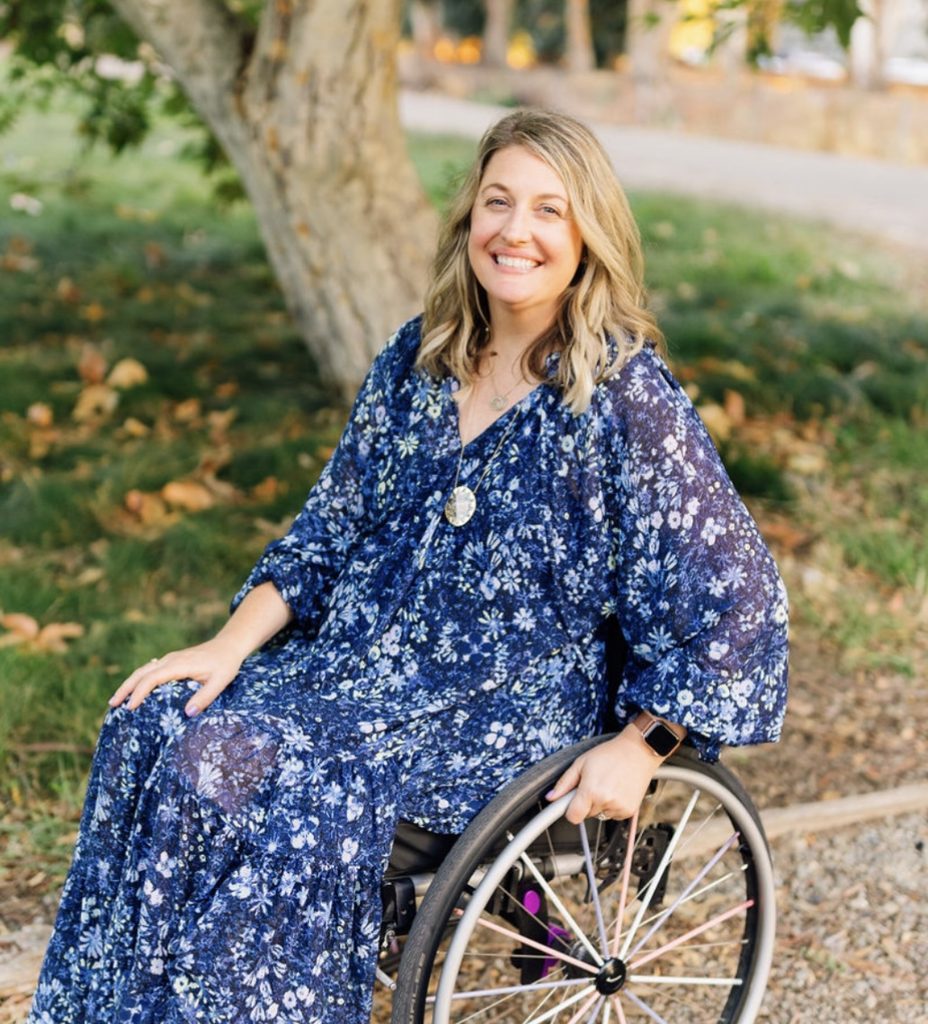
About Lindsay
Dr. Lindsay Ulrey (PsyD, PMH-C) is a busy mom on wheels, licensed clinical psychologist in private practice, and certified perinatal mental health specialist who is passionate about supporting and empowering mothers of all abilities. She facilitates Wheel Good Motherhood, a free monthly support group for disabled moms, creating space for connection, community, and shared experiences. In 2021, Lindsay acquired a complete T4 spinal cord injury as a result of idiopathic transverse myelitis. Since then, she has been navigating a new chapter of motherhood as a full-time wheelchair user, bringing her professional expertise and lived experience together to support other moms along the way. You can learn more about her at www.drlindsayulrey.com and follow her @wheel.good.motherhood on Instagram.
Disclaimer
The Disabled Parenthood Podcast shares personal stories and educational conversations about disability, pregnancy, parenthood, and family life. The information shared in this episode is not intended as individualized medical advice and should not replace guidance from your own healthcare professionals.
Transcript
Erica Evans (00:00)
Welcome to the Disabled Parenthood Podcast, where we have honest conversations about disability, pregnancy, parenthood, and family life.
Erica Evans (00:06)
I’m Erica Evans and today I’m talking with Dr. Lindsay Ulrey Lindsay and I connected through Instagram, through her Wheel Good Motherhood account. And I’ve been very much looking forward to getting to know her a little bit better and having this conversation. So, Lindsay, please say hi. Tell us a little bit about yourself and the work that you do.
Dr. Lindsay Ulrey (00:27)
I’m so honored to be here. Thank you for reaching out. I’m really glad that we connected on Instagram. And so, yeah, my name is Dr. Lindsay Ulrey I am a perinatal mental health specialist and a therapist. I have a private practice that I do from my house. That’s actually where I’m sitting right now. and I also am a mom. I have two boys who are 10 and 7.
And so I started Wheel Good Motherhood. It was almost two and a half years or it’ll be three years in January. So um that’s exciting. And so I started Wheel Good Motherhood when I was finding I was trying to find resources and support online for moms who use wheelchairs.
So I acquired a T four complete spinal cord injury from something really rare called transverse myelitis. And it was completely out of nowhere, completely unexpected. And so I literally became paralyzed overnight out of nowhere. And at the time, yeah, at the time my kids were two and five.
I was so lost and overwhelmed and really truly had no idea what I was doing. I didn’t know a single person in a wheelchair, let alone any moms in wheelchairs. And so I really felt I’ve never felt more isolated in my entire life, I will say. Going from, parenting on my feet with really very little knowledge about disability and knowledge about
How to move through the world with a disability as a mom, I was yeah, just very, very overwhelmed and scared. And so I ended up going online and I think I literally just Googled wheelchair moms and started finding random people here and there. and then I was really grateful to connect with this group of women who were actually mostly in Canada, but we were on a Facebook group and a lot of them were moms and that just really helped me feel like I could ask them questions and then I also just felt a lot less alone. I felt more hopeful for my future and I felt like I would hear the things one of the moms was like, yeah, I like coached my kids’ soccer team and she uses a wheelchair full time. You know, so all these things that I thought were over in my life. I thought I was never gonna drive again, never gonna do pretty much anything I imagined myself doing as a mom. And then I would talk to these other moms in wheelchairs and they were completely just doing all the things I thought I was going to be able to do. So that started off that. And then as a mental health professional, I was well aware of the importance of having spaces, where you can talk about common experiences. And I was
really craving a support group type thing for moms who use wheelchairs and I was asking around like I didn’t at the time I was like, I don’t really want to start one because I didn’t want to take on an extra thing. But I was asking all these mom friends that I knew in wheelchairs and they were like, We know, I don’t know about one. I don’t know of one. Um, you should start one. And so I was like, yeah, why not? You know, and then I had the idea to start this Instagram page that was really focused on building community and also honestly just showing my life and showing parts of my motherhood experiences on wheels because I did find a couple pages, but I also didn’t really see a lot what that was kind of connected with mental health and motherhood and wheelchairs. And so I kind of wanted to just curate my own what I really needed at the time and what I could have I think would have been really helpful for me to see and to experience when I was first. And so I ended up starting putting little thoughts together. I share experiences that I have out in the world as a mom in a wheelchair and just thoughts about acquiring a spinal cord injury and as a mom and what that feels like for me. And ways to talk to wheel, you it’s just like different different aspects that I cover. But I really like it. And it’s honestly been kind of healing and therapeutic for me to put my life out there in a way that feels like I can kind of reclaim my narrative or something like that and feel empowered. It’s still kind of a work in progress. But for right now it’s an Instagram page, and then it’s a free monthly support group that we meet once a month. And it’s virtual, it’s on the third Tuesday of every month at noon, Pacific Standard, 3 p.m. Eastern. And yeah, it’s free and it’s a peer support group. So we all come and just share what’s going on for us. And we always start off with a little intro and then we share one thing that we’re working on and one thing that we’re really proud of. It’s kind of a nice way to, you know, join together and discuss the things that we encounter as moms who use wheelchairs.
Erica Evans (05:35)
There’s nothing like connecting with other people who are doing the thing…
Dr. Lindsay Ulrey (05:39)
Yeah.
Erica Evans (05:40)
…to instill a new vision for oneself to see, here’s how other people are doing it. I can do this too. Here’s what that could look like.
Dr. Lindsay Ulrey (05:50)
Yeah, exactly. And I’ve had a lot of people reach out to me and say, Your page is exactly what I needed. It’s really, you know, it really resonates. It’s really filling a space that I didn’t know was empty and just things like that. And to me, that’s exactly why I’m doing it. I have my reservations about social media in general, but it links people together. It really does. And it was kind of a lifeline for me in the very beginning of my injury. If I didn’t have that resource, if I wasn’t able to kind of just go on the internet and look up wheelchair moms, and I mean, I really wouldn’t have met a lot of the people I’ve met and I wouldn’t have the community I have. I’ve tried to be really intentional about this is a community space. This is a safe space for people to come and to
And even for people who may be women who are in wheelchairs but aren’t moms yet, but are thinking about it and want to see what’s possible and learn about what’s possible. I’ve had a couple prospective moms come to our meetings and they just soak in the wisdom and ask questions. And so that’s another thing to mention is that it’s not just for moms. It’s for I mean, seriously, anyone if you’re curious about pursuing motherhood.
Erica Evans (07:09)
Yeah. I think you might be the first guest I’m interviewing who had a story of disability that happened when you already were a parent, when you were already a mom. And I can imagine that, I mean, it’s a whole life change. Parenting is already a life change, and then you’ve got this other huge piece on top of it. When you went on the internet we’re like wheelchair moms and we’re looking for that, what were you looking for there in the immediacy you couldn’t find? What was that, what was it you were really looking for?
Dr. Lindsay Ulrey (07:42)
I think I was just looking for examples of what I could do or what my life could possibly look like. I just honestly, I mean, I really remember so clearly sitting in or laying down in the bed, paralyzed, you know, from the chest down basically and saying, How am I gonna live like how? Like literally, how am I gonna be a mom? I don’t it just wasn’t in, you know, I just didn’t have it in my brain as a uh
as a template. So I was looking for a template to pull from. And I remember um there was a woman in the rehab facility and she was a mom. And she was a quadriplegic She was injured when she was 17 and then she had a kid later on. And so she was really encouraging me to, you know, be like, you can do this. Like I did it from the very beginning. and so
She encouraged me to search online and find other examples of people living their lives as moms in wheelchairs. So I think I was again looking for a template, looking for hope I guess too. I I needed to find some hope because I really felt quite hopeless and I couldn’t wrap my head around how I was gonna do anything. Like, I mean, this is someone who I didn’t even know hand controls existed.
I didn’t even know I was gonna be able to drive. So I was thinking I’m not gonna be able to drive my kids anywhere. And now I drive them everywhere. I would look up at things like how are moms, you know, taking I don’t know, how are they taking their kids to soccer practice or how are they doing these everyday things? And so that was super helpful again for me to just feel like okay, there’s again, I’m not the only one.
And it’s very possible. And so you just keep going.
Erica Evans (09:23)
When you did start to see other disabled moms doing the thing, how did that change what you thought was possible for yourself?
Dr. Lindsay Ulrey (09:31)
I had very limited experiences seeing moms disabilities. So I think it opened up my mind to just how little I understood about what was gonna be possible and then it made me realize that parenting doesn’t mean you have to have a certain type of body.
I think that’s what I really thought. It was probably my own internalized ableism or something like that around and also just honestly a lack of experience because again, I did not know a single wheelchair user or a mom in a wheelchair. So I think it was just a combination of I just physically couldn’t understand what was gonna happen or how these things were gonna happen. And then I started to kind of see, yeah, and be like, okay, so.
This was my own probably limited experiences and beliefs that were getting in my way too. And so I think that was helpful in terms of expanding my perspective around how parenting can be done, because for me especially at five and two, it’s such a physical stage. My two-year-old was still in diapers. And I was like, my God, I’m gonna have to potty train from a wheelchair. And again, we did it and we figured it out. But I remember just being like, How am I gonna do this? And then it was like, okay, there is a way. There are many ways. And there’s many creative people out there with disabilities doing this every single day. And this really helps me feel like, okay, we got this, right?
Erica Evans (10:50)
You got this, you’re not alone. Other people have been doing it. We can adapt too.
Dr. Lindsay Ulrey (10:54)
Yes, exactly. And then I remember clearly coming across the work of Rebekah Taussig and her book Sitting Pretty. And I was like, my god, I love you. And I just was bawling, reading her beautiful words and feeling just she just put into words so many things that I felt. and that helped too. So then I started just like reading more and then I read um We’ve Got This, the Eliza Hull. So I just was like, Oh, I can okay, this is not only doable, this is badass and I just felt like Yes, this is this is what I need to be surrounding myself with yeah, more.
Erica Evans (11:28)
Yes. I’ve got literal goosebumps right now. When I was pregnant, maybe right before I got pregnant, I read an essay of Rebekah Taussig’s that I think was in We’ve Got This, but it was on some website somewhere. And she talked about in it how her body prepared her to be a parent. It helped her lean into like she’s already familiar with fluctuating capacity and limitations outside oneself and I think I read that essay three or four times a week throughout my entire pregnancy. Like it was a prayer because it gave me a vision, a hope, I can do this. Not only can I do this, I am uniquely qualified
Dr. Lindsay Ulrey (12:10)
To do this. Yeah. Yes.
Erica Evans (12:13)
Yeah. I already know what it’s like to live like for a lot of non-disabled people, becoming a parent is the first time they have to deal with limitations outside themselves. Or lack of sleep and pain and still having to function. It’s all of these things that wait a minute. I’ve been doing this. Okay. We’ve got this. Literally, we’ve got this.
Dr. Lindsay Ulrey (12:35)
We’ve literally got this. and that is so true. And it’s really interesting you said that because I did not have that life experience before. Right. However, I kept finding these parallels between when I first had, especially my first kid, he was breech and I had to have a C section. Like you just said, for me as a person, non-disabled person, that was my first time my body wasn’t quote unquote full functioning because I had the C-section scar, I was exhausted, my nipples were on fire because we had terrible breastfeeding issues. I remember that was the first time I had ever been like, my gosh, my body does not want to cooperate. And this is so challenging. And I remember being really frustrated. It’s also my first time ever in a hospital for longer like ever, really. as the patient. So I remember when I acquired my injury thinking back, I’m like, this some of this feels like postpartum all over again. But like in this weird way where like I’m the baby in a way because I’m relearning, I have to really accept the fact that I have really real limitations and I have to relearn how to do everything. I have to learn how to use the bathroom. I have to learn how to bathe myself. I have to learn so many things like how to get myself off the floor, and so I remember thinking, dig deep because in postpartum, that’s when I was the most fragile. And I would say, that is a disability. I was disabled temporarily. Yeah. And I remember pulling from that experience and it was really helpful to remember, like, remember when you got through that? That was the gnarliest thing you’ve gotten through. You can get through this. And remembering, like you said, it was a lot of accepting my capacity and honoring and how to work with that though. My entire capacity and my physical abilities were completely shifted. And so anyway, I just remembered that and I wanted to write about this, but I don’t know in some way. Some point I maybe will, but just those interesting parallels between postpartum adjustment and acquiring a disability and there’s a lot of grief. There’s so much body grief. There’s so much. Oh yeah. It’s so humbling. But it’s also so beautiful. And those have been the pieces that have really stuck out to me slowing down as a mom in a wheelchair is like, and don’t get me wrong, we are busy and we are not just sitting around. but it definitely is especially in the beginning, like it really made me truly appreciate just these tiny moments with my kids that I would have rushed through before. And I had a highly traumatic medical experience. And so that also was, I mean, there was a point where I thought I wasn’t gonna survive. And I so that whole thing was also really mind blowing in terms of the different priorities, the different perspectives, the different ways of being with my children and really not taking any single moment for granted because especially in the very beginning, it was a really big deal for me to get out of my bed, into my wheelchair and outside with my kids. That was a really big deal in the beginning. And I’ll never forget just sitting outside in our backyard and the sun was on my face. My kids were playing. I started crying. It was such a simple thing that I wouldn’t have thought twice about before my injury. It would have just been you know, running around and checking my phone and just being scattered. And so it was kind of a beautiful thing to be wow, I mean, it’s slow, it slows you down in some ways, but it also just makes you really appreciate these really tiny moments that I think would have just slipped by before that I wouldn’t have thought twice about.
Erica Evans (16:10)
The thing that you want to write, you’ve been wanting to write something about postpartum and becoming disabled, there’s sort of these parallels and mirrors. It’s funny because I often think about it flip-flopping the other way, about how I can learn from or relate my experience of having a disability prior to becoming a parent to what the lessons are that I’ve taken from that and applied to postpartum, you know.
Dr. Lindsay Ulrey (16:36)
So interesting. I love that. Maybe we should work together. Maybe we should do
Erica Evans (16:40)
something together on that. I know. Yeah. So you started to touch on this a little bit. What surprised you about parenting after becoming disabled?
Dr. Lindsay Ulrey (16:51)
You know, honestly, something that surprised me was how not different it was once things got more stabilized for me. I was still holding all the snacks. I was still in charge of a lot of things. And um well, like I I don’t know, it’s hard it’s interesting because like, yeah, sure, I’m I’m getting around differently for sure, but I’m dealing with pretty much all of the same stuff that I was dealing with before in terms of just being a mom and navigating toddlerhood and all that kind of stuff. So I remember thinking like I imagine it being profoundly different. I was just like, wow, every single thing’s gonna be so different. And again some things, especially in the beginning, were really different. and they’re still they still are. I still get around differently. But overall. Now again, now that things have stabilized, and I’m driving, I’m riding my bike, I’m getting around. I just happen to be getting around a little differently. But I’m dealing with a lot of the same stuff my mom friends who are non-disabled are dealing with every single day. I think that surprised me for whatever reason. Um, I’m also kind of surprised by part of my disability. I get fatigued pretty easily and I have to rest more and I have to kind of really take breaks. And I thought that was gonna be really, really hard to do. and there are times when it’s been harder than others, but I’ve also been surprised by how amazingly my kids have adapted to so many parts of that. They’re like, Okay, mom’s laying down. Let’s go lay down with her. Or we’ve done like play play in bed and they really quickly were especially I don’t know if it was their ages, but they were like, um, okay, she’s in a wheelchair, but like, let’s go, you know, like we’re not we’re not like sitting around they’re not sitting around being like, Oh, poor mom. Like they like, Wow, like, okay, so this is interesting. And I’m sure they have their own experiences that I’ll always be really curious about when they’re older. I’ll be like, What was it really like? You know, I don’t know. But, for the most part, it surprised me how easily we all adapted to recognize capacities. And that surprised me because I was imagining that my kids just not getting it and running off and really being us being in lots of dangerous situations where I couldn’t run after them and um I will say my kids are naturally very attuned and They’re not the boys who are classically jumping off walls and they’re not those kinds of boys anyway. They never were. But they are also very attuned to seeing where I’m at and checking in and so I think I’m lucky in that regard, because they are naturally just those kids who are gonna stay nearby anyway. If that makes sense.
Erica Evans (19:30)
Yeah. And you know, the thing too is I think sometimes people forget, we forget about kids, especially when they’re two, four, five. Um, they wanna be a part of what’s happening. They wanna be a part of a family. They wanna belong. They wanna feel like they’re in it too. And they’re like sponges for learning, right? And understanding the world around them.
My almost three year old, I think it was six or nine months ago, we had a new sitter who was coming, who was covering for somebody who couldn’t be here. And a lot of our child care help at home, they are also other disabled or chronically ill people. It’s just the way things worked out. And at the end of the day I went to get my kid from the other part of the house where they were with the sitter.
And this person said to me, Erica, you know, I’m just so impressed by the way that your child just honors my capacity and limitations. Like he wanted to run around or whatever it was. And I told him, I don’t have the energy for running around games right now. Can we find something to do on the floor? And he was like, okay, yeah, my mama has that do that sometimes too, it was just a proud mama moment for me.
My kid understands access intimacy and he’s two and a half. But this is normal for him. And even your kiddos having this experience along with you, they’re young enough that they can adapt and understand. Okay, well, this is just what it is now. Yeah.
Dr. Lindsay Ulrey (20:57)
Yeah, exactly. Like
Erica Evans (20:59)
Horizontal parenting is a big part of our lives. Get in bed, let’s do the things, whatever.
So it is surprising and revealing of just how adaptable family kids can be. What turned out to be harder than you expected?
Dr. Lindsay Ulrey (21:21)
Hmm. I think um the grief part I think I was imagining the grief, the body grief around things that I used to be able to do would kind of like eventually fade off into the distance. And that has not been the experience at all.
It’s kind of a daily thing, honestly. It’s kind of living on my shoulder at all times. And um I really did think well, I don’t know. I mean, there’s a lot of layers to this because with my disability, it was unclear if I was gonna regain any mobility. with TM, I don’t know if this is a real stat, but you hear this in the community of one third of people regain full function. One third of people have partial function and then one third don’t gain anything back. And so, you know, and there’s this whole thing in the SCI community where it’s two years, you have two years and again, this is really I don’t even know who what this is based on and this is probably not really factual, but there’s this thing you hear where if you get to two years, that’s where you’re that’s where you’re gonna be for the rest of your life. So I think that prolonged the grief too because I just wasn’t really sure. Absolutely. I just really wasn’t sure what I had to adjust to yet or adapt to yet. And even in our family, we were like, well, do we need to get a van or do we what do we need to do? Because am I gonna be walking next year? I really didn’t know. So I think there was this prolonged thing of well, maybe, maybe, maybe this will change, maybe this will change. And I’ll regain function. And then it was learning, no, no, no, and seeing through the years, it doesn’t seem like that’s gonna happen at this point, and then at this point, at this point. And so that has really been challenging because of the grief part, because I didn’t really have the language for body grief until I discovered it from Jayne Mattingley. She has a really good book called This Is Body Grief. And have you heard of that book?
Erica Evans (23:17)
I haven’t read it yet.
Dr. Lindsay Ulrey (23:18)
It’s amazing. It’s so good. That book was really helpful for me, just that term too, because I would just feel so profoundly sad about certain things that I used to be able to do that I could no longer do. And it would take me down. We went to this family camp that I grew up going to forever and it was two years in. And I was so excited to go. And I because I was like just in my mind, I was picturing this really beautiful healing place that I just was so needing, after being in the hospital and just all this stuff. And then we went and it was so not accessible. It was so sad because all the things I used to love doing were impossible for me to do all the hiking, all the things. And it again, it wasn’t a camp designed for wheelchair users. So it was also I think naive of me to just kind of show up and expect it to be like, you know, I don’t know. I wasn’t prepared and I got really depressed and really sad. And um, you know, so and and again, like that has shifted. And I have now learned from that experience and I have a different set of experiences. And I have a different—every time that we have a trip. I think traveling is a really big one, actually, because that used to be something we would do quite a bit, something I used to really enjoy. And it was a good escape for me. And now it feels like a big chore and a big task, but it’s something that I value. So we do it. Um so yeah, I think that there’s a lot of other things, but that’s the thing that came to mind for me.
Erica Evans (24:44)
Yeah. Yeah, there’s I’m I’m just I’m definitely gonna read that book, that body grief and how you said it sort of sits there on your shoulder. Uh I think with disability, whether it’s acquired, whether suddenly, whether over time, whether you maybe you have always had it, but it progressively is getting worse whatever it is, um, there is grief, I think, for most of us. I don’t want to speak for everybody, but I think most people I’ve talked to and myself included, there is a grief that comes and in my life I’ve felt like there’s points where I’m okay, I’ve made peace with this. This is—my grief has sort of retreated a little bit. And then I enter a new stage of life. And suddenly this looks so different than the way that I had imagined. Like becoming a parent was a big part of it for me. I didn’t think I just pictured it differently. I pictured the things we would do together differently or or whatever it is. And that grief comes back around. It’s like a spiral where I just keep coming back around to it over and over and realizing, okay, this grief is never gonna go away. Um, it will always be here as long as I’m having new experiences.
Dr. Lindsay Ulrey (25:52)
And okay.
Erica Evans (25:53)
And as long as those new experiences are probably not matching up with whatever it was I had imagined for myself years ago or what have you, you know.
Dr. Lindsay Ulrey (26:03)
Yeah, absolutely. And I even just—random stuff like my older guy, he’s really into sports and he’s really athletic. And, I was really athletic too as a kid and I played volleyball and I played soccer. And I remember I always pictured that I would do some sort of coaching or something because I just really loved always connecting in that way. And so that’s been tricky too, because that that came up with soccer and then that came up with baseball and then even just interesting things that I never really thought about, but sitting in bleachers, I can’t get onto a bleacher and it anyway, there’s just yeah. So yes, it’s like all you’re like exactly like you said, it’s these new experiences where and I think for me it’s I have thirty seven years that I did things in the in the body in a certain way that, accessibility was not something I thought ever about, ever, and then suddenly, yeah. So yes, it comes back. I picture it like circling around this drain and it’s just coming back and coming back. And it’s probably you’re right. I think it’s always gonna be a part of my life. And but it but I will say too that finding words for it, finding resonance in other people’s stories, um has really shifted it and helped it kind of evolve. I don’t know if I’ll ever make peace with what happened and, the fact that um I have this is supposed I don’t know, like a permanent disability, it seems like, unless they find a spinal cord injury cure. But for the most part, yeah, I feel very much like it’s gonna be probably there on my shoulder for forever.
And you know, how do you integrate that in? And I think that that’s where um it’s like an art form, And yeah, but this is we talk it grief comes up a lot in the support group as you can probably imagine.
Erica Evans (27:56)
This is what the support group is primed for.
Dr. Lindsay Ulrey (27:58)
Yeah. Exactly. Exactly. It really does come up, I think, almost every single time we talk, so we’re not alone. Yeah.
Erica Evans (28:07)
For sure. And I think that’s been one of the most valuable things about connecting with other disabled parents is you don’t always have to explain everything either. because you both have that lived experience, even if it’s two different disabilities, there’s an experience of emotion or feeling that um you can recognize in one another. Yeah. What do you think people misunderstand about parenting as a wheelchair user or or just disabled parenthood, motherhood more broadly?
Dr. Lindsay Ulrey (28:35)
Mm. I think a lot. I mean, I think a big thing is many people misunderstand that again, life goes on and we’re not just sitting at home doing nothing. I think there’s I think that’s from the outside that might be the assumption of wow. So that must be, you know, your kids, I don’t know, it must be like a limited experience or something. I don’t know. But, I think that there’s that. And then I think that again, there’s so many assumptions about motherhood that are very physical, like physically based. And I see that a lot in a lot of these mommy wellness spaces where it’s are you mom enough? And are you and it’s like, I don’t know, I think that there’s there’s so many layers to mothering and yes, some of it is some of it is physical, a lot of it’s physical, but there’s so many other things, right? And I think the pieces around emotional attunement and showing up for your kids, meeting them where they are, all those things where it’s like, that has nothing to do with ability. You know? So I think that there’s something there in terms of um
People don’t get that. I think there tends to be this more like, oh, that’s so sad. And those kids must be caretakers and they must have to do some you know what I’m saying. Yeah. And I’m like, no. And I’ve actually did a post about this where it was like, uh-uh. So there’s I think these assumptions, uh yeah, around um around those types of things.
And it’s interesting because I have a unique experience because I was moving through the world as a mom on my feet for the first five years of motherhood. So I was treated a certain way. I had a certain set of experiences and now I have this other set of experiences. And it actually will be five years this October. So after October, I’ll be a mom in a wheelchair for longer than I—which is also kind of a trip. But um but I do see how people treat me differently and look at me differently when we’re at Target or whatever. And um it’s weird because I do feel a lot more pressure than I ever felt in terms of showing that I’m good mom and showing my competence and I mean, I think all moms to some degree, when you’re out in public, you’re like, okay, you’re you’re doing your best momming, right? But I think I noticed when I became a wheelchair user and people would kind of look and I have my kid in my lap and you feel like you’re under a microscope a little bit, and it feels like you’re suddenly I so weird. I found myself being like, I have to be an extra good mom now. And um, so again, probably my own internalized ableism stuff, but also there is a different experience and there is a way.
Erica Evans (31:27)
Yeah. It’s hard because you also feel a little bit like and I’m sure non-disabled parents feel this too, but I think with our lived experience being disabled, you feel like you’re you have to perform good mom more. Yeah. You know? I’m curious, did becoming disabled change your own idea of what being a good mom was supposed to look like?
Dr. Lindsay Ulrey (31:49)
Yeah, absolutely. Yes. Yes. Because a lot of my good mom stuff was about productivity and how much can you do and how much can you get done and how many activities are you going to be engaged in? And that was how I really saw being a good mom as before my disability. And then like yeah…
Erica Evans (32:10)
What does Mom enough mean to you now, right?
Dr. Lindsay Ulrey (32:13)
Right, yeah. And it’s like, oh well, there’s so many more there’s so many different layers now that I’m like, it doesn’t actually really matter if I’m hustling and doing all these things. If I’m there present with my children, showing up in the ways that I can, that is enough. And it’s more than enough. It’s beautiful. And in fact, it’s also helped me get out of the rat race, if you will, or the, I don’t know, the hamster wheel or whatever you want to call it. But I’ve just noticed not only is it not possible, it’s undesirable to me at this point too. Because it really wasn’t that fulfilling anyway. I think there were a lot of myths there around like, oh me, I’m gonna do this, I’m gonna do that, I’m gonna be over here, I’m gonna be there, and go, go, go, go, go. and if anything, that was just creating a lot more distraction and a lot more fragmented attention. And so I think it has kind of I don’t know what’s the best way to say this, but yeah, it’s kind of opened up my mind to like um there’s so many nuanced ways and other ways that you can show up and as a mom and be there for your kids that again is not about what I think the traditional stuff is around um going, going, going, going, getting get getting get stuff done, stuff done, stuff done.
Erica Evans (33:31)
Just before we started our conversation, I was on a call with a bunch of other disabled parents, and the topic of conversation came up about being like, Am I enough as a disabled mom or a disabled parent? Um, and the same conclusions are reached because they’re universally true.
A kid needs to be loved and cared for and know that they matter. That’s what they need. Love, care, nurture, and to know that they matter. and it makes me think what you’re saying is the before, idea of a good mom was oh my god, I don’t know why this is the analogy that came up for me. I I or I had a small stint where I worked at a nonprofit and we had grants and we were always having to do grant reporting and we would talk about outputs versus outcomes, right? So, what are the actual number of, I don’t know, workshops we held, but then what are the actual outcomes in the community of those workshops? And I feel like the before what makes you a good mom is the output. How many—all the doing? What are you doing? How are you doing it? What are all those things that you’re producing or the activities? But really what matters is the outcome. Does my kid, is my kid loved? Do they know that they matter? Do they have what they need to grow up and be a human in this world?
Dr. Lindsay Ulrey (34:36)
Yes, exactly. Exactly. And part of that I think is in the outcome piece with it’s like the quality for me, it’s like the quality time you spend with your kids and the way you show up with your kids is so much more meaningful to me and to them. And I don’t know, I really feel like um it also became a lot more for me anyway, satisfying to slow down and to be like, we’re gonna do this task at home in our garden. And we don’t have to book a million activities and we don’t, I don’t know. It’s just there’s like a quality. And then I found myself feeling a lot a lot more present and a lot more kind of um yeah, relaxed in my role. And I don’t know, it’s an interesting thing because I mean, who and that’s the thing, I’m always curious about the outcomes for my kids because they are young and I do hold this in my heart all the time around what will it really be like? How will they look back, when they’re in their 30s or in their 40s and what will that experience be? And how do I want to be, how do I hope they remembered me, and I and I hope it’s like I was there, you know, like I showed up.
Erica Evans (35:56)
Right. I think as an adult what meant more to me was it the number of things that my parents did with me or was it that they showed up?
Dr. Lindsay Ulrey (36:03)
Yes, exactly.
Erica Evans (36:04)
They showed up and they saw me for who I was. Yes. That’s right. Yeah. What adaptations or accommodations or supports have made the biggest difference in your parenting since becoming disabled?
Dr. Lindsay Ulrey (36:21)
Well, I mean the van that we have—I have a wheelchair accessible van that I drive. That was such a game changer. Like, my gosh, driving ’cause we have a we live in a kind of suburban community where you kind of have to drive everywhere. I told you this before, I had no idea that hand controls existed. And I was just like, What? And so it was really helpful. I ended up calling this driving rehab place and this wonderful man came and showed me all the ways that I could drive. and then we found a van. Um, we had a GoFundMe. It was really a lovely kind of thing. All my friends wanted to know how can we help? How can we help? And I was like, actually, this van is not cheap and it could really, really help us. And so that was a huge thing for me just as someone who, you know, um, the freedom and just having access to a way to try to get transportation for myself and for my kids, that was huge. So I’d say that was always the one that stands out to me. but also finding a a wheelchair that worked best for me kind of in the home and then outside of the home. So I I use a manual chair around the house because it’s just it’s easier for me to move around in a manual chair around the house. But when we go outside,
I have this front attachment thing that it’s called a striker, but it makes it so it lists up your casters and then you can go on grass and you can go on trails and so that thing’s been pretty cool too because I can now go to soccer games because there’s grass and gravel and all these terrains that, are a nightmare if you’re in a manual chair. and so this thing’s cool because it attaches on and off. So then when you don’t need to use it, you don’t have it because I actually originally had a power chair when I first got out of rehab because I didn’t know what I didn’t know anything. And I was like, what can I—what’s gonna be the easiest way to get my kids to and from places before I can drive? Um but then I and I and it was great and I still have it, but it was kind of clunky around my house. and then I realized that it might be making sense for me to have a manual chair. So anyway, I think those things and then um we did a couple adaptations in the bathroom that were really helpful. Like I did a roll in shower, a roll under sink, and we have a roll under sink in our kitchen as well. We’re in a one story house, which also really helps too. Um Right, right.
Erica Evans (38:33)
Yeah, you had mentioned earlier that one of your first thoughts was, Oh my god, I have a two year old who’s in diapers, am I gonna have to potty train him now? Can you think of any other of those first parenting things where you were like, Okay, how the hell am I gonna do this now?
Dr. Lindsay Ulrey (38:49)
Yeah, I feel like there’s so many.
Erica Evans (38:51)
And then, what did you figure out? how did you how did you work around that, adapt to that, change it up?
Dr. Lindsay Ulrey (38:58)
Yeah. Um well, let me think. There’s I feel like there’s so many, but now I’m like, how okay. Well, I think one of the biggest ones, the one of the first ones was navigating the classroom, like navigating my kids’ classrooms. And I had to have some conversations with teachers around the space being a little cramped and needing to have desks moved around. And I got more and more comfortable with just being like, Look, I’m gonna show up to a place and then we’ll figure it out. I think that I was at first really nervous and anxious about asking people to move and I just didn’t know. I had this whole thing about like I don’t wanna be high maintenance and you know, yada yada. And then I just was fuck that. I mean sorry, I was like, screw that, I’m not gonna do that because I wanna show up for my kids and I also wanna show them that it’s okay to need accommodation. There’s nothing to be like, oh sorry. It’s like no, in fact this should be the norm. So, I’ve kind of come into more confidence with that. Like, no, we’re gonna need to move that desk over there. And I go into the kids’ classrooms and I help at the parties. I have done readings and you know, like read books about disability. And so I think um, but like that, it would that even just navigating a classroom was super hard and intimidating at first, but now I’m just okay, I’m here and I’ve actually made it a point to always go to my kids’ classes and just be like, yeah, this is this is me. I’m in a wheelchair and this is how I move around in the world and answer questions, stuff like that. But um what else is there? Grocery shopping. We did a lot of Instacart actually in the beginning because I couldn’t even imagine dealing with it. But we started kind of working together. Um, my kids really like to help.
It’s fun because as they get older they can do more stuff. and they want to. And they’re like, okay, I’m in charge of the cart, you’re in charge of this, and we’re gonna do this all together. And we again collaborate on um, okay, can you reach that thing up there? Okay, if none of us can reach it, who should we ask? You know, like who should we talk to? So I’m always externally processing too. So I’m like, Oh, whoops, okay, that one, that item that we want is way up high. Can you try to reach it? Okay, can you try? All right, none of us can reach it. Who should we ask? Who should we have help us? And yeah.
Erica Evans (41:05)
I know there’s I feel like a lot of the mainstream narrative critique is the parentification of children who have disabled parents, right? Whatever. Let’s put that aside. But so it does happen. However, what I think is so wonderful about what I’m hearing you say is that you’re also teaching your skills like how to be in the world. Yeah. These are gonna be some kids who understand like there’s some adult adults you know who are like I don’t know how to ask somebody to get this for me. I don’t know who to talk to or what I’m gonna do. But your kids are developing some really important life skills.
Dr. Lindsay Ulrey (41:43)
Exactly. I’m teaching them that we are in a community. We are not isolated people with it’s like we all are in community and we all will need help at some point. Like, you know, no matter exactly. And it may happen gradually, it may happen immediately. It could happen at any moment. No one is immune to this, you know, no one is. So yeah. So I think part of what I love about it is that I’m showing them too. This isn’t a unique thing that I’m only doing because I’m in a wheelchair, but everyone can ask for help and everyone should work together when we’re out and about in the community. And I think the whole parentification thing is a tricky one, but I also think that that’s totally something you can be really intentional about in terms of teaching your kids. Supporting other people and helping out is not necessarily like you’re not taking on their emotional burden of their experience. I think that’s where the parentification comes in when they become the adult in the room and they have to manage emotional experiences as well as physical. That’s a whole different conversation, right? That could be a different podcast altogether, but um a whole different episode. But I’ve been intentional about that too, because I don’t expect them to hold my grief with me and I think that’s where I really draw the boundaries around that.
Erica Evans (43:06)
Absolutely. Absolutely. There’s a difference between teaching my kid that interdependence is a part of the human condition. Right. And and who’s
Dr. Lindsay Ulrey (43:16)
Responsible.
Erica Evans (43:17)
for somebody’s emotional well being capacity, whatever it is. Yeah.
Dr. Lindsay Ulrey (43:23)
Right, exactly.
Erica Evans (43:25)
As your kids have gotten older, how have the things you need to adapt to as a family changed? What’s something you’ve had to reinvent as your kids have grown?
Dr. Lindsay Ulrey (43:35)
Well, we’ve had to reinvent or kind of reimagine our family trips. Because growing up, we were the family that was always hiking, always going to national parks and traveling a lot and walking a lot, honestly, walking, walking, walking. I just remember as a kid, we were always walking places and that was a big part of it. I think a big one is adapting how we take a trip and what we do on our trips and how we spend how we spend our time together. I guess overall too, not just on trips, but overall how we work together to to move, you know, and so part of that could be I have a hand cycle, an adaptive hand cycle, which is also a great and amazing tool.
Because that is something that we can do together. We can go down to the park or we can bring it to places and ride bikes together. We’ve definitely had to kind of reimagine those kinds of experiences. We went to the Santa Cruz boardwalk, which is like a little amusement park over down here. It’s these roller coasters and all these rides that I just can’t really easily get on and off. And so we had to make a plan with my son and my husband hates rides. And so we were trying to make a plan for how we could make it fun for everyone. And so again, it’s all of these things that um I before my disability wouldn’t really be, I wouldn’t think much about them. I’d just be like, yeah, we’re gonna go to this, we’re gonna go here and do that. Now we have to kind of rethink, what’s this, what’s gonna make this accessible, what’s gonna make this um, not exhausting and what’s gonna make this fun for everyone. So I think that’s what so that’s one of the things we’ve had to kind of reimagine for sure.
Erica Evans (45:18)
Mm-hmm. going back a little bit to your kids, do you remember how you explained what was happening back when they were young?
Dr. Lindsay Ulrey (45:29)
Yeah, let’s see. Well, they were really young. Yeah, two and five. My younger guy, well, my younger guy was so young. I mean, there wasn’t really a way to be. I mean, so for my five year old though, he was in kindergarten, he just started kindergarten. And you know, I I always was very much using terms that I picked up, I don’t remember where, but something just around like, um this is how I’m gonna be moving around now. And this is how this is because my legs need help now. My legs used to not need help and now they need help. And so this wheelchair is actually really helpful for me because if I didn’t have this wheelchair, I’d be stuck in bed all day long. You know, and so I started off really early with the um like this wheelchair is actually a really helpful tool. And and I’ve used that language through throughout and I even
I’ll never forget when I went to one of their kindergarten classes and I was reading a book and one of the kids was like, Why in a wheelchair? And I was like, because it helps me get around. And he’s like, Well, that’s great. And she was like, She’s like, and then he just goofed a lot. He was so happy about it. He’s like, That’s you know, he’s just like I’m like, Yeah, it is great that it does help me. And I will never forget that. But yeah, but so talking about my actual disability though, I just talk about spinal cord injury. I don’t say transverse myelitis. I don’t go down all that right now anyway, because it doesn’t help anything. But basically, mommy’s spinal cord got damaged. And the spinal cord is the way our brain communicates with the rest of our body. And so when there’s some sort of damage, the communication signal gets blocked, like a traffic jam. And so that’s what I’ve always said. And that’s why I always say when I explain it to their friends, it’s like, yeah, it’s like the messaging can’t get through past a certain point. So mine’s T4. So I can move this part of my body and the brain, the signals can go through in that way. And then when it goes down below and I say, wiggle your toe, it’s like it gets stuck and it can’t go down past there. So um that’s what I say. And they’ve asked me many times, is your spinal cord injury gonna go away?
Um, when are you gonna walk again? What’s what’s happening? we’ve had to have a lot of conversations about at this point, there is not a cure for a spinal cord injury, but there is research being done. We don’t know. So I always just say, for now, this is how I’m gonna be getting around. And um, and I don’t know how long. I’m honest about it. I don’t know if this is going to be something that is gonna be a part of our lives forever or I don’t know.
You know, so but for now I try to focus on. I am really grateful that I have my wheelchair and that I have a way to move through the world. My husband is an engineer and so they’re cool kids because they think a lot about just how things work and they’re always kinda thinking like they were really into Iron Man for a little bit. And they’re like, We should make you a wheelchair that has rocket jets. And so you can just who cares about stairs? You’ll just fly right over them. And maybe we should just make you a jet pack and all these cute little things. Or I’m gonna invent a wheelchair that just hover. It’s a hoverboard wheelchair. And I’m like, Yes, let’s let’s do this. It’s really cute. They’re constantly trying to think of cool ways to um adapt and they want to make all these cool new wheelchairs, new age wheelchairs. And my kids are always like, Mom, there wasn’t a ramp. ah Where is the ramp? and they’re like, Oh, come on. They’re so cute. They’re like the cutest little accessibility. They’re like, wait, okay, there’s the ramp it’s over there. Okay. We’re good. They’re so really sweet. They’re constantly aware.
Erica Evans (48:59)
They’re looking out.
Dr. Lindsay Ulrey (49:00)
You know, they’re aware. Yeah. They’re always going to be aware.
Erica Evans (49:04)
Yeah. Was there ever a moment after becoming disabled when you thought, I can actually do this? Or was there never just one moment?
Dr. Lindsay Ulrey (49:12)
Um, there were a lot of moments. I remember the first day I was home alone and the kids were at their various activities and or I think there was daycare and school. And because when we first got back when I first got back in the hospital, I was I don’t I don’t know, I was very I was having a really hard time. We ended up hiring this kind of caretaker to help out with certain things and um that was a hard adjustment. She also ended up not being a really good fit for our family. And so anyway, I started gaining more skills and I was just getting more confident. And so I remember the first day and I was like, whoa, I haven’t been alone in so long. I was just so and I have a dog, but we were um I was trying to take him outside and then I remember I went to the I was just I felt so accomplished. I’m like, I can just be alone in my own house. Like this is but I also was kind of scared. But I’ll never forget this. I let the dog out and then I went to the fridge to just grab something really quickly. And then this whole thing of blueberries fell on the ground. And I’m like, my God. blueberries are like it’s like a wheelchair and I’m like, what do I do? And I was squishing all over them, squashing them into the ground because I was rolling around trying to figure out how to clean them up.
And I started crying and I ended up calling my husband and being like, there’s blueberries everywhere. And I had blueberries in my wheels. And I was just like, no. And I remember being really annoyed, but also I got through it. Now I can laugh about it because it was not that big a deal. But um, I don’t know. So then I think once I started seeing and I went back to work and I started seeing my clients, and I was like, okay, I can do this. I’m a therapist, my job is sitting and talking. So I can sit and talk. I can still do that. And so regaining, I think that part too. I remember being like, oh, seeing my first client after I was back, after I was away in the hospital. Um, I remember feeling so just like this part of my identity. I didn’t lose that. She’s still in there. I still get that. And so that actually really felt like, my God, I can do my job. I’m so lucky. I’m so lucky. Because there’s so many jobs that are really hard to adjust to after an injury. And so I was like, wait, I had this moment where I was like, I am so lucky. I get to do my job still and pretty much do it exactly how I did it before. Not exactly how, but for the most part, it’s pretty much the same. So that was cool too. I was like, okay, I can do this.
Erica Evans (51:39)
Yeah. because you do spend a lot of time with your support groups, talking to other, disabled moms, moms using wheelchairs, what have you learned being in community with them? are there worries or experiences that you hear over and over again? Or is there something that happens when this group of people come together that doesn’t happen in more general parenting spaces that you see?
Dr. Lindsay Ulrey (52:01)
Um I well, I again I think the grief part comes up so frequently. And and and and again we have different disabilities. This is a group of um different types of disabilities but the grief really does come up in all these different ways. And so I don’t. I don’t feel like I hear that as much when I’m with my non disabled mom friends.
There’s still grief for other things, like, my kid’s not not a baby anymore, or I miss having a toddler. There is that, but the body grief, um, and then the grief of not being able to participate in certain things that you really want to. I remember one of the moms was like really bummed because um she was taking her daughter to this dance class, but the dance class wasn’t accessible and she had to watch from a video screen and you know, and I was like, we all were like, yes, we’ve all had a variation of I wanna be in there, but I have to observe and or you know, or I like or I don’t have to observe. But you know what I’m saying I have to sit back and spectate a little bit because that’s the only way that I can be uh involved in this. And so that’s a theme that comes up quite a bit in these different settings that I think really yeah, definitely deviates from experiences with non-disabled moms that I talk to. Um but what I also love is we can just see how everyone is just so so happy to see each other and to hear again to be reminded that they’re not the only mom in a wheelchair because often we are the only moms in wheelchairs in our communities. There’s an event later tonight at our school and I’m going and I’m gonna be the only mom in a wheelchair. But when I know that my gals are out there doing their thing all over the country, it just makes me feel a little more confident and also just a lot less lonely. It’s so nice to go talk to those people in particular because they really really get it, and I love my non disabled mom friends too. I mean I do, but there’s just a felt—there’s just a lived experience that you just can’t really explain. And so I think the resonance that is a part of that group is so palpable. It’s like, oh yes. And we’re all just like, yes, preach, you know, like me too. And um so I think that that that really it and I think it really like I don’t know, it’s a unique bond that we get to have. And um it really holds a special place in my heart when I think about it because it’s like, yeah, there’s just um these really beautiful, unique experiences. And then when we have a win, it’s such a big win. I figured out how to pick up my baby and we’re all like, yes, and and I just don’t and people will say that, yeah, you guys are the only ones who really get what a big deal this is. like physically, how yeah. Like you guys really get how big a deal it is for me to I took my kid solo to Target. Like ah, you know, what I it’s like it’s—So there’s those kinds of things too where we really do get it. And so we really celebrate all the wins, even if they’re a tiny little thing. It’s something that seems really tiny, maybe to the outside, we know it’s not tiny.
Erica Evans (55:04)
Right, There’s that shared connection and belonging. There are things that I think we do as disabled parents that might look unusual to other people, but that are completely normal in our lives and in our families.
Okay, so before we wrap up, if somebody listening sees themselves in your story and is wondering whether parenthood could be possible for them, what do you hope they take away from hearing your story today?
Dr. Lindsay Ulrey (55:39)
Um, I hope they take away the fact that they are not alone. And that I really do encourage anyone who’s considering becoming a parent to find your find other people, like find pair so go find a parent who has a disability that you um admire and that you see things that you want to be doing and go talk to them and ask them questions and connect with them and make them be your peer mentor maybe or something like that. I don’t make them, but ask them if they’re open to talk. And I think that is part of it where um you would be amazed, I think what you can actually really do, but you can’t do it alone. I mean you can do it alone, but I don’t recommend it. I think I do recommend trying to find your community. And it’s probably gonna be virtual. I mean I don’t know for sure, but don’t be shy about reaching out to people and just that that was a big thing for me too is I just sent people messages. I was like, hey, this is me. And what do you think? Let’s chat. And that was really helpful for me too because again, the more information that I gathered, the more again, I could then find my way. But I just always came away from those conversations feeling so much more empowered and hopeful and with different ideas and just um, you know, you don’t have to brave this one alone. and so I think as much as you can put yourself out there and try to try to connect with people who um, who you relate to and who you feel like are doing something that you want to be able to do too.
Erica Evans (57:17)
What about someone who’s already a parent and has recently become disabled and they’re wondering like how am I gonna do this now? What would you want that person to hear or know?
Dr. Lindsay Ulrey (57:26)
I want them to hear that first of all, I really get it, how scary it is initially and how devastating it is. I really do get that. And to keep going and it will evolve and shift and change and it’s not always gonna be this hard. It’s not always gonna feel so impossible. Um you are way stronger than you know. And, um, but again, I think part of it is coming to terms with the fact that your life has profoundly changed. And the more you can find support, like go to support groups or go just I think just talk to other people, find other people who understand, read all the books you can get your hands on. Um, but give yourself grace and give yourself time. It’s gonna take time to navigate your new life.
Um, it’s gonna take time. But I think the thing that I remember really clearly in the beginning was um just feeling so lost. And then I think I just had to do one day at a time and just figure out one task at a time and then it started to just, you know, kind of roll from there and I just felt so much better once I started talking to other people. So um that’s what I would say is just keep on reaching out and keep on keep on remembering that you are actually not alone. Even though I know it feels really lonely.
Erica Evans (59:01)
Connection and community are the two most important aspects of it. Yeah. Absolutely.
Dr. Lindsay Ulrey (59:05)
Yeah. Yeah.
Erica Evans (59:07)
Okay. And last for fun question. What is bringing you joy in parenthood these days?
Dr. Lindsay Ulrey (59:14)
Oh man. Um I actually am having a lot of joy uh watching watching my kids sports and being a sports mom and actually finding the things that I can really help with. I organize the snack, the snack charts and whatever else we need. Um, I really do love doing that. I love because I do love being involved in the ways that I can be. Um I also really love cooking and so I’ve been enjoying helping teach my kids how to cook. And um yeah, my 10 year old, we’ve been trying to perfect the art of making a grilled cheese sandwich. And it’s really fun. I’m adapting in the kitchen and it’s kind of fun. We’re both navigating a space that um can be intimidating. But I think we’re both working together on that. And I really do love it. It’s really fun because we’re like, Okay, how did we melt the cheese right? And we’re, you know, look how nice and toasty that is. We didn’t burn it. Yay. It’s just been really fun for me. And I always loved cooking and so kind of rediscovering joy in that has been really fun for me with my kids.
Erica Evans (1:00:20)
Yeah. Growing and having new experiences for both of you in a different way together.
Dr. Lindsay Ulrey (1:00:26)
Exactly. And I will say the last thing I will say about that is it is really interesting to acquire a disability and then see the world from I mean, quite literally my point of view that my kids have in terms of I’m lowered to the ground. I see our house, and I see our space from a seated position. And I’ll never forget the first time I came into the house and I was like, like, why is everything up so high? And ugh, I was so annoyed. And I’m like, my gosh, this is what it must feel like for them. So then we rearranged the whole kitchen so we could reach things, but I was like, my gosh. So I really have a lot of empathy and a lot of you know, it resonates a lot with me to be a beginner or trying things out for the first time again and trying it from a point of view where you’re seriously just lower to the ground. And um that has been such a cool thing because I said this earlier, I had to relearn how to do l so many things and it was so frustrating. And so I really feel like it’s provided me with a huge perspective shift on when my kids are navigating something new, when they’re doing something new for the first time.
I really can join with them and being like, I really get how frustrating this can be. And I really also know you can do it. And so the whole we can do the hardest things is that was a really big part of this too, was that I I can really I still am really connected to that experience of doing things for the first time again and really being humbled by this perspective shift, but I think it’s also really helped me join with my kids’ experience as um, you know, a younger person in the world navigating. Um, because if you think about it, kids are constantly navigating inaccessible spaces all the time. Absolutely. All the time. Absolutely. Yeah. Yeah. And so they’re cool and they’re doing great. And so we are too. Okay. And so I’m just, I think that was so fascinating to me. And um because I didn’t think about it until then, like, wow. This is annoying that all the cups are way too high and you have to ask somebody. Let’s move them down, So anyway. Um, yeah,
Erica Evans (1:02:34)
I think also like you said, kids navigate an inaccessible world constantly.
Dr. Lindsay Ulrey (1:02:40)
Yeah. All day, all the time.
Erica Evans (1:02:42)
Right. And I think that gives us a really unique, a really unique perspective and ability to be alongside them, which I think a lot of people don’t think about being alongside their kid. The term like raising children, to me it implies that there is a hierarchy or something, but we can be alongside our kids and see the world the same way that they do in a way that other people might not be able to easily access. And that I think it makes us better parents. Not better than other people, just makes us a better version of the parent we are.
Dr. Lindsay Ulrey (1:03:17)
Yes. Oh, I completely agree with that. And I can really honestly speak to the two different experiences and one hundred percent. and I I don’t you know, I always struggle with better, but it uh there’s a quality that I…
Erica Evans (1:03:31)
A different quality. There’s more texture to it. Mm-hmm.
Dr. Lindsay Ulrey (1:03:35)
Yeah, a hundred percent. And it’s something that, it’s an interesting thing to think about as um I mean, I don’t know if what’s the right word. Yeah, l like a I don’t like to say the word blessing, but kind of you know, like a it’s a piece that I never would have known if this never happened kind of vibe. So…
Erica Evans (1:03:55)
We could call it a door opened that maybe wasn’t open before.
Dr. Lindsay Ulrey (1:03:58)
Yeah, it’s like a yeah, it’s a portal of some
Erica Evans (1:04:00)
A different, like a new opportunity that maybe yeah maybe that opportunity was always there, but it wasn’t right in your focus.
Dr. Lindsay Ulrey (1:04:07)
Yeah. And I just don’t see how I would have been able to access that. Um any other way. Yeah. This has been such a joy to talk with you. I absolutely love this conversation. Thank you for having me.
Erica Evans (1:04:19)
Thank you for listening to the Disabled Parenthood Podcast. If this conversation resonated with you, I’d love for you to follow the show and share it with someone who might find it helpful. You can find episode notes, resources, and more about the show at disabledparenthood.com.
Erica Evans (1:04:32)
How did that feel for you?
Dr. Lindsay Ulrey (1:04:33)
It was great. I love talking about this stuff because it also helps me process things out. And um I’m telling you, like there’s a book somewhere inside my brain and um I don’t know. It’s kind of related to the postpartum, disability thing and the new perspective thing with the kids. Like those are the themes that keep coming up to me that are so interesting and I just want to share it with everybody.